

Dhaka University Professor Launches Bangla-Waki Initiative to Preserve Endangered Native Tree Species
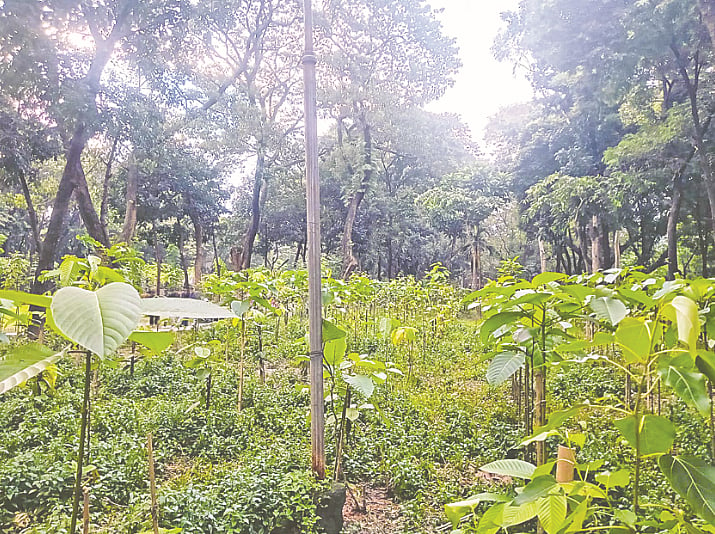
Photo Collected
University of Dhaka is spearheading a conservation initiative at its Mall Chattar grounds, planting nearly 120 endangered indigenous tree species to create a “living museum” for students and researchers. The project, dubbed “Banglawaki,” draws inspiration from the Japanese Miyawaki method to establish a dense, preserved forest dedicated to native flora, including species from the Madhupur, Bhawal, and Sherpur Sal forests.
Mohammad Jashim Uddin, a professor in the Department of Botany at the university, said the initiative aims to provide students with direct access to rare plant species that are otherwise difficult to study outside of specialized forests. By cataloging these trees within the campus, the project serves as an educational resource for future botanical research and environmental conservation efforts.
As part of the project’s expansion, university researchers recently completed a collection expedition to Chittagong to secure rare saplings. On July 25, the team visited the Bangladesh Forest Research Institute (BFRI) in Sholashahar, where they received 30 species of endangered native saplings as a donation. Dr. Hasina Mariam, a senior scientific officer and department head at BFRI, facilitated the transfer, waiving all costs in support of the university’s environmental mission.
The team subsequently traveled to the Institute of Forestry and Environmental Science at the University of Chittagong to collect the iconic “Boilam” tree, a species known for its significant height and rarity in the capital. With the assistance of Professor Dr. Mohammad Akhtar Hossain, the team secured more than 20 Boilam saplings. During the visit, the researchers documented a mature Boilam tree, highlighting its stature as a vital component of Bangladesh’s natural heritage.
The Banglawaki project arrives at a time when the University of Dhaka is working to diversify its campus ecosystem. A recent tree census conducted by the university identified 17,161 trees across 277 species, noting that the vast majority are non-native. Professor Jashim Uddin envisions a transition where the campus becomes a sanctuary for indigenous species, preserving the nation’s botanical legacy.
University authorities stated that this model of integrating education, research, and conservation is scalable. They encouraged other universities across the country to establish similar gardens for endangered native trees, arguing that such initiatives are critical to preventing the extinction of local plant life and fostering a deeper connection between students and their environmental heritage.
0%
0%
0%
0%