
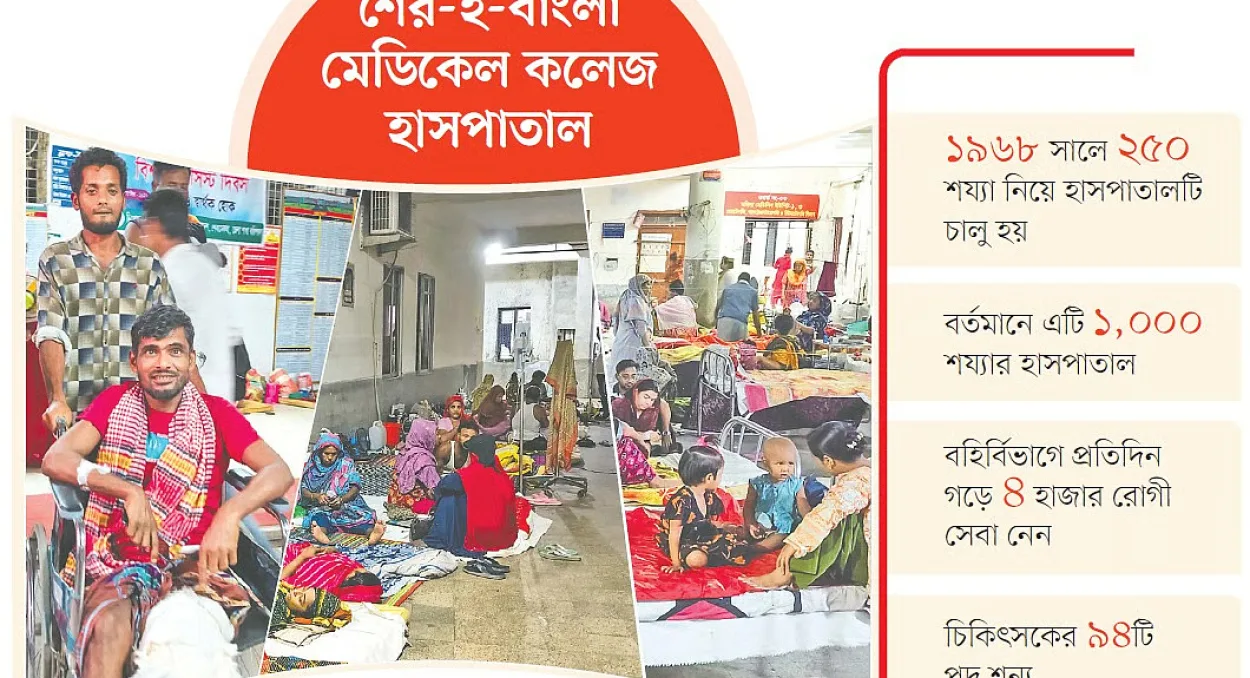
Acute overcrowding, severe staff shortages, and infrastructure deficits have severely crippled healthcare delivery at Barishal Sher-e-Bangla Medical College Hospital, leaving hundreds of patients to sleep on bare floors in corridors and walkways. The crisis at the premier healthcare institution came to light during visits and patient interviews conducted on Sunday afternoon (Oct 13) and Monday evening (Oct 14).
Seventy-year-old Abdus Salam, suffering from a high fever for seven consecutive days, travelled from Barguna to Barishal on Sunday afternoon after failing to control his illness locally. Upon admission to the hospital, he failed to secure a hospital bed and was forced to set up temporary bedding on the bare floor of the ground-floor corridor in the old building. Expressing his anguish on Monday evening, Salam remarked that the physical agony of the fever was compounded by the complete lack of a proper bed.
Similarly, Belal Hossain, a dengue patient who arrived from Barguna on Saturday (Oct 12), remained bedless on the floor of the same building until Sunday evening. While expressing resignation over the bed shortage, Hossain voiced severe concern over the appalling state of the hospital restrooms, describing them as entirely unusable due to overwhelming stench and filth. A thorough inspection of the premises on Monday morning revealed a massive influx of patients spilling over into the floor spaces of the surgery, orthopedic, gynecology, and children's wards in the old building, as well as the medicine unit in the new facility.
Serving as the primary medical sanctuary for approximately 10 million residents across the southern region—encompassing all six districts of Barishal Division alongside parts of Madaripur, Barguna, Shariatpur, and Lakshmipur—the hospital has failed to scale its operational capacity proportionately over the decades. Originally established in 1968 with 250 beds and subsequently upgraded to 1,000 beds in 2013 across two five-story buildings, the institution continues to operate under a manpower structure originally designed for 500 beds. Hospital records indicate a daily average of 4,000 outpatients and a combined inpatient and outpatient load of 6,500 individuals, with roughly 2,500 patients admitted at any given time—translating to an occupancy rate running at two and a half times its actual bed capacity.
Administrative data reveals a staggering vacancy rate across all tiers, with 94 out of 323 physician positions lying vacant, representing a 29.10 percent shortage. The staffing deficit deepens across support roles, featuring 66 empty posts out of 183 in third-class categories, 216 vacant positions among 414 fourth-class posts, and a 47 percent vacancy rate among second-class staff including senior nurses and administrative officials, where 282 of 597 posts remain unfilled. Although authorities have engaged 222 workers through outsourcing, the workforce remains drastically overwhelmed, with just 53 doctors managing an average of 4,000 outpatients daily—equating to roughly 75 patients per physician.
Intern doctor Durga Prasad Sarkar highlighted the immense pressure on the medical roster, noting that intern physicians form the sole backbone of round-the-clock inpatient care from 3:00 PM to 9:00 AM the following morning. Emergency department in-charge Mehedi Hasan maintained that despite the compounding infrastructural and administrative bottlenecks, the medical team is exerting utmost efforts to ensure care delivery. Meanwhile, critical medical infrastructure remains absent, including a dedicated Critical Care Unit, while existing Intensive Care Units and Coronary Care Units lack comprehensive advanced support, and the total absence of a cathlab forces cardiac patients requiring angiograms to seek treatment in Dhaka. Furthermore, severe shortages of ward orderlies—with only 19 of 21 sanctioned positions filled—frequently compel distraught family members to personally push hospital trolleys and wheelchais for emergency admissions and deceased relatives.