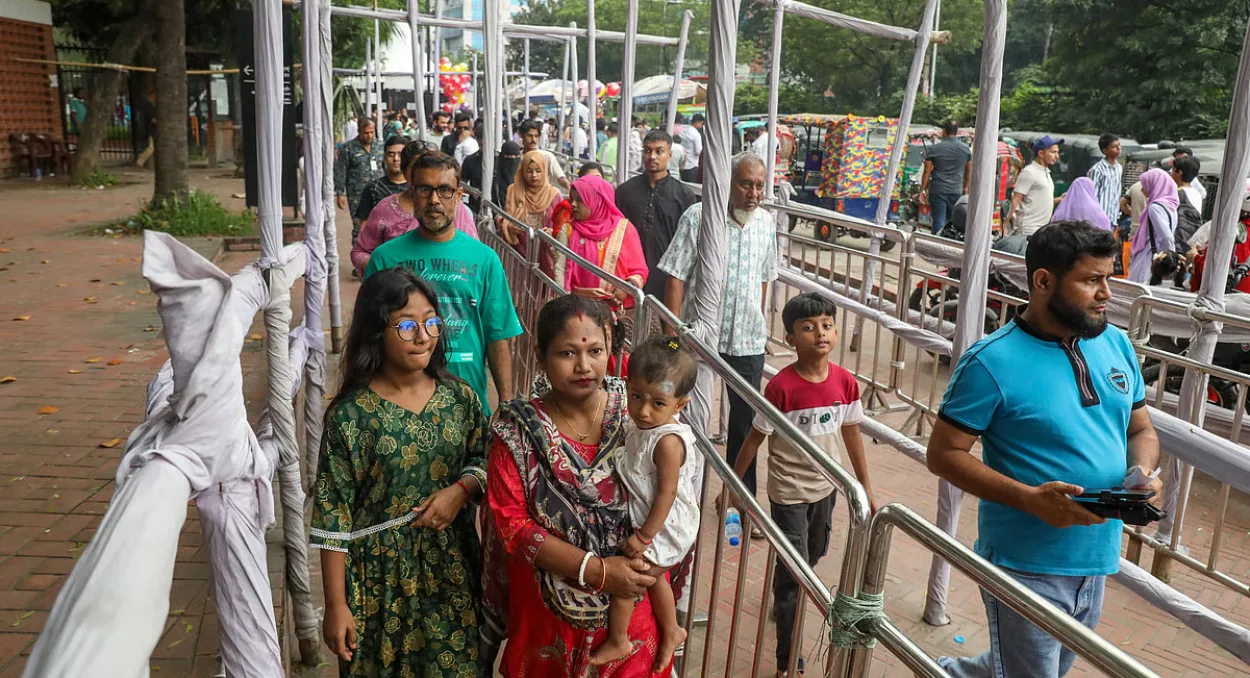
Two months after opening its doors to the public, the July Uprising Memorial Museum in Dhaka remains severely understaffed, sparking serious concerns over crowd management and site security. Established following the historic mass uprising that toppled former Prime Minister Sheikh Hasina on August 5, 2024, the institution has drawn massive visitor numbers, frequently overwhelming authorities and raising the risk of untoward incidents on the premises.
According to official data provided by the museum, a total of 155,770 visitors flocked to the site between August 17 and October 6, averaging about 3,500 daily visitors, with numbers doubling on Fridays and Saturdays. Because crowds breached the main gates when the museum first opened on August 7, visitor counts prior to August 17 remain unrecorded. Ticket sales generated 9,845,351 Bangladeshi Taka, while parking fees contributed 120,821 Bangladeshi Taka, bringing cumulative revenue to 9,966,172 Bangladeshi Taka. Ticket prices are set at 50 Bangladeshi Taka for domestic adults, 20 Bangladeshi Taka for children aged 3 to 12, 500 Bangladeshi Taka for SAARC nationals, and 2,000 Bangladeshi Taka for other foreign visitors, with the museum remaining closed on Thursdays and government holidays.
The museum occupies Ganabhaban, the 17.68-acre former official residence of ousted leader Sheikh Hasina in Sher-e-Bangla Nagar, Dhaka. Following her departure to neighboring India amid the student-led uprising, crowds surged into the complex, turning the 29,000-square-foot two-storey residence into a site of widespread vandalism and looting before an interim government led by Chief Adviser Professor Muhammad Yunus took oath on August 8, 2024. The residence was subsequently transformed into a national memorial, with the museum officially inaugurated on August 5.

Despite its vast scope and 11 operational branches requiring an approved structure of 107 personnel, the institution currently relies on a skeleton staff. While a Director General, Director, and Additional Director have been appointed, operations are chiefly managed by 35 officials deputed from the National Museum, alongside 44 outsourced workers, volunteers, and roughly 40 scouts. Museum Director General Ehsan Mahmud emphasized that the lack of accountable, skilled permanent staff poses a major operational vulnerability, noting that even symbolic memorial sites dedicated to victims of fascist-era enforced disappearances and killings are suffering from neglected maintenance.
Addressing financial and recruitment controversies, Director General Ehsan Mahmud stated that previous recruitment attempts involving waiver of written tests faced public criticism, and the administration now plans to combine 14,000 previous applications with fresh notices to finalize transparent hiring. Meanwhile, addressing media reports of financial irregularities during the construction—which cost 110.92 million Bangladeshi Taka out of a 123.45 million Bangladeshi Taka allocation, with the remaining 12.53 million Bangladeshi Taka returned to the state treasury—Cultural Affairs Minister Nitai Ray Chowdhury announced on August 4 that a probe committee would be formed after formal handover. Mahmud added that the Public Works Ministry has yet to officially transfer the facility to the Cultural Affairs Ministry, and a technical committee is currently reviewing the handover before a comprehensive audit is conducted.