
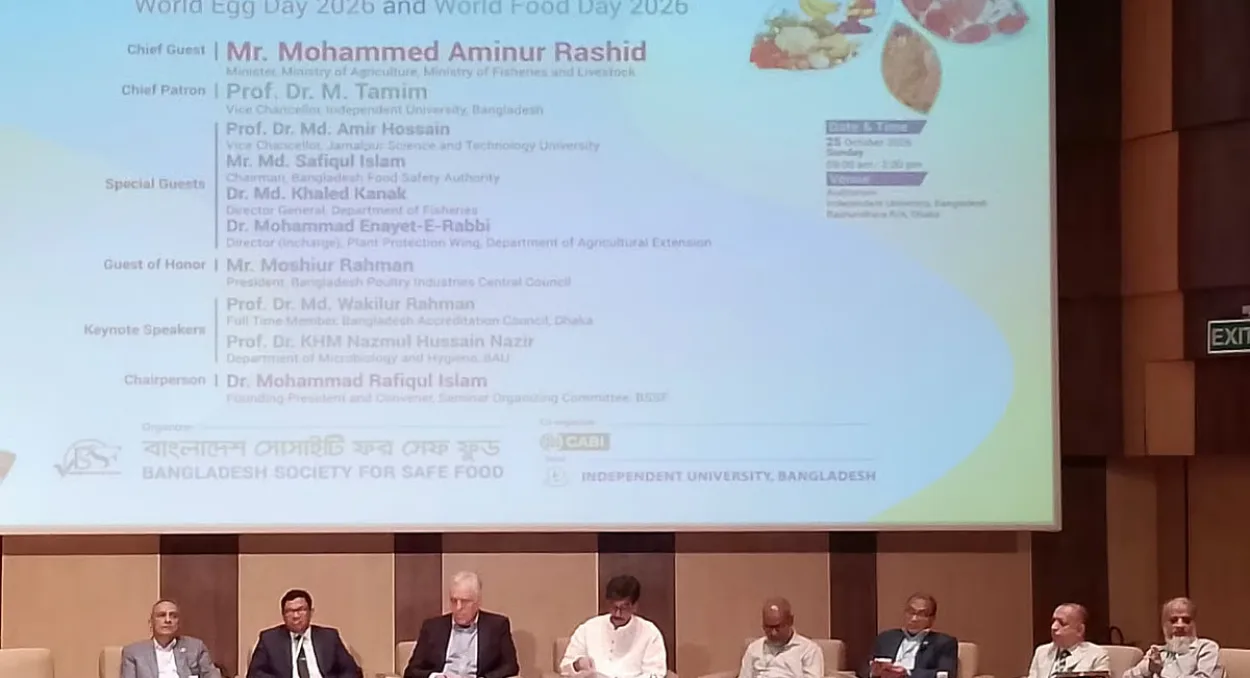
Food adulteration, persistent chemical residues, and inadequate surveillance pose severe threats to public health in Bangladesh, necessitating stringent legal enforcement, institutional synergy, and comprehensive oversight across the entire supply chain. These critical concerns took center stage on Sunday during the sixth national technical seminar organized by the Bangladesh Society for Safe Food (BSSF) at Independent University, Bangladesh, in observance of World Egg Day and World Food Day 2026. Centered on the theme of food safety governance and leadership among policy, science, and practical application, the event brought together policymakers, researchers, and industry stakeholders to deliberate on public health protection and agricultural export potentials.
Addressing the inaugural session as the chief guest, Agriculture and Fisheries and Livestock Minister Mohammad Amin Ur Rashid revealed that the government has initiated port-level testing mechanisms for imported pesticides, a crucial step given the previous lack of screening at the entry stage. Highlighting the necessity of elevating domestic agricultural standards to meet global benchmarks, the minister announced plans to expand exports of jackfruit and pineapples next year, underscoring that food safety policies must align with international market requirements. Presided over by BSSF Founding President Mohammad Rafiqul Islam, the seminar featured extensive discussions on safe production, regulatory frameworks, and sustainable development.
Presenting the keynote paper on agriculture and safe food, Bangladesh Accreditation Council Member Professor Md. Wakilur Rahman cited World Health Organization 2026 data indicating that roughly 866 million people globally, translating to one in nine, fall ill from unsafe food annually, resulting in approximately 1.52 million fatalities. He noted that non-communicable diseases account for nearly 70 percent of total deaths in Bangladesh, with food adulteration serving as a primary catalyst, while farmers bear the brunt of occupational health hazards such as excessive sweating, chronic pain, and respiratory distress. Expanding on these findings, Bangladesh Agricultural University Microbiology and Hygiene Professor Md. Ariful Islam advocated for risk-based routine surveillance, enhanced laboratory capacities, and the adoption of a One Health approach.

Experts at the seminar underscored systemic gaps in the regulatory framework, pointing out that inter-agency discord often hampers effective enforcement despite a multiplicity of active institutions. Dhaka University Microbiology Department Professor Sangita Ahmed stressed that while laws are abundant, implementation remains lax, necessitating robust public awareness campaigns alongside punitive measures and a centralized data repository for research findings. Echoing these sentiments, Sher-e-Bangla Agricultural University Professor Jasim Uddin warned against the over-utilization of pesticides, urging the strict implementation of the farm-to-fork supply chain methodology and mandatory training for farmers on Good Agricultural Practices (GAP).
Focusing on the fisheries and livestock sector, Bangladesh Agricultural University Professor K H M Nazmul Hussain Nazir presented a keynote outlining the imperative for a collaborative, risk-based food safety governance structure involving the government, industry, and consumers. Fisheries Department Director General Khaled Kanak reported that Bangladesh currently exports fish worth BDT 6.10 billion across 52 nations, noting ongoing negotiations for aquaculture exports to Saudi Arabia and a pending two-year European Union inspection protocol for farmed shrimp and marine fish. The event also featured welcome remarks by Seminar Organizing Committee Member Secretary Jibunnahar Khandaker, the unveiling of the BSSF annual publication Safe Food Digest, and insights from special guests including Jamalpur Science and Technology University Vice-Chancellor Professor Md. Amir Hossain and Bangladesh Food Safety Authority Chairman Md. Saiful Islam.