



Wild Elephant Herd Sparks Fear, Prompts Early Harvest Among Border Farmers
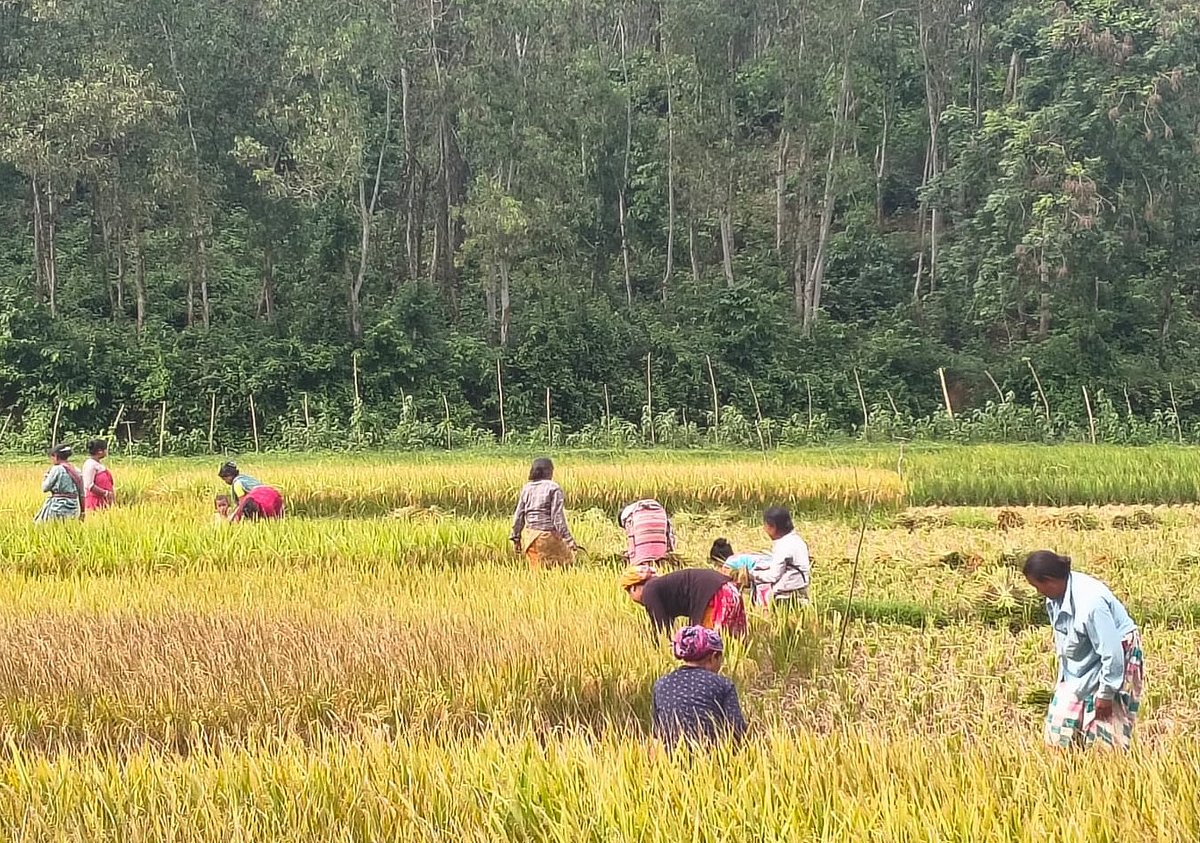
Photo Collected
Farmers in Sherpur’s border areas are rushing to harvest their nearly ripe paddy crops prematurely, driven by the fear of a herd of wild elephants that has been destroying fields. The elephants, numbering between 40 and 45, including about 15 calves, have been moving through the Jhinaigati, Sribordi, and Nalitabari upazilas.
The urgency stems from recent damage: in the past week alone, wild elephants have consumed or trampled crops on approximately five acres of land belonging to 20 to 25 farmers in the Ganjni, Gondigaon, and Bakakura areas of Jhinaigati. Many farmers face the prospect of losing their entire harvest if they wait for the paddy to fully mature, which is still 15 to 20 days away for most.
বিজ্ঞাপন
Rajib Koch, a 48-year-old auto-rickshaw driver from Gondigaon village, typically cultivates a small plot of land to meet his family’s food needs. This year, he planted Boro paddy on 60 decimal (about 0.24 hectares) of land on the slopes of Ganjni hill, investing Tk 16,000. However, with the elephants in the nearby forests, he hired six laborers on a daily wage of Tk 700 to quickly cut his crops while they are still green. “There is no other option,” Koch said, standing near bundles of harvested paddy by the border road. “The elephant herd is in the hills. If we don’t cut the paddy now, they will finish it all in one night. They have already destroyed crops in many nearby fields. So, we are forced to cut the paddy while it is still raw.”
This anxiety is shared by hundreds of farmers across the border regions. In a single instance, farmer Lal Krishna Koch, 37, also from Gondigaon village, reported that elephants destroyed his one-acre paddy field over two nights. He has since applied to the Forest Department for compensation.
বিজ্ঞাপন
The current Boro paddy season has seen cultivation across 8,857 hectares in the three border upazilas, with Sribordi accounting for 4,501 hectares, Jhinaigati for 2,240 hectares, and Nalitabari for 2,116 hectares. While the majority of the crops are in the mature stage, they require another 20 to 25 days to ripen fully.
The preemptive harvesting is expected to lead to reduced yields. Field visits over the weekend revealed farmers cutting crops at various stages of ripeness—from green to semi-ripe to mature—in villages like Balijuri, Kharamura, Tawakocha, Ganjni, Rangtia, Samaschura, Modhutilla, and Barmari. Ajanta Sangma, 50, harvesting paddy on a hillside in Ganjni village with ten to twelve women laborers, echoed the sentiment of fear. “There are elephants in the hills. If we don’t cut the paddy now, they will destroy everything later. So, to protect the crops, everyone is fearfully cutting the semi-ripe paddy early.”
Somaschura beat officer Md. Kawser confirmed that the elephant herd is currently in the Somaschura and Batkuchi forests. “An elephant response team and villagers are on guard to prevent them from entering populated areas,” he stated.
Md. Tohidul Islam, the officer in charge of the Ganjni beat under the Mymensingh Forest Department, confirmed that about five acres of crops belonging to 20 to 25 farmers have been damaged in the past week. Farmers have been advised to apply for compensation. While five have already submitted applications, the Forest Department is maintaining vigilance to ensure the safety of the elephants.
0%
0%
0%
0%