
Some loadshedding at the start of surgery, some closed nebulizer-pathology examination
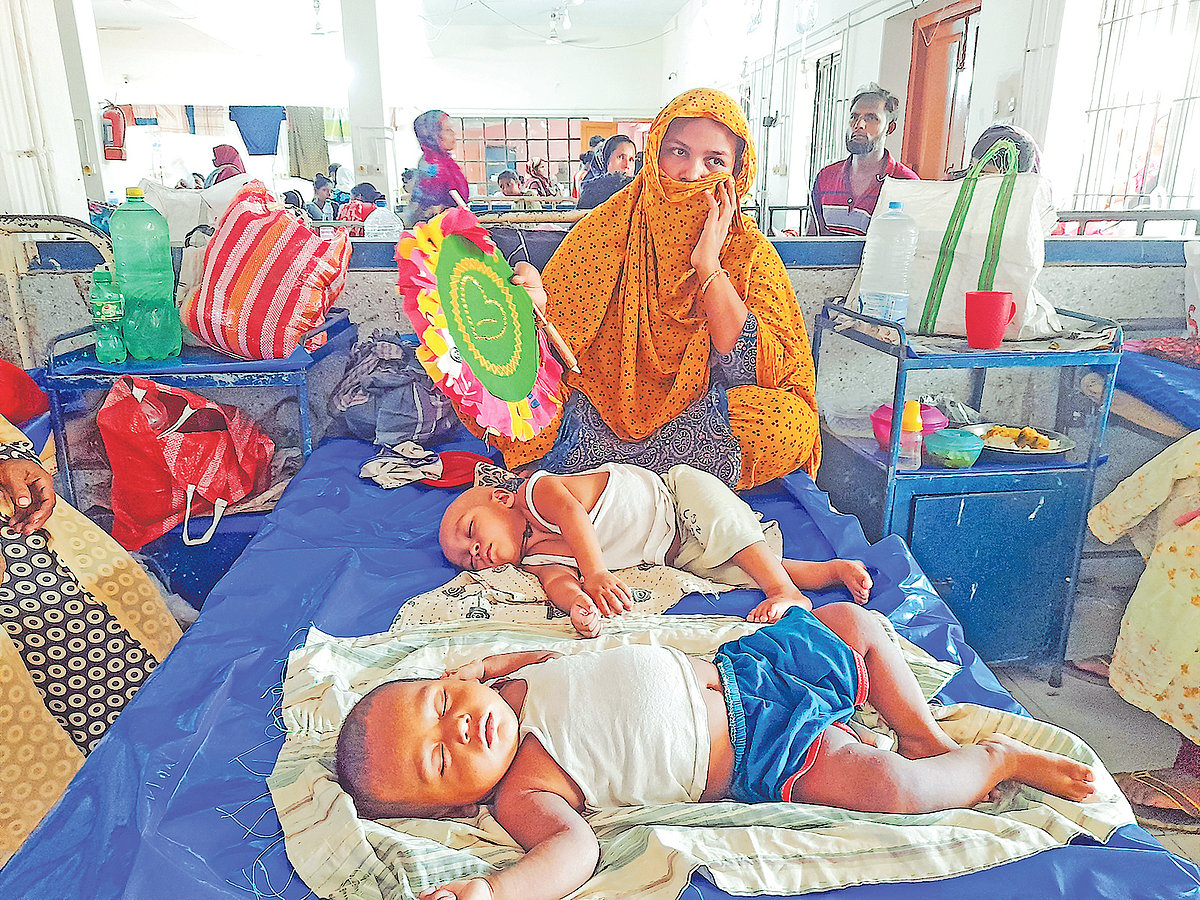
Photo Collected
58-day-old baby Hafcha Jahan is having trouble breathing. He was admitted to Matlab Dakshin Upazila Health Complex in Chandpur last Saturday due to pneumonia. A nebulizer should be given several times a day to reduce shortness of breath; But due to lack of electricity in the hospital, proper treatment is not being given. The fan above the head is also closed. Shortness of breath increases in summer. Mother Kamrun Nahar is waiting for electricity to come with her sick daughter. This picture is from yesterday Sunday.
Mothers and children from different areas of the country including Patia in Chittagong and Raipur in Laxmipur have to wait like Hafcha Jahan. A one-and-a-half-year-old Mofashir suffering from pneumonia in Patia was supposed to be given nebulizer six times a day, but it was given three times last Saturday. Minu Akhter, a four-year-old child with pneumonia in Raipur, needs a nebulizer four times a day; But due to lack of electricity, it cannot be provided regularly.
Other medical services are also being disrupted in upazila level hospitals. When the power goes out, nebulizers, X-rays and ECGs are stopped in some places. Even pathology tests are stalling. Some hospitals have to turn on generators because of power outages in the middle of surgery. Again there is no fuel even though there is a generator. As a result, patients and their relatives have to come to the hospital for treatment and wait for electricity to come. Again, patients and their relatives have to spend their time in unbearable heat when there is no electricity. Last Saturday and yesterday, visiting the country’s 1 district headquarters and 13 upazila health complexes and talking to patients, relatives and doctors-health workers, such a picture of electricity crisis in medical services was found.
Along with the gas crisis in the country, the electricity crisis has been going on for more than a month. If it rains occasionally, the level of load shedding will decrease, if it is hot, it will increase. In the beginning all the load shedding was outside Dhaka. Loadshedding is also being done in Dhaka under the government guidelines from the night of August 12. Loadshedding is supposed to be done for one hour every day in any area of Dhaka but it is not being followed.
According to the information of Power Development Board (PDB) and Power Grid PLC (PGCB), electricity cannot be produced as per demand due to lack of fuel. Its effect has now reached upazila level hospitals as well.
Caesarean section was going on a week ago at Bagmara Upazila Health Complex in Rajshahi. Loadshedding immediately after surgery begins. Panic spread among patients and relatives when darkness suddenly fell. At last the operation has to be completed by switching on the light of the mobile phone and quickly buy oil and start the generator.
A large number of outpatients are treated daily in this 50-bed hospital. It was seen on the ground yesterday, X-ray, laboratory and ECG services are also being disrupted due to load shedding.
Bagmara Upazila Health and Family Planning Officer Shankar Kumar Biswas said that without electricity, all the activities of the hospital, including examinations, came to a standstill. Even after the start of the surgery, there are many times when the power goes out, which poses an extreme risk. Even if a generator is repaired, it is not possible to keep it running regularly due to lack of fuel allocation.
Nilphamari General Hospital is also experiencing power outages during surgery. Since last Saturday morning, various departments of the hospital have been seen, due to power outage, patients are suffering from examination, surgery and admission process. At around one o’clock, there was a crowd of patient’s relatives in front of the operating room. Then a woman named Shapla Begum was taken to OT for caesarean section.
About 15 minutes after surgery, the power went out. Then Shapla Begum’s daughter was born. The baby was brought out of the OT, but the mother’s surgery was not over, the stitches were still going on. After a while the generator was started and the rest of the work was completed.
Rashti Roy, senior staff nurse in charge of the operating room, said four to five caesareans are performed here every day; But due to power problem now not more than one or two can be done. Made one today (Saturday). He said, in this hospital, five-six different types of surgeries including orthopedics, ear nose and throat (ENT), surgery are performed every day. Now the number of these surgeries has decreased due to load shedding.
Bidhan Chandra Roy, in-charge of the surgery room, said that there is a problem if the environment required for surgery is not there. A generator has to be run if the power goes out during surgery. AC cannot be operated then. In this situation, there is a risk of infection if the body sweat of the doctor or nurse on duty gets on the patient’s cut.
A generator should be available as an alternative in case of power outages; But various hospitals have generators but do not have fuel oil. Chandpur’s Matlab Dakshin Upazila Health Complex’s only generator is off due to lack of fuel. It requires 15 to 20 liters of oil per day to run; But there is no money allocated for buying that oil.
Matlab Dakshin Upazila Health Complex resident doctor Rajiv Kishore Vanik said that the hospital has been without power for a long time for several days. There is frequent load shedding. Disruption of X-ray, ECG and nebulization procedures. Due to the lack of electricity, the overall medical services of the hospital are being disrupted.
Raipur Upazila Health Complex in Lakshmipur also has generators; But due to non-allocation of diesel, it cannot be run at the time of need.
Many hospitals do not even have generators. For example, Pabna Bara Upazila Health Complex does not have a generator and when the power goes out, the suffering of the patients and their relatives increases. Golam Sarwar, in-charge of the pathology department, said that when the power goes out, the work of experiments has to be stopped. Patients have to wait.
In Moulvibazar’s Kulaura Upazila Health Complex, when the power goes out at night, candles have to be lit. Doctors see patients in the ward by the light of mobile phone torches. Juri Upazila Health Complex has IPS provided by a private organization. With that one bulb can be lit in two wards at night.
The most direct impact of power outages is on experiments. In Sakhipur Upazila Health Complex in Tangail, the X-ray machine is occasionally down due to low voltage along with load shedding. Rafiqul Islam of Gargobindpur village was injured in a motorcycle accident and came to the hospital last Saturday; But since the X-ray machine was not working, I had to go to a private clinic and pay 500 rupees for the test. It used to cost him 55 taka to get tested at the government hospital.
SM Amirul Islam Momen, medical technologist of the X-ray department of Sakhipur Upazila Health Complex, said that in addition to loadshedding, the X-ray machine is becoming inactive due to low voltage.
Kamrul Islam came to the Raipur Upazila Health Complex of Laxmipur yesterday for an X-ray due to a broken finger. After waiting for almost an hour, he had to go back without taking the test as the electricity did not come on. He said, ‘I have come to the hospital from Charbanshi in Raipur to undergo X-ray. I waited for an hour. There is no guarantee when the power will come. So I am forced to go back.
Yesterday, when I went to Manikchari Upazila Health Complex in Khagrachari, it was seen that the X-ray service is closed most of the time due to low voltage. Patients have to go to private clinics and diagnostic centers on doctor’s advice.
Abdul Wadud, a resident of Dakshin Upazila Sadar, waited for two hours yesterday to get an X-ray of a sick old mother at the Matlab South Health Complex in Chandpur. Later he had to decide to go to a nearby private hospital.
Load shedding is not only shutting down equipment, but also making the normal life of hospitalized patients miserable. Yesterday, going to Pabna Bara Upazila Health Complex, it was seen that his mother Asma Khatun was sitting next to his 18-year-old son Ashiq Hossain who was suffering from fever and was continuously fanning the air. According to him, electricity went out repeatedly during the night. In summer, other patients including his son also became restless.
Aleya Khatun, the wife of 70-year-old Amjad Hossain, who is suffering from diarrhea, said that her husband suffered from power outage several times during the night, and he also could not sleep properly.
The hospital in Taraganj of Rangpur had no power for 4 hours and 45 minutes in five phases in the next 12 hours from 7:30 am last Saturday. Last Saturday, he went to Taraganj Upazila Health Complex and talked to Shamima Begum, a patient with respiratory problems. He said that he was admitted to the hospital for three days. His shortness of breath worsened when the power went out. The nebulizer cannot be operated. So you have to fan the air. If the electricity goes out, it does not come for one and a half to two hours.
Patients and relatives of Kulaura and Juri Health Complex in Moulvibazar said that there is no electricity for 8 to 12 hours day and night. Last Saturday, I went to the Kulaura Health Complex and spoke to the patient’s relative Poppy Rani. He said that a two-year-old child suffering from pneumonia was admitted to the hospital for four days. At night, when the electricity goes out, you have to light a candle.
Load shedding has increased in six upazilas of Lakshmipur for two-three months. Shafiul Alam, general manager of Lakshmipur Palli Vidyut Samiti, said that about 30-35 percent less electricity is available compared to the demand.
The demand for rural electricity in Pabna is about 9 MW during the day and 12-13 MW during the night. On the contrary, there is a deficit of 25-30 percent during the day and 35-40 percent at night, said Uttam Kumar Saha, DGM of the zonal office of Pabna Palli Vidyut Samiti-2.
According to the information of Power Development Board (PDB) and Power Grid PLC (PGCB), electricity cannot be produced as per demand due to lack of fuel. As a result load shedding is not reduced even during weekends. Last Saturday, the maximum load shedding happened at 3 pm, 3 thousand 612 MW. The previous day on Friday, the maximum load shedding was 3 thousand 244 MW at 12 pm.
The country’s largest distribution company, Rural Electrification Board (REB), says that their maximum load shedding was 2,673 MW on Friday. At that time the power deficit in Mymensingh region was 46 percent.
[All data collected by own reporter, Khulna and representatives, Khagrachari, Nilphamari, Laxmipur, Noakhali, Patia, Chittagong, Bara, Pabna, Matlab Dakshin, Chandpur, Bagmara, Rajshahi, Taraganj, Rangpur, Juri, Moulvibazar and Sakhipur.]
0%
0%
0%
0%
More News from Local