

Questions arise over legality of Humayun Kabir ministerial appointment amid uncertainty regarding renunciation of British citizenship

Photo Collected
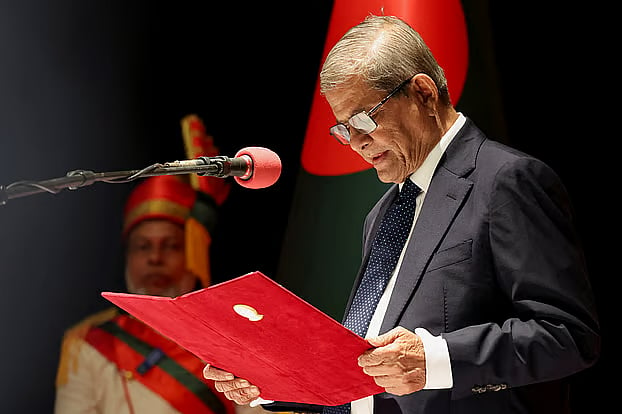
Humayun Kabir took the oath of office as a State Minister for Foreign Affairs last Friday, having previously served as the Prime Minister’s Foreign Affairs Advisor with the rank of State Minister. His appointment has ignited significant public and legal debate regarding his citizenship status, specifically whether he has renounced his British nationality as required by the Constitution of Bangladesh.
Born in the Osmaninagar Upazila of Sylhet, Kabir moved to the United Kingdom at the age of two. He was raised and educated there, eventually obtaining British citizenship and engaging in active politics with the UK Labour Party. While government sources confirm that Kabir surrendered his green general passport on February 23 of this year—shortly after his appointment as an advisor—and subsequently transitioned to a red diplomatic passport, there is no official documentation verifying that he has renounced his British citizenship.
Records indicate that since acquiring the diplomatic passport, Kabir has traveled extensively, visiting at least 11 countries, including the United States, Russia, China, India, and Turkey. Despite these public movements, inquiries directed to the State Minister and the Ministry of Foreign Affairs regarding his citizenship status remained unanswered.
The constitutional controversy centers on Articles 56 and 66 of the Bangladeshi Constitution. While the Constitution permits the appointment of non-elected individuals as ministers, it mandates that such appointees must be qualified for election to Parliament. Article 66 clearly stipulates that a person is disqualified from being elected or remaining a member of Parliament if they hold citizenship of a foreign state or declare allegiance to one.
Legal experts, including Supreme Court lawyer Sharif Bhuiyan, have raised questions about the legitimacy of Kabir’s appointment. Bhuiyan noted that the renunciation of foreign citizenship is a legal process governed by the laws of the country of origin, not merely a unilateral application. He argued that the failure to clarify this status before the appointment leaves the constitutionality of Kabir’s tenure in doubt.
The issue of dual citizenship has been a recurring factor in Bangladeshi politics. During the 13th parliamentary elections, candidates such as Abdul Awal Mintu and Shama Obaid renounced their foreign citizenships to comply with electoral laws. Conversely, previous election cycles have seen candidates, including Shammi Ahmed and Shamim Haq, face disqualification or legal challenges due to foreign citizenship ties.
Kabir, who holds degrees from the University of Sussex, the London School of Economics, the University of Cambridge, and Leeds Law School, has previously held high-ranking positions in the UK, including roles within the Mayor of London’s office. He served as the secretary of the Bethnal Green and Bow branch of the Labour Party from 2006 to 2009. Prior to his current government role, he served as the Joint Secretary (International Affairs) for the Bangladesh Nationalist Party (BNP), starting October 22, 2025.
0%
0%
0%
0%
More News from Local