Netrokona lawmaker bars active politicians from leading school governing bodies
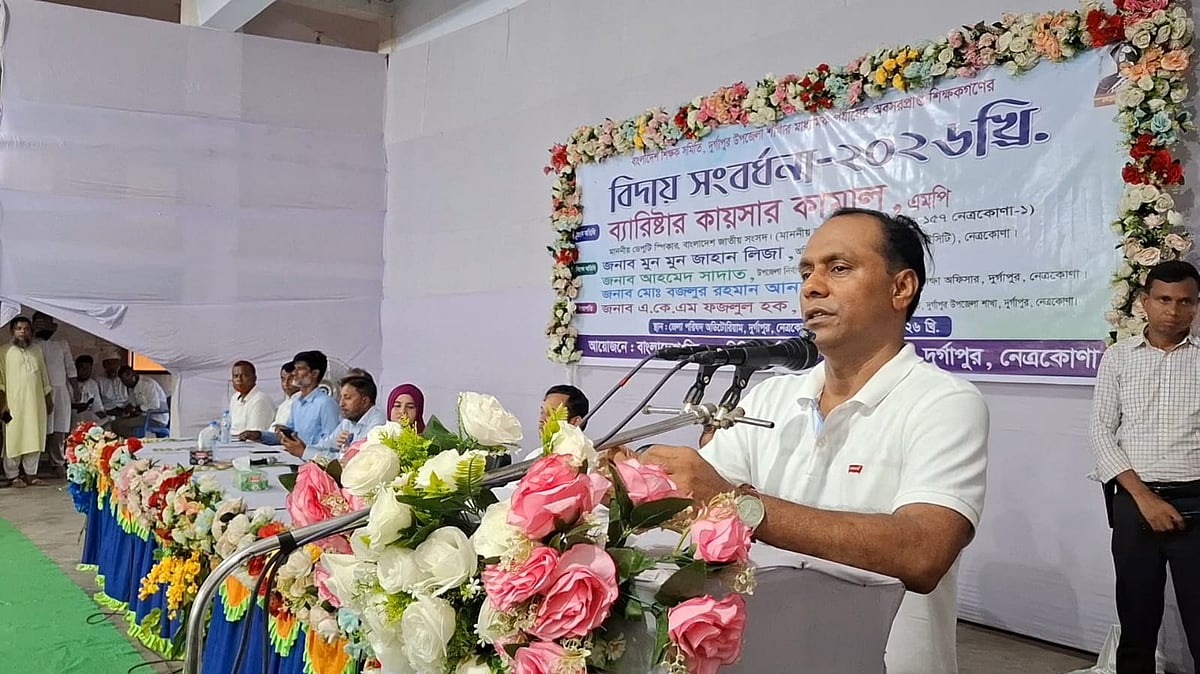
Photo Collected
Deputy Speaker of the National Parliament and Member of Parliament for Netrokona-1, Kaysar Kamal, has launched an initiative to exclude active politicians from leadership roles in the governing bodies of private educational institutions across Kalmakanda and Durgapur upazilas. Under this new directive, individuals holding political party positions are prohibited from serving as committee presidents, with the authority instead being transitioned to retired educators, highly educated professionals, and respected community members.
The lawmaker announced the policy during a farewell reception for retired teachers in Durgapur on Sunday, organized by the local Upazila Teachers’ Association. He reinforced this stance during an exchange meeting at Kalmakanda Girls’ High School on Monday. Kamal stated that political involvement often leads to the abuse of power within school management, necessitating a shift toward non-partisan oversight to ensure academic integrity and administrative independence.
The initiative aims to overhaul the governance structure of the region’s educational landscape, which currently comprises six private colleges, six technical colleges, 59 secondary schools, and 15 madrasas. Many of these institutions have historically been led by political figures and are currently managed by ad-hoc committees. Moving forward, any individual holding a political office who seeks to serve as a committee president must resign from their party position to qualify.
Implementation is already underway, with retired teachers having been appointed to leadership roles in at least 19 institutions, including Baromari High School, Kakoigora High School, Krishner Char High School, and Kalmakanda Girls’ High School.
The move has drawn praise from academic experts and administrative officials. Noni Gopal Sarkar, a former head of the Political Science department at Netrokona Government College, noted that replacing political activists with experienced, neutral figures will enhance professionalism and protect the academic environment from political interference.
District Education Officer Jahangir Alam also endorsed the initiative, highlighting that academic development is heavily dependent on effective leadership. He stated that integrating the expertise of retired teachers into management committees will significantly improve the quality of education and the effectiveness of institutional monitoring.
Defending the policy, Kamal emphasized that educational institutions must remain free from political influence to foster good governance. He maintained that while political participation is a separate civic right, those seeking to lead schools must prioritize neutrality and the educational success of students over partisan agendas.
0%
0%
0%
0%