
Freedom Fighters Unique Love for Birds
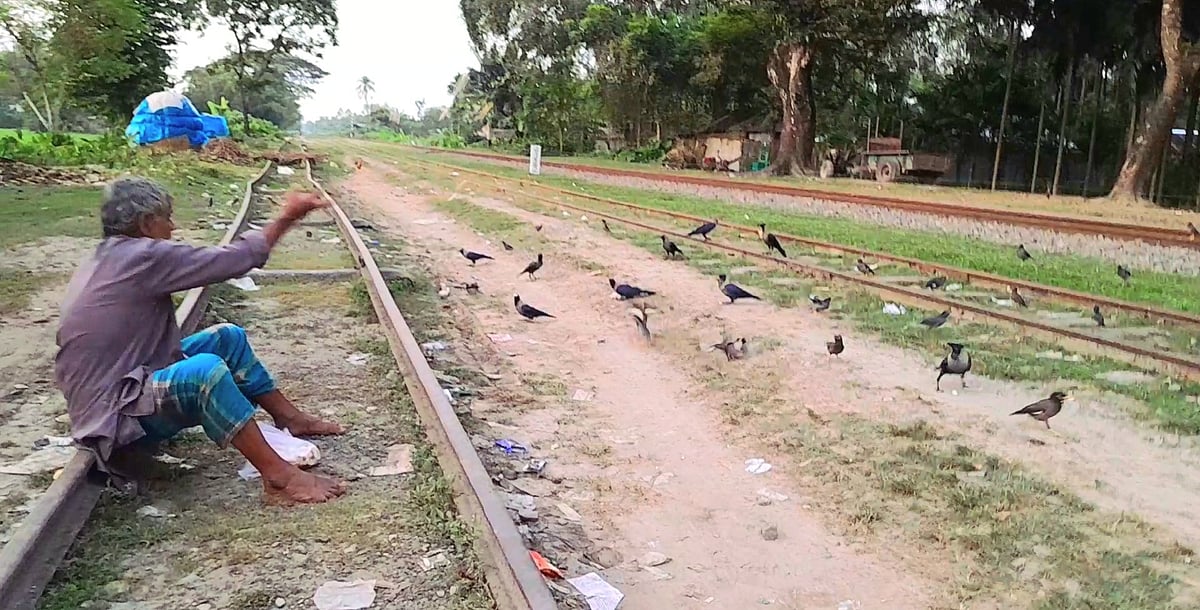
Photo Collected
RANGPUR, BANGLADESH — At the Anandanagar railway station, freedom fighter Ananta Kumar Barman, 76, can be found most mornings, leaning on a stick, distributing parathas he buys from a local eatery to flocks of eager birds. This ritual, which has earned him the moniker “The Kind One” among locals, has been a daily practice for the past 16-17 years, transforming the station’s tin roofs into a lively avian feeding ground. Despite his local nickname, Barman is more widely known as “The Fighter” for his heroic contributions during Bangladesh’s War of Liberation.
The captivating scene, recently witnessed at dawn, draws countless birds from nearby trees and foliage, their chirping filling the air within minutes. Barman watches them with a gentle gaze, replenishing their food as needed, embodying a profound dedication that often sees him prioritize the birds’ meals over his own.
বিজ্ঞাপন
Barman, whose home is located half a kilometer west of Anandanagar station in the Jadu Lasker Mouza of Pirgachha Upazila’s Anandanagar Union, resides in a village known for the constant chirping of birds from gardens flanking every house. After his Tuesday morning feeding ritual, Barman settled into Yusuf Ali’s tea stall, where he joined a group of locals including small businessman Nurul Islam, farmer Hamidul, Ayub Ali (son of another freedom fighter), and betel leaf vendor Shahidul.
Nurul Islam, in his fifties, recalled knowing Barman since arriving from Mymensingh. “He is our local son-in-law,” Islam stated. “He feeds the birds from his own donations. Even if he has no money, he will seek help from others to feed them. He often goes without food himself to ensure the birds eat.” Farmer Hamidul Islam reminisced about Barman’s affluent family background, noting his father, Ambika Charan Roy, was a former landholder (joddar) and chairman of Chawla Union, with an estate spanning 700 bighas, surrounded by a wall.
বিজ্ঞাপন
Barman himself shared the dramatic change in his circumstances. “There is nothing left now,” he revealed, explaining that bricks from their family well were used for two house foundations, and much of their land was lost to river erosion or given away. “What I feed the birds, I also eat. I do not eat until they have eaten. This is my pledge,” he affirmed. “My history is vast. I have lost wealth, but I live with love, and that is enough. Let the rest of my life pass this way. There is no sorrow, no pain.”
Locals attribute Barman’s initial connection with the birds to his youth. After his family disowned him for marrying for love, he settled with his wife, Purnima Rani, at her ancestral home in Anandanagar. During that time, he frequented the railway station, developing an affection for the birds that gathered for food, thus beginning his practice. He recounted how his wife used to make bread for the birds, and he would call them with “Ay, ay.” Now, he says, the birds recognize him and approach him on sight.
Barman, who was an SSC candidate at Tepomadhupur High School in Kaunia Upazila in 1970, was known for his friendly disposition even then, according to the Anandanagar residents at the tea stall. After the Liberation War, he would entertain friends with music and, notably, assisted poor families with their daughters’ weddings. He even sold his own assets to help Hindu and Muslim girls in the area marry.
Barman clarified that dowry demands were high then, and many farming and laboring fathers struggled to marry off their daughters. Costly bridal attire was also a burden. While many friends pledged assistance but failed to deliver, Barman stepped in. He estimates he has facilitated the marriages of 85 impoverished girls.
An hour into the gathering at Yusuf Ali’s tea stall, Barman’s wife, Purnima Rani, 65, arrived to call him home. She joined the conversation, revealing a recent instance where Barman, without her knowledge, gave away her new saree and blouse to a poor girl whose family lacked money for wedding clothes. “I kept a new saree and blouse in the box. A few days later, I saw they were gone. I had no clothes to wear myself,” she recounted. “He took them and gave them to the girl. He is such a kind man. He has nothing himself, yet he will still donate.”
When asked about her feelings regarding her husband’s actions, Purnima Rani admitted, “Before, I used to get angry. Now, I feel good.” She added that sometimes when her husband is away, she visits their old house and calls the birds, who then gather for food from her. She noted that Barman’s only income is his freedom fighter’s allowance. They recently took out a 5 lakh taka bank loan for their youngest daughter’s wedding, with the bank deducting 10,000 taka monthly from his allowance. The remaining 10,000 taka barely covers their living expenses and the birds’ food. She revealed they accrue a 2,000 taka monthly bill at the hotel for the birds’ food, which Barman pays when his allowance arrives.
Freedom fighter Ananta Kumar served in Sector 6 during the war. He lives in a “Bir Nibas” (freedom fighter’s home) built by the government two years ago on 4 decimal (approximately 0.04 acre) of land inherited by his wife, as he possesses no other property. Their elder son, Probin Chandra, is a farmer, and their younger son runs a tea stall in Anandanagar market. They have three married daughters, with the youngest, Eti Rani, working as a health inspector.
When questioned about an ideal human character, Barman emphasized “honesty, character, behavior, and work.” He believes these four qualities ensure establishment and longevity. Asked about his desires, he responded, “My only wish is that I can depart with the love of people and animals. I have no other wants or desires.”
Sirajul Islam, former headmaster of Anandanagar Dwimukhi Balika High School and former commander of the Pirgachha Upazila Freedom Fighters’ Council, has observed Barman closely. He confirmed Barman’s affluent background, his move to Anandanagar after marriage post-Liberation War, and his struggles before receiving his freedom fighter’s allowance. “He is a benevolent and humane person,” Islam said. “If he has 20 taka in his pocket and a beggar asks for money, he will give all 20 taka.”
0%
0%
0%
0%