
Experts call for strategic planning and integrated management for Padma Barrage project
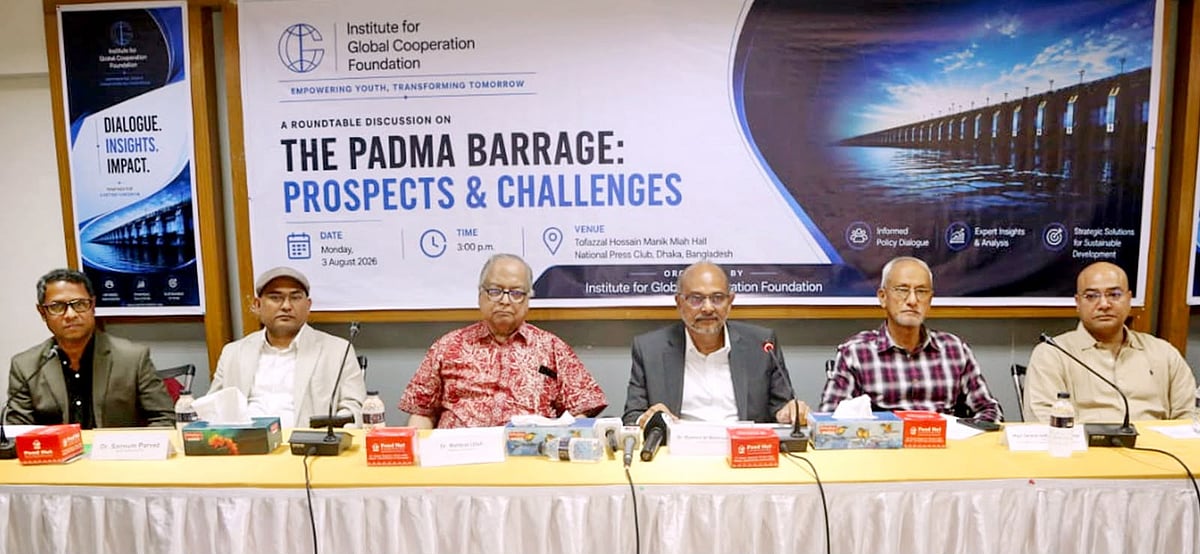
Photo Collected
Policymakers, economists, and engineers have identified the proposed Padma Barrage as a critical national priority, positioning the infrastructure project as a cornerstone for securing long-term water resources, bolstering agricultural output, and mitigating the adverse effects of climate change. During a roundtable discussion titled “Padma Barrage: Potential and Challenges,” held at the National Press Club in Dhaka, experts emphasized that the project’s success hinges on data-driven planning, scientific evaluation, and rigorous environmental and diplomatic oversight.
Addressing the forum, the Prime Minister’s Adviser on Finance and Planning, Dr. Sadiq Ahmed, highlighted the recurring crisis of water variability in Bangladesh. He noted that while various initiatives have been proposed since the landmark 1977 Ganges Water Sharing Treaty, the current administration is prioritizing a redesigned barrage structure to meet public demand. Projections suggest the completed project could contribute an additional 0.5% to 1% to the nation’s gross domestic product (GDP).
The project, which received initial approval from the Executive Committee of the National Economic Council (ECNEC) with a budget of 34.49 billion taka, is viewed as a vital instrument for national sovereignty. Saimum Parvez, a special assistant to the Prime Minister, affirmed the government’s commitment to the project as a key manifesto promise. He underscored a “Bangladesh First” approach, asserting that the state will prioritize the welfare of its citizens and the mitigation of water-related disasters over external geopolitical pressures.
Expert analysis during the event, moderated by North South University professor Bulbul Siddiqui, highlighted the historical context of the project, which has been under consideration since the 1960s to serve the needs of nearly 70 million people across 19 districts. However, stakeholders cautioned that the project must address technical complexities, including sediment management and the preservation of the Sundarbans’ biodiversity, alongside the broader implications of regional water diplomacy.
Major General (Retd.) Fazle Elahi Akbar of the Foundation for Strategic and Development Studies drew attention to emerging regional challenges, noting that massive upstream water projects in neighboring nations could significantly alter the geopolitical landscape by 2030. Given these external factors, participants stressed that the government must implement stringent fiscal controls and efficient management practices to ensure the 34.49 billion taka investment delivers maximum sustainable impact.
As the nation moves forward with the first phase of the barrage, the consensus among attendees—including academics, development experts, and environmental scientists—was clear: the project must transcend mere infrastructure development. By integrating comprehensive social and environmental impact assessments with regional diplomatic strategies, the government aims to transform the Padma Barrage into a sustainable solution for Bangladesh’s food and water security.
0%
0%
0%
0%