
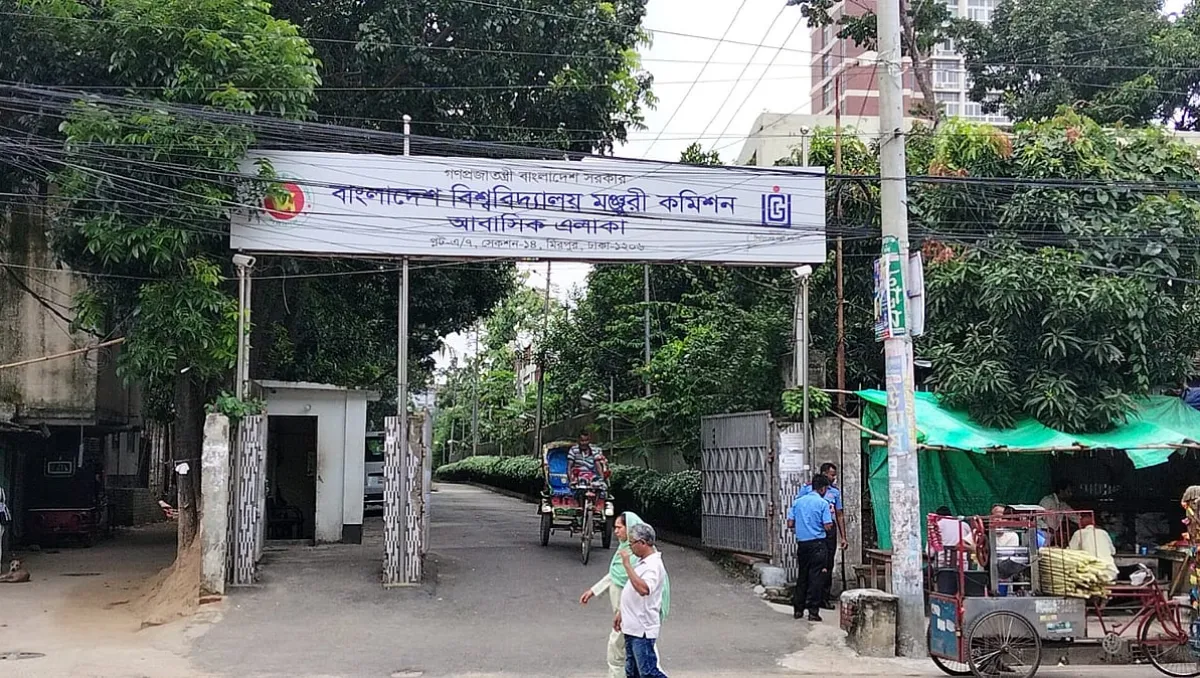
Three luxury duplex residences, constructed at a cost of approximately 100 million BDT for the Chairman and members of the University Grants Commission (UGC), have fallen into a state of severe disrepair after remaining vacant for years. While the residences have been left to rot, the officials entitled to them have opted to reside elsewhere while collecting government house rent allowances.
The residences, located within the UGC housing complex at Mirpur-14 in Dhaka, consist of one unit designated for the Chairman and two for commission members. According to UGC records, the two units for members were occupied by a total of 10 individuals between 2002 and 2015 but have remained empty since. The Chairman’s residence has never been occupied by any Chairman, having hosted a junior official only until 2010.
A site visit on July 18 revealed the buildings have reached a state of dilapidation. Windows and doors have been destroyed, iron grilles and fixtures are heavily rusted, and walls are covered in moss and overgrown vegetation. The main boundary gates were dismantled years ago and remain missing. Inside, the properties are largely stripped of furniture, resembling abandoned structures rather than official residences.
The housing complex, which spans approximately three acres and was completed in 2001, currently provides accommodation for 67 of the UGC’s 400 staff members in nine other buildings. While the staff residences remain well-maintained and occupied, the three high-value duplexes—measuring 3,400 square feet for the Chairman and 2,600 square feet each for the members—have been neglected.
Under the Bangladesh Allotment Rules of 1982, officials are expected to occupy government-allocated housing within a specified timeframe. Failure to do so, while simultaneously claiming house rent allowances, may constitute a violation of administrative regulations. Despite these rules, successive UGC members have declined to move into the Mirpur complex, citing factors such as the location’s proximity to slums, poor environmental conditions, and the preference for living in their own homes or neighborhoods of choice.

Furthermore, former officials noted that many members are academics on deputation from public universities who fear losing their permanent campus housing if they permanently relocate to the UGC complex.
The crisis of management extends beyond the Mirpur site. A 22-katha property in Dhanmondi, also designated for the UGC Chairman, has similarly sat vacant for eight years. Currently, a committee is evaluating the risks associated with the building to determine its future use.
Controversy has also emerged regarding the UGC’s decision to fund renovations for a private residence at Dhaka University currently occupied by the incumbent Chairman, Professor Mamun Ahmed. The UGC’s General Services and Engineering Department recently requested a budget proposal from the university to refurbish the flat, which is allotted to the Chairman in his capacity as a university faculty member. Critics have questioned the logic of spending public funds on a private flat, especially when the agency’s own housing assets remain in ruins.
When asked about the vacant properties, Professor Mamun Ahmed stated that both the Mirpur and Dhanmondi homes are currently uninhabitable. He defended the renovation of his current apartment by claiming the work is intended to create minimal office space for urgent, after-hours duties. Regarding the future of the abandoned duplexes, the Chairman noted that the UGC has yet to formulate a concrete plan for their restoration or repurposing.




