
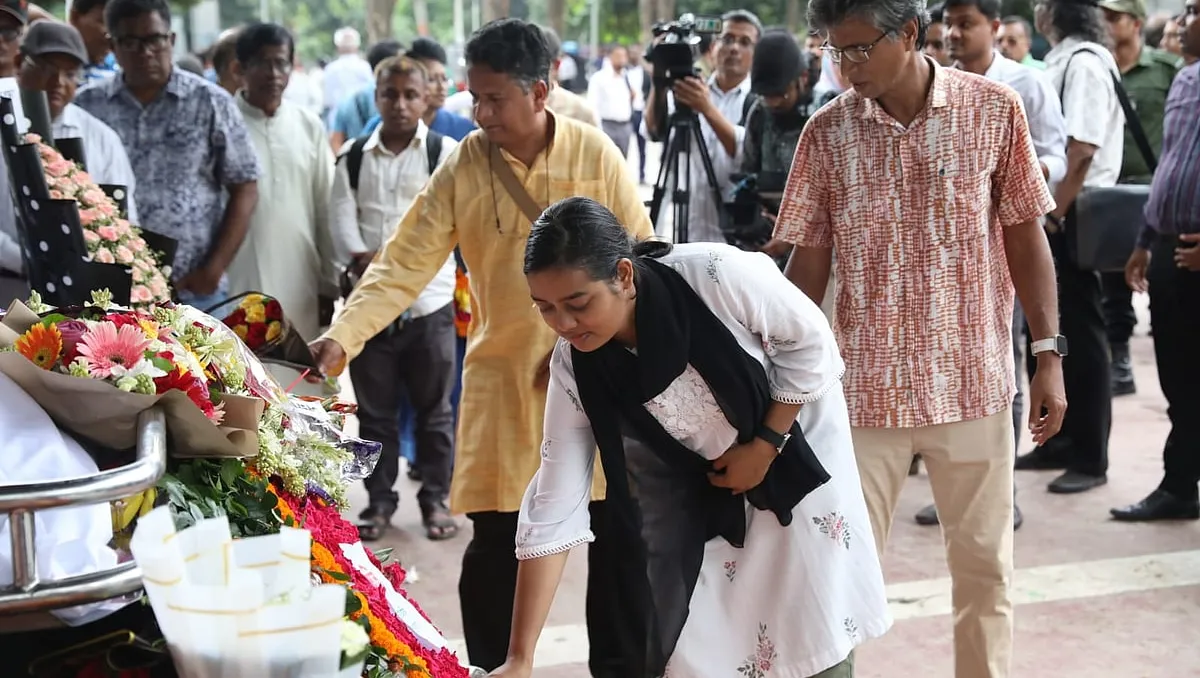
The academic and intellectual communities of Bangladesh bid a final farewell to Professor Abul Kasem Fazlul Haque, the esteemed educator, political thinker, and president of the Bangla Academy, who passed away Sunday following a sudden cardiac event. The veteran scholar, celebrated for his profound contributions to national consciousness and social discourse, was laid to rest Monday afternoon at the Martyred Intellectuals Graveyard in Mirpur, Dhaka.
The day of mourning began with a series of public tributes held at the Bangla Academy and the Central Shaheed Minar, where diverse cultural, political, and educational organizations gathered to honor his legacy. Reflecting on his life, Bangla Academy Director General Mohammad Azam described Professor Haque as one of the most brilliant minds of the 1960s nationalist movement, noting that his intellectual rigor and commitment to public welfare would continue to resonate through his extensive body of writings and lectures.
Prominent public figures emphasized the depth of his character. Former interim government adviser Sharmin Murshid highlighted his unique ability to dissect complex political and social issues, mourning his loss as a significant setback for the nation’s intellectual landscape. Open University Vice-Chancellor Professor Siddiqur Rahman lauded his unwavering integrity, noting that the professor remained steadfast in his ideals despite the myriad challenges he faced throughout his career.
Following the tributes at the Shaheed Minar, the professor’s remains were brought to the Arts Building of Dhaka University, his long-time place of work. Despite heavy rainfall, colleagues, students, and university officials, led by Vice-Chancellor Professor A.B.M. Obadul Islam, gathered to pay their final respects. The Vice-Chancellor remarked that Professor Haque had deeply illuminated the university through his scholarship and his persistent advocacy for societal reform.

The faculty and peers who stood in his honor described a man whose intellectual reach extended far beyond the classroom, encompassing history, philosophy, and international relations. Colleagues noted that his pedagogical philosophy was rooted in encouraging critical inquiry, constantly urging students and citizens alike to engage deeply with the realities of the nation.
Following a funeral prayer (Janaza) at the Dhaka University Central Mosque, the professor was interred in Mirpur. His family expressed gratitude to the hundreds of representatives from various political parties, including the Communist Party of Bangladesh and the Workers Party of Bangladesh, as well as cultural organizations and individual admirers who gathered to pay their respects to a man whose life was defined by a selfless devotion to humanistic ideals and national progress.




