
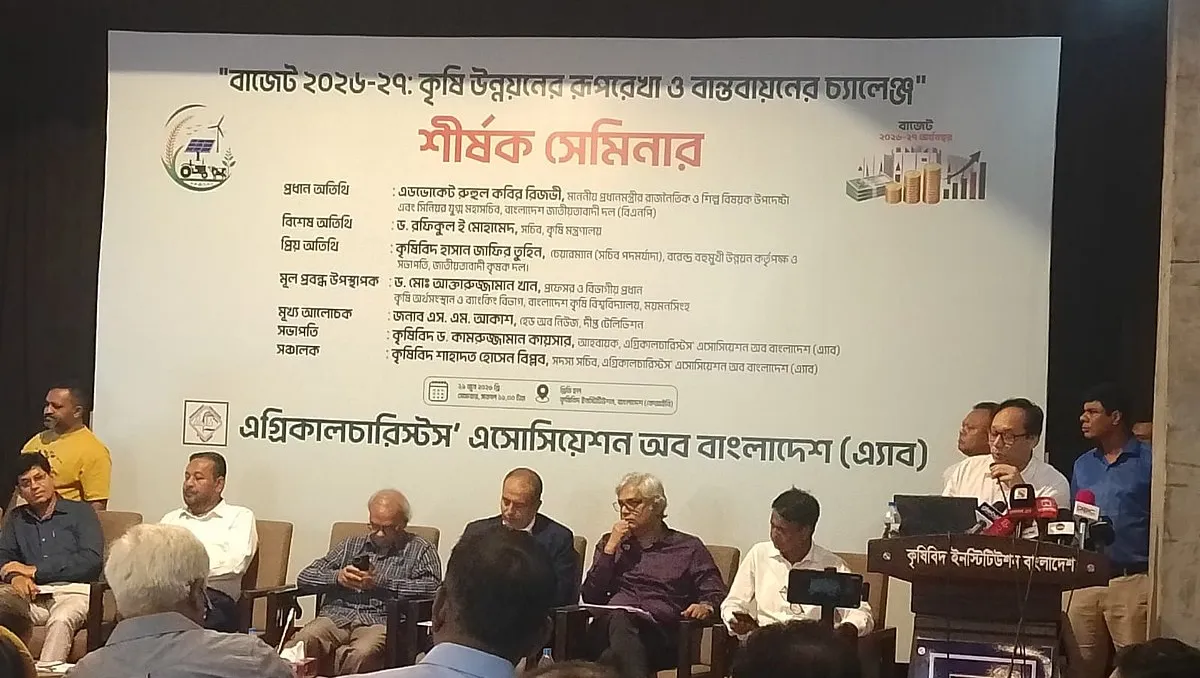
Agricultural experts and policymakers are calling for a substantial increase in budget allocations for the agricultural sector, urging the government to dedicate at least 10 percent of the national budget to the industry to secure long-term food stability. The demand was raised during a seminar titled “Budget 2026-27: Roadmap for Agricultural Development and Implementation Challenges,” organized by the Engineers Association of Bangladesh (EAB) at the Krishibid Institution Bangladesh in Dhaka.
During the event, speakers emphasized that prioritizing agriculture is essential not only to ensure food security and bolster farmer incomes but also to build resilience against the growing threats posed by climate change. Experts argued that current funding levels are insufficient to support necessary research, infrastructure development, and technological expansion within the sector.
Professor Md. Akteruzzaman Khan of the Bangladesh Agricultural University, who presented the keynote paper, highlighted the disparity between current funding and developmental needs. He noted that the proposed 938-billion-taka budget for the 2026-27 fiscal year earmarks only 33.8 billion taka for agriculture, fisheries, livestock, and forestry. This allocation represents a mere 3.8 percent of the total budget, a figure he described as part of a concerning downward trend.
To reverse this trajectory, the keynote address outlined a four-point proposal for long-term growth. The recommendations include increasing research and extension funding to 10 percent, establishing robust cold-chain networks to reduce post-harvest losses, expanding access to institutional agricultural credit under favorable terms, and creating a dedicated budget line for digital agriculture. These measures are seen as vital to overcoming systemic hurdles such as bureaucratic delays in fund disbursement, inadequate oversight, rising global input costs, and climate-induced disruptions.

The event featured addresses from prominent political and administrative figures. Ruhul Kabir Rizvi, Advisor to the Prime Minister on political and industrial affairs, underscored the critical role of agriculture in national prosperity. He reiterated his party’s commitment to modernizing the sector, citing historical initiatives like the “canal digging program” as proof of their foundational belief that national survival depends on the welfare of farmers.
Agricultural Ministry Secretary Rafiqul Islam Mohamed also spoke on the government’s ongoing efforts toward agricultural modernization. The seminar, chaired by EAB convener Kamruzzaman Kaiser, brought together key stakeholders, including representatives from the Department of Agricultural Extension and the Bangladesh Agricultural Research Council, to discuss the implementation challenges facing the nation’s primary economic engine.




