
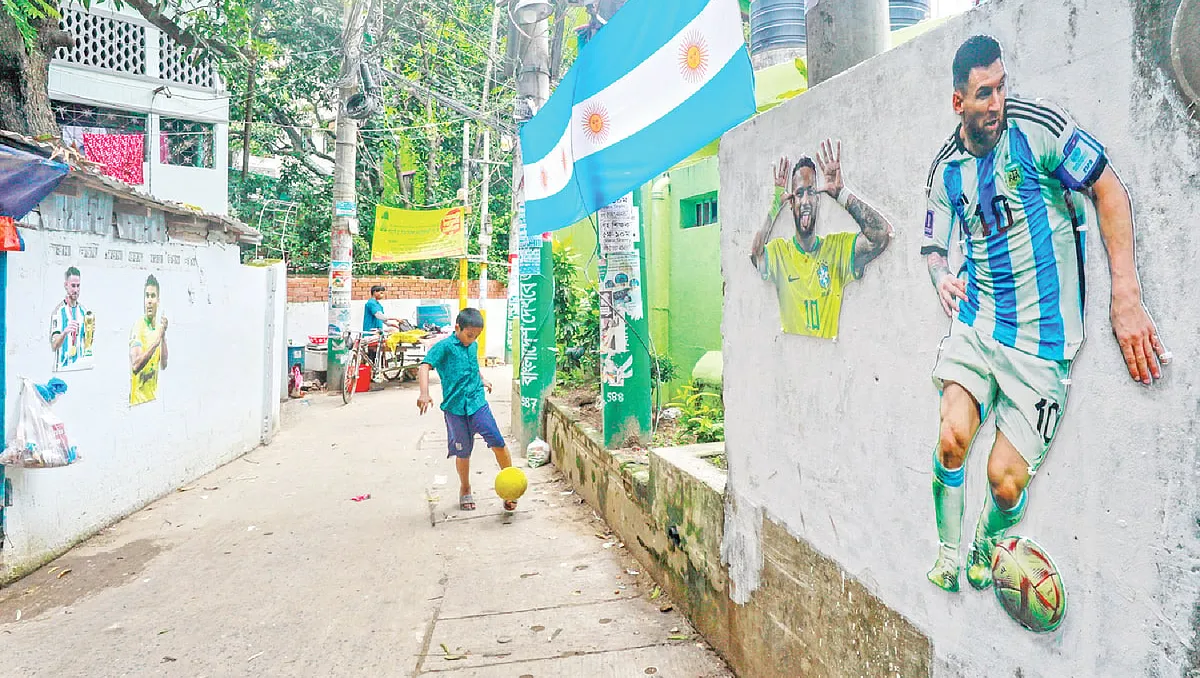
As the world turns its gaze toward the football pitch, the port city of Chittagong has undergone a vibrant metamorphosis. From the narrow alleys of Sharif Colony to the bustling intersections near New Market and the stadium district, the city has transformed into a kaleidoscope of team colors, with flags fluttering from rooftops, balconies, and utility poles. In this coastal hub, the global tournament has transcended mere sport to become a profound social phenomenon that bridges generational and ideological divides.
In neighborhoods like Chandgaon’s Khatibpara, the landscape is now dominated by murals of legends ranging from Pele and Ronaldo to modern stars like Lionel Messi and Neymar. Locals have affectionately dubbed one such street the “Brazil Alley,” reflecting an intensity of fandom that sees rival colors coexist in a shared celebration. According to former national team captain Mamunul Islam, who represented Bangladesh in 67 matches, the enthusiasm this year is particularly palpable, uniting men, women, and children in a collective fervor that turns every local tea stall and office into a stadium of discourse.
The commercial impact of this passion is equally significant. Markets and jersey shops across the city report a surge in demand, with the jerseys of Messi, Neymar, Vinícius Júnior, and Kylian Mbappé topping the sales charts. As evening descends, the city’s character shifts again. Giant screens erected in public spaces such as Prabartak Mor, Kazir Dewri, and the Halishahar BDR field draw hundreds of spectators who gather on plastic chairs and floor mats to witness matches, fostering a communal atmosphere that defines the modern Chittagonian football experience.

This deep-seated obsession is rooted in a rich historical tapestry. As noted by essayist and author Abul Momen, football took hold in Chittagong during the British colonial era, propelled by the railway and port authorities. Organizations like the Assam-Bengal Railway Sports Association were instrumental in establishing the city’s early sporting culture. Throughout the 20th century, the city became a powerhouse of talent, contributing numerous players to the national stage and nurturing a competitive local club scene that thrived in venues like the historic M.A. Aziz Stadium.
Despite this storied past, experts like Momen argue that the city's potential has been hindered by a lack of infrastructure, insufficient long-term planning, and a dearth of grassroots development programs for youth. While the city continues to produce passionate fans, the transition from spectator enthusiasm to professional excellence remains a challenge. Nevertheless, for the people of Chittagong, the quadrennial arrival of the World Cup remains an essential homecoming. As the next generation takes to the alleys with footballs at their feet, the city proves once again that while players and teams may change, its enduring devotion to the beautiful game remains constant.




