ADVERTISEMENT
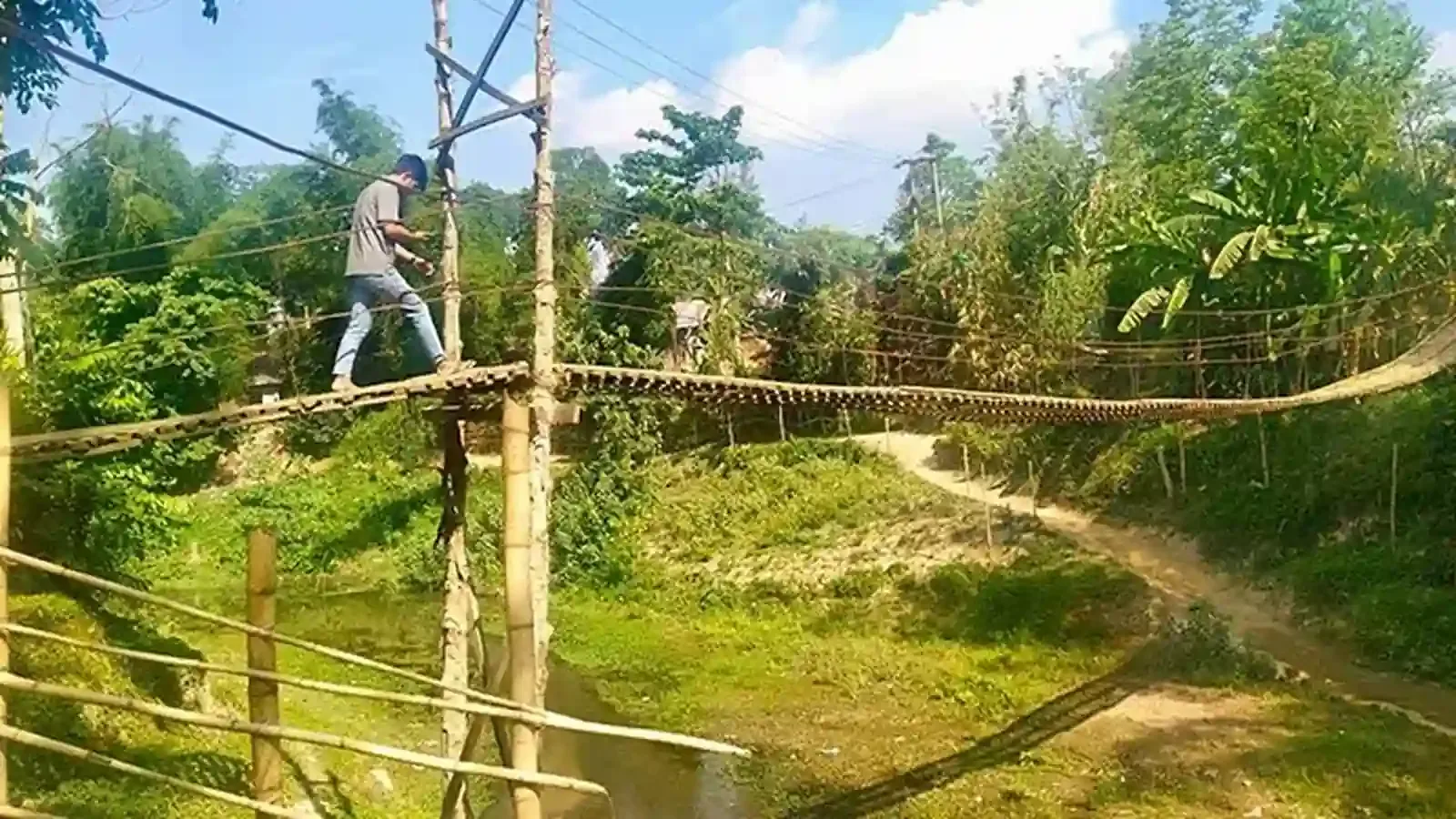
The moment a foot touches its wooden planks, the whole structure begins to sway. Below runs the water of the Dholia Khal. Yet for thousands of people in at least 12 villages of the Mohammadpur Barajhala area in Matiranga upazila of Khagrachari, this rickety wooden hanging bridge is the only way across — and every crossing is made in fear.
There is no permanent bridge over the Dholia Khal beside Hospital Road. Students, elderly people, patients and pregnant women from the Pahari-Bangali communities of Mohammadpur, Rasulpur, Barajhala, Chhankhola Para, Atbari, Taikatan, Mistripara and the surrounding villages must cross it every day, risking their lives.
Local people say the bridge is dangerous even in normal times. Its wooden planks have sunk and come loose in places. When several people cross together, the entire bridge sways, and at times a plank breaks or sinks, causing accidents involving children and elderly people.
ADVERTISEMENT
To keep it usable, residents repair it themselves with bamboo and wood. But the repairs last only a short while before the bridge falls back into its earlier state, leaving them to cross at risk day after day.
Monsoon cuts off the far bank
In the monsoon, hill runoff raises the water in the khal quickly, and crossing becomes impossible. At times the hanging bridge goes under water; at times it is washed away altogether. People on the far bank are then effectively cut off, and going to market, collecting daily necessities or seeking emergency treatment becomes difficult.
Schoolgirls Raisa and Mahia cross the bridge every day to reach school, their hearts pounding with fear as the planks sway beneath them. When heavy rain raises the water, they cannot attend school at all, disrupting their studies.
Abdullah, a resident of Ward No. 7 in Mohammadpur, said they had been travelling over the risky bridge year after year. Hardship grows when the monsoon begins, he said, and when the water rises, taking patients to hospital and sending children to school both come to a halt. Without a permanent bridge, he said, the problem will not be solved.
Labrechai Marma, who has lived in the area for a long time, said everyone promises a bridge before elections, but no one follows up afterwards. In the monsoon, when people cannot reach the market, they spend days in hardship, he said, adding that a bridge should be built there quickly in view of people's suffering.
Promises continue, wait does not end
Residents complain that elected representatives have promised a permanent bridge for a long time without taking any effective step.
Md Shahjalal Kajol, president of Matiranga Municipal BNP, said many people had promised a bridge in the past but no work was done. He said Khagrachari MP Wadud Bhuiyan was vocal on the matter, and expressed hope that work on a permanent bridge could begin soon to ease the suffering of residents across the Dholia Khal.
Umme Tahmina Mitu, upazila nirbahi officer (UNO) of Matiranga, said the administration was aware of the risky crossing over the Dholia Khal and had reported the matter to the higher authorities with the aim of a permanent solution to reduce the suffering of people on the far bank. She said she hoped for a resolution soon.
No timetable is yet known for when construction of a permanent bridge will begin. Until then, thousands of people must keep using the bridge every day at risk. Residents say they expect real action this time, not only assurances. Their wait has lasted not months but year after year — a generation has changed and students have grown up, yet the demand for a bridge remains unmet.