
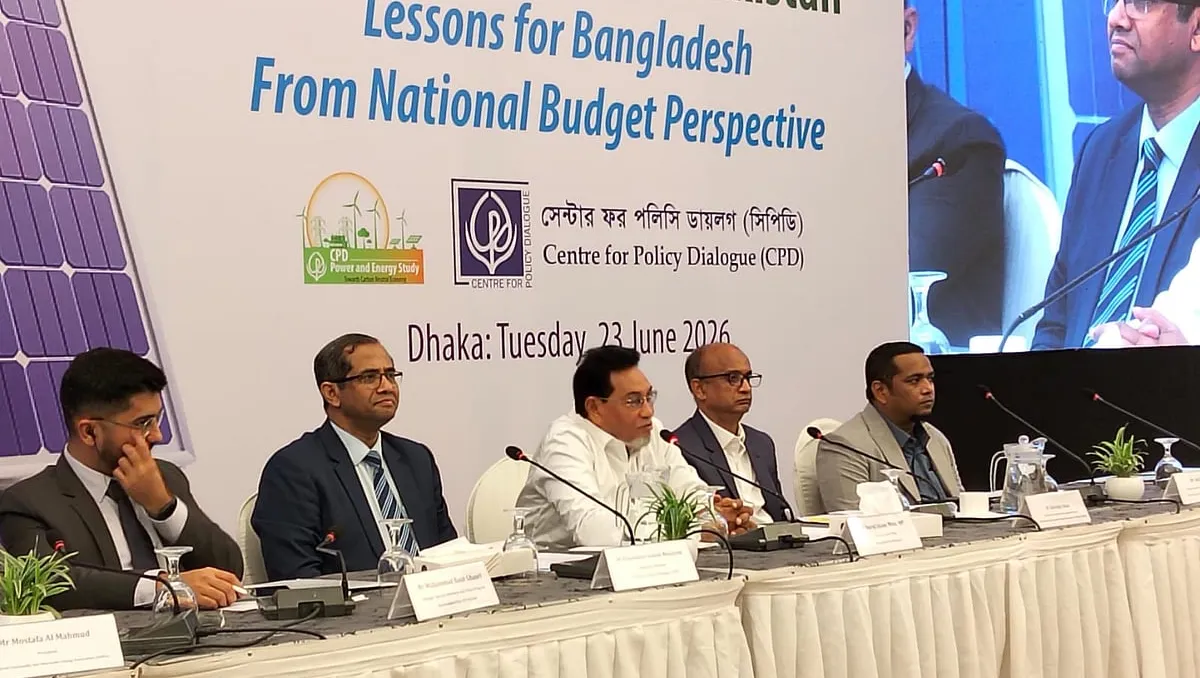
Prime Minister Tarique Rahman, currently on an official visit to China, is expected to sign a significant agreement focused on advancing Bangladesh's solar energy sector. While the final details remain under negotiation, National Parliament Chief Whip Nurul Islam Moni confirmed that discussions are underway to secure a major partnership aimed at bolstering the nation's renewable energy capabilities.
Speaking at a dialogue titled "Solar Revolution in Pakistan: Lessons for Bangladesh from the Perspective of the National Budget," organized by the Centre for Policy Dialogue (CPD) in Dhaka on Tuesday, Moni emphasized that the government is prioritizing sustainable and affordable energy. He stated that the administration views the renewable sector as a cornerstone for building a welfare state and is committed to providing full parliamentary support to legislative efforts aimed at expanding green energy.
The government has outlined an ambitious roadmap to integrate solar systems across all public rooftops and industrial zones. Furthermore, to alleviate the financial burden on rural farmers, plans are in place to transition irrigation pumps and deep tube wells to solar-powered systems.
The forum also highlighted the success of Pakistan’s solar transition, with Muhammad Basit Ghouri, a program manager at the Pakistani organization Renewables First, detailing how his country bypassed traditional grid limitations. Ghouri noted that Pakistan saw approximately $13 billion in investment—nearly double the value of an IMF loan—driven largely by the middle class and rural households through self-financing rather than traditional banking. This grassroots shift resulted in the creation of 500,000 jobs.
CPD research associate Atikuzzaman Sajid contrasted these findings with the situation in Bangladesh, noting that while Bangladesh has seen a 300% growth in net-metering over the past two years, the reliance on bank-funded models persists. He urged a shift in mindset toward self-financed solar initiatives. CPD research director Khondkar Golam Moazzem added that the government is currently reviewing 31 solar projects that were previously canceled, characterizing the move as a critical step toward addressing the nation’s energy crisis.

Industry stakeholders, however, cautioned that a transition requires balanced policy frameworks. David Hasanat, president of the Bangladesh Independent Power Producers Association (BIPPA), argued that Bangladesh’s currently subsidized electricity prices reduce the immediate incentive for consumers to switch to solar. He also pointed to geographic factors, noting that Bangladesh receives significantly less sunlight than Pakistan, which increases the relative cost of production.
Addressing the economic barriers, Mostafa Al Mahmud, president of the Bangladesh Sustainable and Renewable Energy Association (BSREA), identified the $10 billion annual expenditure on fuel imports as a primary driver of the nation’s foreign exchange crisis. He advocated for the complete withdrawal of duties and taxes on solar panels and batteries to stimulate private-sector adoption.
Government officials confirmed that these fiscal hurdles are being addressed. Ashraful Alam, a member of the Sustainable and Renewable Energy Development Authority (SREDA), announced that a high-level committee is currently negotiating with the National Board of Revenue to rationalize duties on solar equipment, including batteries and panels. A new tariff structure is expected to be formalized through a statutory regulatory order as early as next month.




