
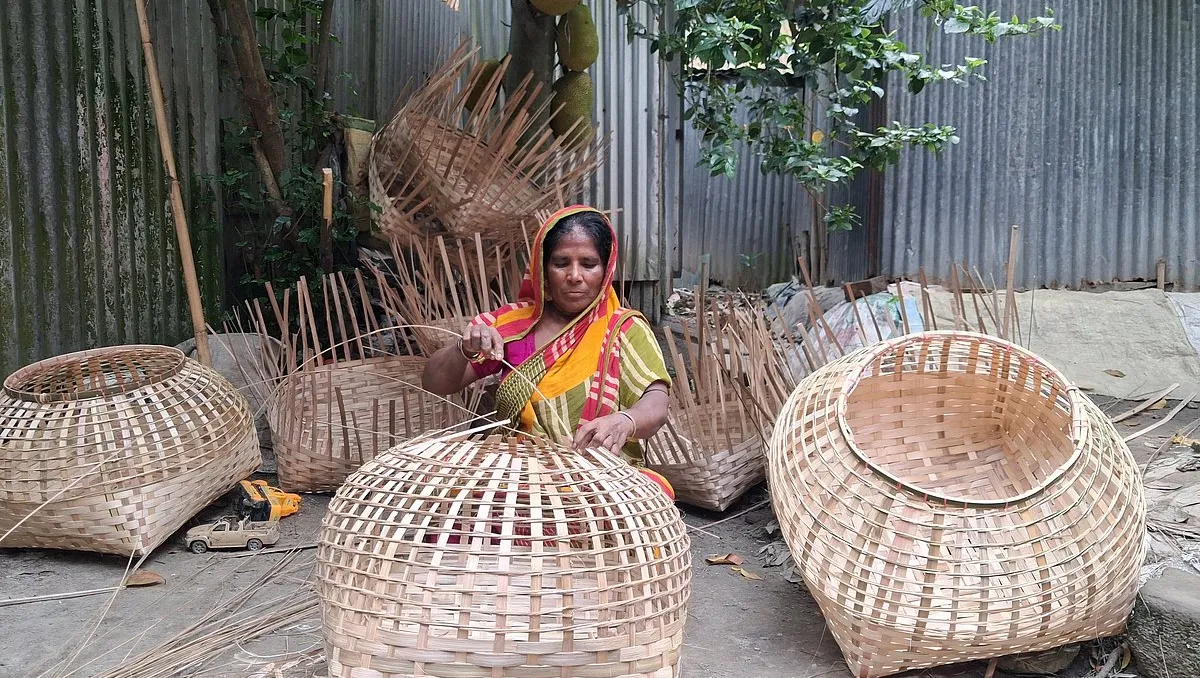
In the village of Boromachimpur, located in the Titas sub-district of Cumilla, the rhythmic sound of bamboo craftsmanship defines daily life. For approximately 50 families, the production of traditional winnowing trays—known as kula—and poultry cages is not merely a job, but a century-and-a-half-old legacy passed down through generations.
Members of the local Namsod community, who have maintained this craft for nearly 150 years, operate as a tightly knit production unit. Men and women alike participate in the labor-intensive process, which involves harvesting raw bamboo, splitting the stalks into strips, weaving the frames, and securing them with durable plastic threads.
For veteran artisans like 58-year-old Nikhil Chandra Namsod, who has spent 48 years in the trade, the craft has served as the sole financial engine for his eight-member household. Similarly, others like Milan Chandra and Nitai Chandra Namsod credit the steady demand for these handmade goods with the ability to educate their children and, in some cases, fund their migration abroad for employment. The resilience of this industry is also evident in women like 65-year-old Lanchana Rani, who continues to sustain herself through the craft years after her husband’s passing.
The economic model is built on efficiency and local sourcing. Artisans purchase raw bamboo from the nearby Machimpur market for 400 to 500 taka per pole. A single stalk can produce up to 30 winnowing trays or nearly 20 poultry cages, a process that typically requires five to seven days of meticulous labor. Wholesalers regularly visit the village to purchase these goods in bulk, distributing them to local markets, fairs, and religious gatherings across the Titas, Homna, Muradnagar, Meghna, and Daudkandi regions. Retail prices range from 80 to 180 taka depending on the size and type of the item.

Despite their dedication, the artisans face mounting pressure from the rising costs of raw materials and the growing ubiquity of inexpensive plastic alternatives. While these challenges threaten the viability of their craft, the villagers remain committed to preserving their heritage. They suggest that government support and wider market access could revitalize the sector, allowing them to modernize their operations while maintaining the quality that has sustained their families for generations.
Local administrators have acknowledged the significance of this village, with Titas Upazila Executive Officer Mahmudur Rahman noting that the community represents a vital piece of rural heritage. The local administration has expressed its willingness to provide guidance and support to these artisans should they seek assistance to expand their industry. For now, the artisans of Boromachimpur continue to weave their livelihood, serving as a testament to the enduring craftsmanship of the region.




