
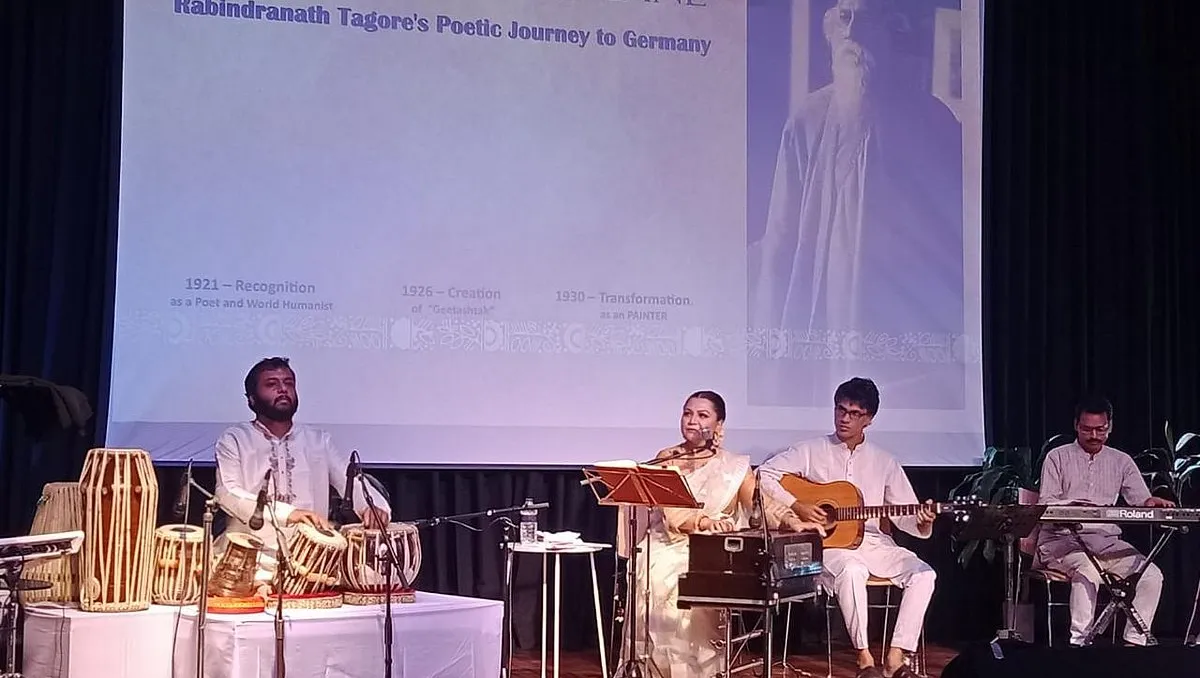
The Goethe-Institut in Dhaka hosted a cultural tribute this Saturday, titled "From the Memory Lane—Rabindranath Tagore’s Poetic Journey to Germany," which explored the profound intellectual and artistic connections between the Nobel laureate and the German cultural landscape. The event sought to bridge the past and present by highlighting how Tagore’s philosophy and music continue to resonate on a global scale.
The evening commenced with the gentle strains of the veena, followed by a documentary presentation chronicling Tagore’s three historic visits to Germany in 1921, 1926, and 1930. The footage captured significant moments from these travels, including meetings with renowned intellectual figures such as physicist Albert Einstein.
Goethe-Institut Dhaka Director Frank Werner opened the proceedings with a German recitation of Tagore’s poem "Amare Tumi Ashesh Korecho." This was followed by a recital by vocalist Sanchita Rakhi, who performed a selection of Tagore’s most evocative compositions, including "Mor Bina Othe Kon Sure Baji" and "Amar Mukti Aloy Aloy." The performance served to illustrate the universality of Tagore’s work, extending his lyrical depth beyond linguistic borders.
Reflecting on the legacy of the poet, Sanchita Rakhi remarked that more than a century later, Germany remembers Tagore not merely as a Nobel laureate, but as an enduring ambassador for education, art, and universal humanism.

In his concluding address, Frank Werner drew parallels between Tagore and the iconic German poet Johann Wolfgang von Goethe. Despite their disparate cultural origins, Werner noted that both men centered their philosophies on the spirit of global humanism. He highlighted the rapid rise of Tagore’s popularity in Germany during the early 20th century, noting that more than 25 of his works were published there between 1919 and 1925.
Werner further emphasized that while Goethe never traveled outside of Europe, his fascination with Indian literature—sparked by the German translation of Kalidasa’s "Shakuntala"—established a lasting cross-cultural dialogue. According to the organizers, the event was intended to reaffirm these intellectual bonds for a new generation, celebrating Tagore as a philosopher and educator whose vision of love and spirituality remains a foundational element of contemporary global discourse.




