
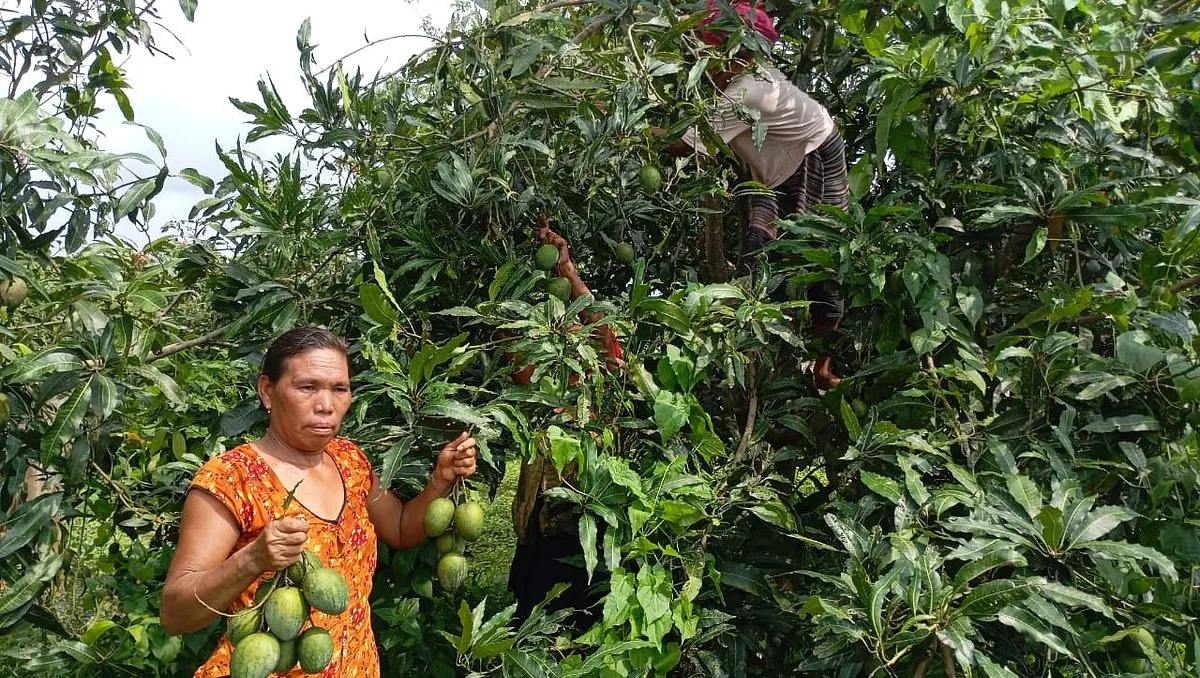
As dawn breaks over the hilly terrain of Khagrachhari, local women are already traversing rugged paths, carrying bamboo baskets and crates toward the region’s sprawling mango orchards. For these women, who typically spend most of the year managing domestic chores, the annual mango harvest marks a significant shift in their daily lives, offering a vital opportunity to supplement their family incomes.
In the Dudukchhara area of Panchhari upazila, the hillsides are currently alive with the activity of harvesting. Women gather in teams, moving through the orchards to pluck ripe mangoes, fill containers, and transport the yield to market distribution points. For many, this seasonal labor is a source of financial independence and communal spirit. Anita Chakma, a local worker, notes that she earns approximately 400 taka per day, providing essential support for her household expenses while enjoying the camaraderie of working alongside other women.
The nature of the work is physically demanding, often requiring the climbers to scale trees or haul heavy, crate-filled loads across uneven landscapes. Despite the rigor, many women view the labor as a point of pride. To maximize their earnings, local women often form groups of 10 to 12, negotiating collective contracts with orchard owners to harvest specific sections of land. This arrangement allows them to secure both consistent daily wages and additional performance-based income.
Orchard owners have lauded the increasing participation of local women, noting that it has effectively mitigated chronic labor shortages during peak harvest months. Growers such as Mongpru Marma and Sujan Chakma report that the influx of female labor has improved efficiency and reduced post-harvest losses. Because these workers are known for their diligence and careful handling of the fruit, the quality of the harvest remains higher, ensuring that produce reaches the market in optimal condition.

The expansion of commercial mango cultivation across Khagrachhari over the past few years has been a catalyst for this shift in local employment. As new orchards continue to emerge, the demand for seasonal labor has created a robust economic niche for women, extending beyond harvesting to include sorting and packaging.
Nasser Uddin, deputy director of the Department of Agricultural Extension in Khagrachhari, highlights this trend as a positive development for gender-based economic empowerment. He emphasizes that while these women are already contributing significantly to the local economy and their own households, providing them with formal agricultural training could further enhance their professional prospects and efficiency. As the region’s fruit industry grows, the role of women as active participants in the agricultural supply chain is becoming an increasingly vital component of the local economy.




