
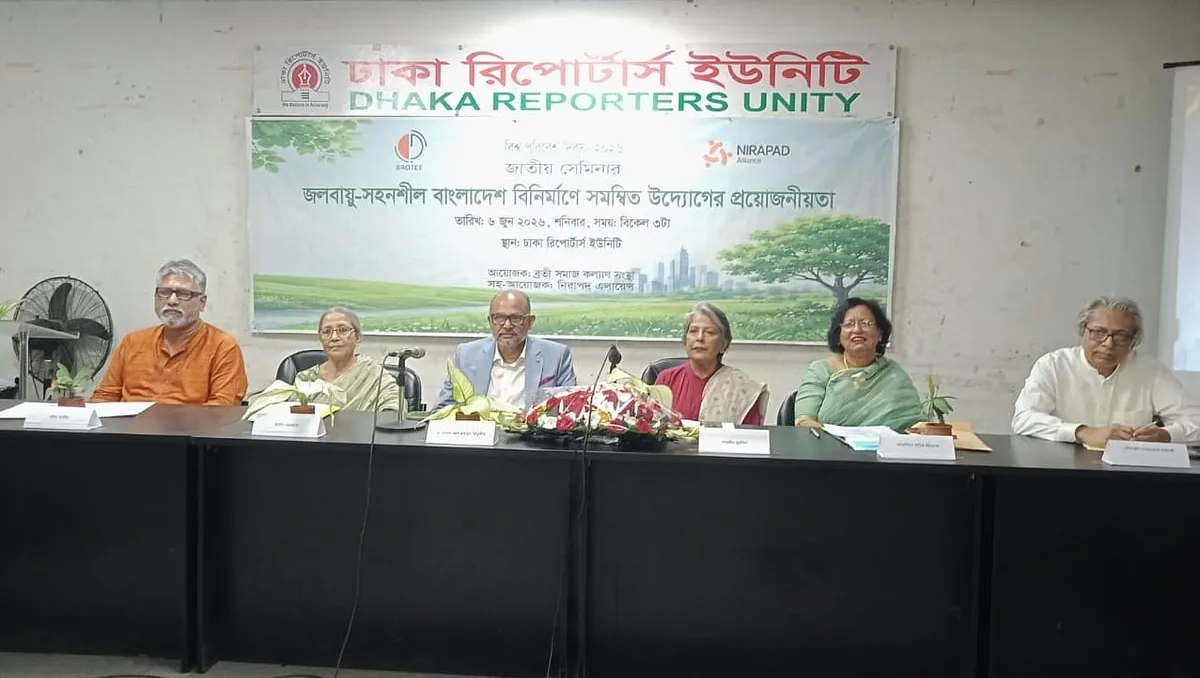
Bangladesh will henceforth prioritize environmental sustainability, job creation, and long-term economic viability when evaluating new investment projects, according to Rashed Al Mahmud Titumir, the Prime Minister’s advisor on finance and planning. Addressing a seminar in Dhaka on Saturday titled "The Need for Integrated Initiatives to Build a Climate-Resilient Bangladesh," Titumir asserted that no development project should be approved unless it meets strict criteria, including value for money, return on investment, employment generation, and environmental compatibility.
Titumir emphasized a transition toward a green economic model, highlighting that the government is moving away from fossil fuel dependency in favor of eco-friendly technologies. Plans are underway to promote electric transportation—including electric buses and locomotives—to foster industrial growth while mitigating air pollution. Furthermore, the advisor noted that the government intends to broaden its domestic revenue base through increased production and employment, rather than raising tax rates, to channel additional funding into health and education.
Addressing the country’s ecological challenges, Titumir called for an integrated approach to water, agriculture, and river management. He signaled a move to reduce reliance on groundwater, focusing instead on river restoration, reservoir conservation, and climate-resilient agricultural practices. Specific initiatives, including a five-year development plan for the haor regions and the Teesta Master Plan, are currently being advanced to address regional climate vulnerabilities.
The seminar, organized by Brati Social Welfare Organization and Nirapod Alliance, brought together experts to discuss the multifaceted nature of the climate crisis. Sharmin S. Murshid, founder and chief executive of Brati, argued that climate change in Bangladesh is no longer a future threat but a daily reality manifested through river erosion, displacement, and socioeconomic instability. She stressed that while international accountability is vital, the country must also bolster its internal defenses through grassroots research and local innovation.

Other speakers echoed the need for a paradigm shift in development policy. Former Fisheries and Livestock advisor Farida Akhter pointed out that the crisis is exacerbated by consumerism, deforestation, and the excessive use of chemical fertilizers. She urged policymakers to prioritize the traditional knowledge of local farmers alongside modern technological solutions.
Meanwhile, experts such as M.S. Siddiqui and Sharif Jamil emphasized the importance of self-reliance, arguing that Bangladesh must look beyond foreign funding by fostering circular economies and sustainable entrepreneurship. The consensus among the participants was that tackling climate resilience requires a synchronized strategy that spans local, national, and international governance to ensure a democratic and humane future for all citizens.




