
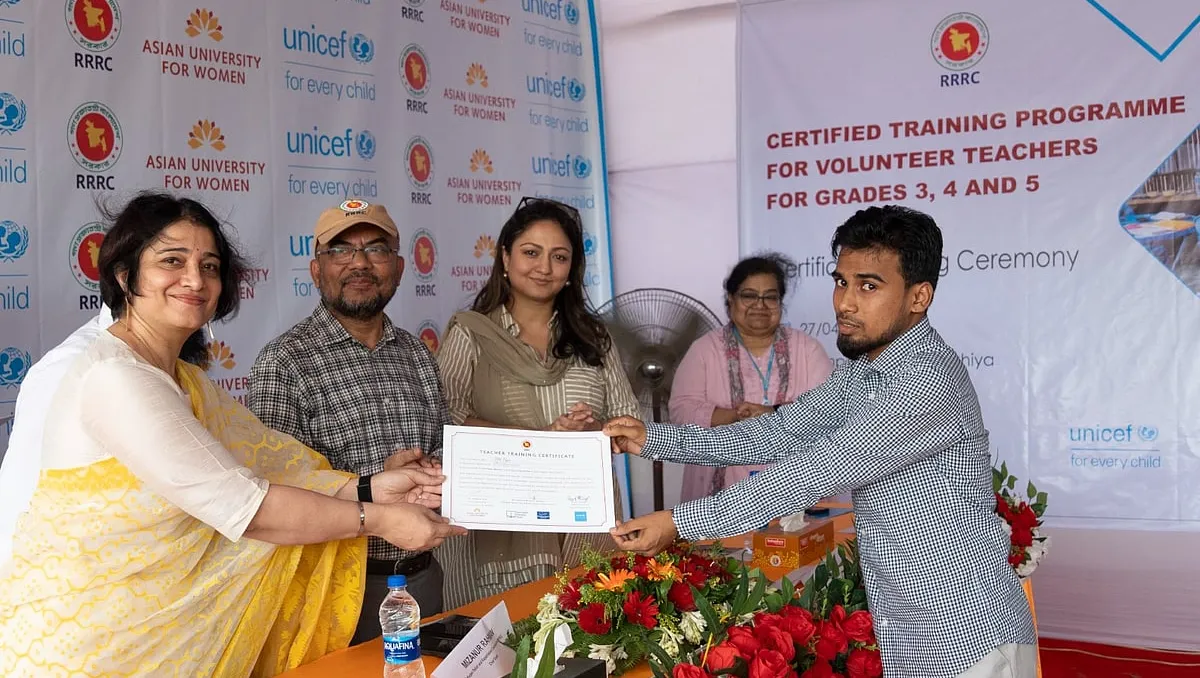
For the first time, more than 1,100 volunteer teachers in refugee camps are going to get certified as a step to improve the quality of education for Rohingya children. Through this, the learning process of Rohingya children is being strengthened in the classroom along with the recognition of teachers' skills.
This certificate is being awarded as a joint initiative of UNICEF and the Asian University for Women and in collaboration with the Government of Bangladesh and the Refugee Relief and Repatriation Commissioner (RRRC).
UNICEF and Asian University for Women announced this information in a joint statement on Wednesday. In the last two years, volunteer teachers and master trainers from Rohingya and local communities in Cox's Bazar and Bhasanchar have completed this training program.
Refugee Relief and Repatriation Commissioner (RRRC) Mizanur Rahman said, "This is a significant initiative. It is not just a charter, it is a symbol of empowerment. Through this you will guide the next generation, they will create their own future.
The press release stated that this training program for volunteer teachers was for three months, and a total of 176 hours of training was provided. English, Mathematics, Science, Sociology, Burmese Language and 118 modules are discussed here in line with the Myanmar curriculum.

There was a combination of direct teaching, peer engagement and hands-on classroom practice. The entire training is conducted with special emphasis on inclusive and gender-sensitive teaching.
UNICEF Acting Representative in Bangladesh, Stanley Gavua, said, "The awarding of this certificate is an important milestone in our collective efforts to ensure that every Rohingya child has access to quality education, not just education." He said, "By investing in volunteer teachers, we are investing in the future of an entire generation of children who are already facing severe barriers and disadvantages."
Kamal Ahmad, the founder of Asian University for Women, said that education is the biggest defense against oppression and discrimination, "Any education is not enough to face these challenges." In that case education must be effective. Must be a means of creating a sympathetic mindset. This training program gives us hope that education in the refugee camps will improve in a way that will instill hope again.'




