
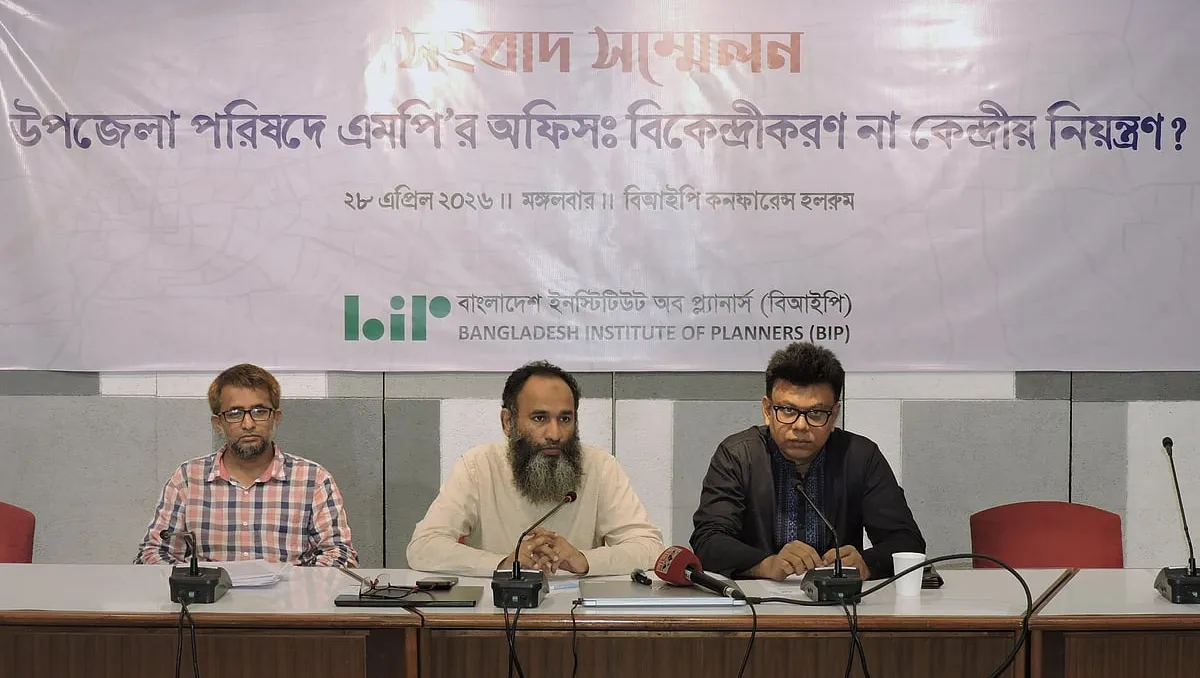
The Bangladesh Institute of Planners (BIP) has expressed concern that the initiative to set up 'inspection rooms' for Members of Parliament (MPs) within upazila parishads could create 'dual leadership' and conflict of power in local administration.
Such initiatives could strengthen central control, the organization says. This will not only weaken the local government but also question the foundation of accountability and institutional transparency.
These fears were highlighted in a press conference organized at BIP conference hall in Banglamotor of the capital on Tuesday morning. BIP Senior Vice President Sheikh Muhammad Mehdi Ahsan presented the main article in the press conference titled 'MP Office in Upazila Parishad: Decentralization or Central Control'.
According to the main article, according to the constitution, the responsibility of the parliamentarians is to supervise the law-making, policy-making and executive departments. On the other hand, Upazila Parishad as a local government institution is responsible for development planning and implementation. A clear separation between these two structures is essential for democratic balance.
It is also commented that if offices for parliamentarians are set up inside the Upazila Parishad, this institutional boundary will slowly erode, surveillance will become control rather than neutral.
BIP's press conference said direct presence of parliamentarians can increase influence on local administrative decisions. There is a risk that the role of elected upazila chairman and parishad will be marginalised. As a result, a kind of 'dual leadership' will be created. Where formal power may be concentrated on one side and effective power on the other. It is also feared that accountability and transparency will suffer.
In the press conference, it was said that for a long time, the influence of parliamentarians in various fields including the selection, implementation and appointment of contractors for development projects is increasing. This weakens the separation of legislature and executive.
According to BIP, if the upazila chairman belongs to the government party and the member of parliament of the respective area belongs to the opposition party, the tension of power at the local level may increase, which will affect the civic services. A common citizen may experience difficulties in accessing services when two parties are in conflict.
In the original article, it is mentioned that the balance of power in the local governance system can take a more complicated form by setting up an inspection room if the upazila chairman is of the opposition party and the member of parliament of the respective area belongs to the government party.

It is said that the ruling party MPs can influence development projects, budget and administrative decisions due to their political influence and central connections. The administration is also in many cases more coordinated with them, as a result of which the opposition party chairmen face obstacles in implementing the plan effectively. This leads to delays in development, lack of coordination and conflict, and disruption of citizen services.
According to BIP, almost all political parties have promised to strengthen and decentralize local government in their election manifestos. But setting up office of parliament member in upazila parishad contradicts that promise.
According to the organization, the role of professional planners is more important than increasing political presence in building effective local government. Because, the main problem of development is not lack of allocation or coordination, but lack of integrated and scientific planning. A planner can bring land use, drainage, infrastructure and urban-rural linkages into an integrated framework that will ensure sustainable development rather than fragmented and politically influenced projects.
BIP has given five recommendations regarding the establishment of inspection rooms in upazila parishads. These are—Members of Parliament may hold office but not within local government; Individual Constituency Offices (at Upazila/District level) may be set up for Members of Parliament if necessary, but initially virtual platforms may be set up; Parliamentarians not having a direct decision-making role in local development planning; Creating institutional coordination framework between parliamentarians, upazila chairman and administration and launching specific public service platform for parliamentarians.
Apart from this, in the press conference, BIP made 10 recommendations regarding the formation of strong and effective upazila parishads and planned development. These are – early local council elections; Establishment of Upazila Parishad as the de facto local governance authority; Hiring professional planners; Upazila Integrated Spatial Planning Mandatory; Land use planning under this plan and implementation of building construction activities accordingly; Coordination of upazila planning with district and national planning; Ensuring independent budget and financial autonomy; Establish an all-party parliamentary committee, including professionals and subject matter experts, to reduce central administrative control, increase citizen participation and accountability, and re-evaluate the report of the Local Government Commission.
BIP General Secretary Prof. Mu in the press conference. Mosleh Uddin Hasan said that the development work at the local level is related to the local government. These are not the work of Ministers, Ministers of State or Members of Parliament. Parliamentarians will monitor these activities of the local government all day and night by spending time in the parliamentary session, this is an unrealistic process. However, if the parliamentarians express interest in this work, it needs to be clarified whether any value will be added to the local government, whether any new work will be done apart from the local government work or not.
The general secretary of the organization also said that not only 300 rooms will be made for 300 members of parliament if there are inspection rooms in upazila parishad, other facilities should be ensured along with these rooms. Through this, if the Upazila Parishad building becomes a busy building, many other activities may be disrupted. Apart from this, it should also be considered whether the construction of huge buildings for these offices in each upazila is possible in the context of Bangladesh.
Senior BIP member Mehdi Hasan was present.




