
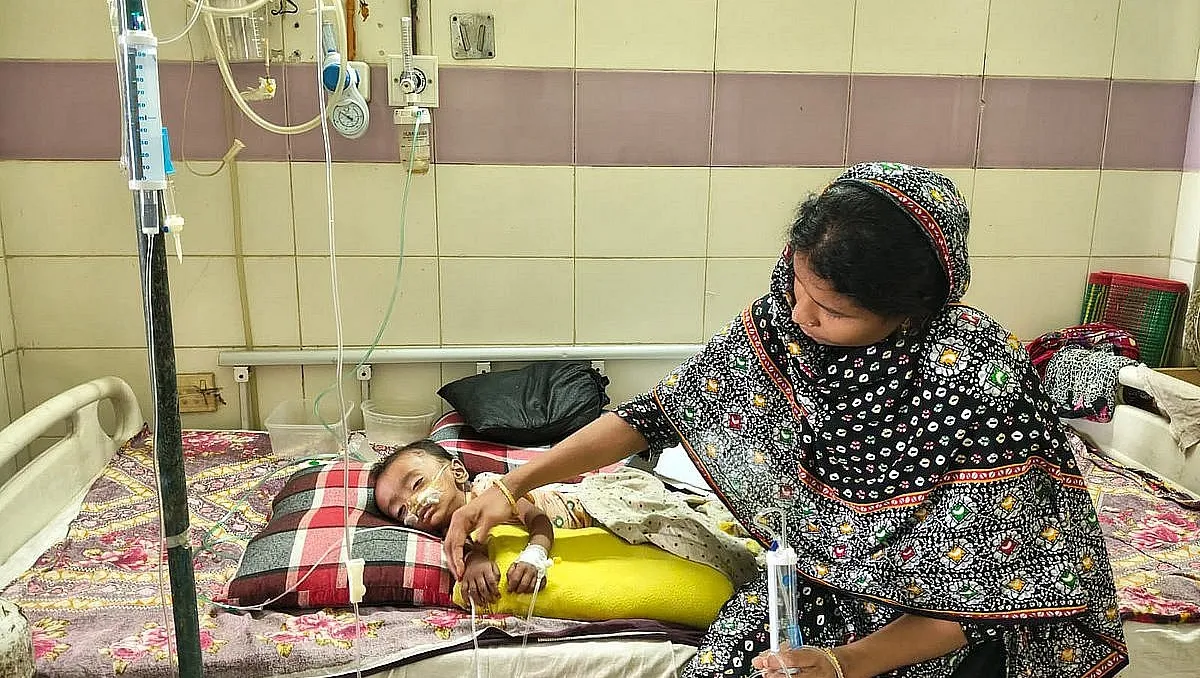
The World Health Organization has expressed concern over the measles situation in Bangladesh. The agency has assessed the situation as 'high risk' nationally.
This assessment was made in the light of the spread of infection in 58 districts out of 64 districts of Bangladesh, large number of children affected, lack of immunity to this disease due to lack of vaccination and deaths due to measles symptoms in the report published by the organization yesterday (April 23).
On April 4, 2026, the National International Health Regulations or IHR Focal Point of Bangladesh informed the World Health Organization that the number of measles cases in the country has increased significantly. This increase is due to ongoing infections within the country. The number of measles patients in Bangladesh is clearly increasing since January.
After the new evaluation of the World Health Organization, the organization's former consultant and public health Dr. Mushtaq Hossain told Prothom Alo on Friday, "As the infection situation is increasing, we said that measles should be declared a health emergency." Now the government should declare a state of emergency and go ahead with vaccinations.'
According to the report of the World Health Organization, from March 15 to April 14, a total of 19 thousand 161 suspected measles patients were found in the country. At the same time, 2 thousand 897 confirmed patients were tested.
However, in the detailed description of the situation, the number of confirmed patients in the laboratory has been mentioned as 2 thousand 973. During this time, 166 people died with symptoms of measles. The mortality rate or CFR is 0.9 percent. There have been 30 laboratory-confirmed measles-related deaths. In this case, the death rate is 1.1 percent.
According to the report, 12 thousand 318 people were admitted to the hospital during this period. 9 thousand 772 people got clearance from the hospital.
The highest pressure of measles patients is seen in Dhaka division. Since March 15, the number of suspected patients in Dhaka Division is 8 thousand 263. Then there are 3 thousand 747 in Rajshahi division, 2 thousand 514 in Chittagong division and 1 thousand 568 in Khulna division.
In Dhaka, more patients are found in densely populated slum areas. These include Demra, Jatrabari, Kamrangirchar, Karail, Mirpur and Tejgaon industrial areas and slum areas.
The World Health Organization says that patients have been identified in eight regions of the country. Out of 64 districts, 58 districts, i.e. 91 percent of the districts, have been diagnosed with patients. It shows, the infection is now widespread nationally.
According to data from the country's Expanded Program on Immunization (EPI), measles has spread in 61 districts of the country. 83 percent of affected children are under 5 years of age.
According to the report of the World Health Organization, most of the patients who go to the hospital are children under the age of five. This rate is 79 percent. Among them, 66 percent are children under two years of age and 33 percent are children under 9 months.
The report said that a total of 166 children were suspected to have died. They are mainly unvaccinated children under the age of two.
The World Health Organization says a major concern in the current outbreak is that many children are either unvaccinated or have received only one dose of measles vaccine. Some children have been infected at 9 months of age before the vaccine is appropriate. Most of the patients, ie 91 percent, are children aged 1 to 14 years. This indicates major immunodeficiency in children of this age.
According to the World Health Organization report, measles is a highly contagious acute viral disease. It can affect people of all ages. Measles is still considered one of the leading causes of death among young children worldwide.
This disease is spread through air. Transmission can also be through droplets from the nose, mouth or throat of an infected person.
Initial symptoms usually appear 10 to 14 days after infection. But this period can be from 7 to 23 days. Symptoms include high fever, runny nose, red eyes, cough and small white spots inside the mouth.
A rash usually appears on the body 10 to 14 days after infection. The rash first starts on the head, then gradually spreads to the middle and then the lower part of the body.
A patient can spread the disease to others from four days before the rash appears until four days after the rash appears. There is no specific antiviral treatment for measles. Most people recover within two to three weeks.
Measles is generally a mild or moderate disease. But it can also create serious complications. These include pneumonia, diarrhea, secondary ear infections, brain inflammation or encephalitis, blindness and death.
The World Health Organization reports that encephalitis after infection may occur in about one in every 1,000 reported patients. And for every 1,000 reported cases, two to three may die.
Measles can cause serious illness in at-risk groups. These include children under five, malnourished children, especially those with vitamin A deficiency and those with weakened immune systems.
The World Health Organization says Bangladesh had made significant progress towards measles eradication before the outbreak. Coverage of the first dose of measles vaccine was 89 percent in 2000. In 2016, it increased to 118 percent. Coverage was 22 percent in 2012 after the second dose was introduced nationwide. In 2024 it increased to 121 percent. At the same time, the rate of laboratory-confirmed measles cases declined rapidly.
However, in 2024-25, coverage of the first and second doses of the vaccine, or MR1 and MR2, is reduced due to a national shortage of MR vaccine in the country. This is compounded by gaps in routine immunization and the absence of a routine nationwide supplementary measles-rubella immunization program after 2020. These factors have increased the number of children at risk of infection and created the current outbreak.

The risk has been assessed as 'high' at the national level. Because transmission is ongoing in multiple sectors, large numbers of children are at risk of infection, immunodeficiency is documented, and suspected measles-related deaths occur.
The number of cases is higher among unvaccinated and partially vaccinated children. This includes children who are not yet old enough to be vaccinated. This increases the risk of continued infection and serious illness.
Overall, the outbreak shows that Bangladesh's previous progress in measles eradication has suffered. At the same time, it proves that Bangladesh is now more vulnerable to the risk of chronic infection. If emergency measures are not taken, the infection can spread further. It is therefore imperative to strengthen surveillance, rapidly detect and combat disease, and bridge the gap in immunity through good quality immunization programs.
The National Immunization Technical Advisory Committee or NITAG approved the nationwide measles-rubella or MR immunization program on March 30, 2026. The program targets children aged 6 to 59 months. With this, children aged 6 to 8 months have also been brought under wide coverage.
The program started on April 5 in 30 upazilas of 18 priority districts. Then on April 20, the nationwide program began.
Vitamin A campaign was held across the country on 15th March 2025. All suspected and confirmed measles patients are being given vitamin A as part of the ongoing outbreak response. It is an essential part of routine treatment and patient management.
District Level Rapid Response Teams or RRTs have been activated. The Ministry of Health has also arranged for quick collection of vaccines.
Other measures to combat the outbreak include strengthening routine immunization, increasing hospital preparedness, ensuring supplies of vitamin A, increasing patient isolation capacity, and strengthening infection prevention and control systems.
Efforts are also underway to strengthen surveillance and epidemiological analysis across the country. Training is being provided to health care facilities to improve disease detection and reporting. Weekly situation reports are being prepared to facilitate evidence based decision making.
The World Health Organization says there is a significant risk of cross-border transmission due to the movement of people in border areas. Major urban centers like Dhaka, Chittagong, Sylhet and Cox's Bazar are important hubs for international travel and transit. This increases the risk of infection spreading within and outside the country, especially through travelers who are unvaccinated or under-vaccinated.
Measles is endemic to Southeast Asia. The risk has been assessed as 'high' at the regional level.
Bangladesh has a long land border with India and Myanmar. The movement of people across this border may exacerbate ongoing infections. The number of unvaccinated or zero-dose children in Myanmar is significant. Monitoring and response capabilities are limited due to ongoing conflicts and humanitarian crises.
India has achieved high vaccination coverage but the number of measles cases has increased in the past six months. High infection-prone cities like Jessore and Chapainawabganj share busy land ports with India. This increases the risk of infection entering from across the border.
The World Health Organization has assessed the global risk as 'moderate'.
The World Health Organization recommends maintaining at least 95 percent uniform and sustained coverage of the first and second doses of measles vaccine in all urban areas. It also called for strengthening surveillance of measles and rubella infections, so that all suspected cases can be quickly identified in public, private and social security-affiliated health care facilities.
The agency has suggested strengthening surveillance in high-traffic border areas. It will be possible to quickly identify and deal with suspected measles patients. In the case of measles patients coming from abroad, prompt action should be taken to prevent local infection from becoming permanent again.
Coordination between the national and local levels should be ensured in the fight against measles. There should be constant and effective communication between all levels.
Appropriate patient management should be ensured at the hospital level during outbreaks. In order to prevent infection within the hospital, the patient should be kept in a separate room and should not come into contact with other patients in the hospital.
The World Health Organization recommends vaccination of at-risk populations, unless they have been vaccinated or have evidence of immunity against measles-rubella. These include health workers, people working in the tourism and transport sectors, hotels, airports, border crossings, public transport-related workers and international travelers.
Planning to vaccinate migrant populations in high-traffic border areas is also suggested. Prioritizing vaccination of migrants and local residents considered at risk will increase population immunity.
Persons at risk of exposure to the infection should be vaccinated against measles within three days. For those who cannot be vaccinated or cannot be vaccinated within three days, a special injection within six days of infection may be considered. Priority should be given to children, pregnant women and immunocompromised persons.
The World Health Organization recommends keeping adequate stocks of vaccines, syringes and necessary equipment.




