
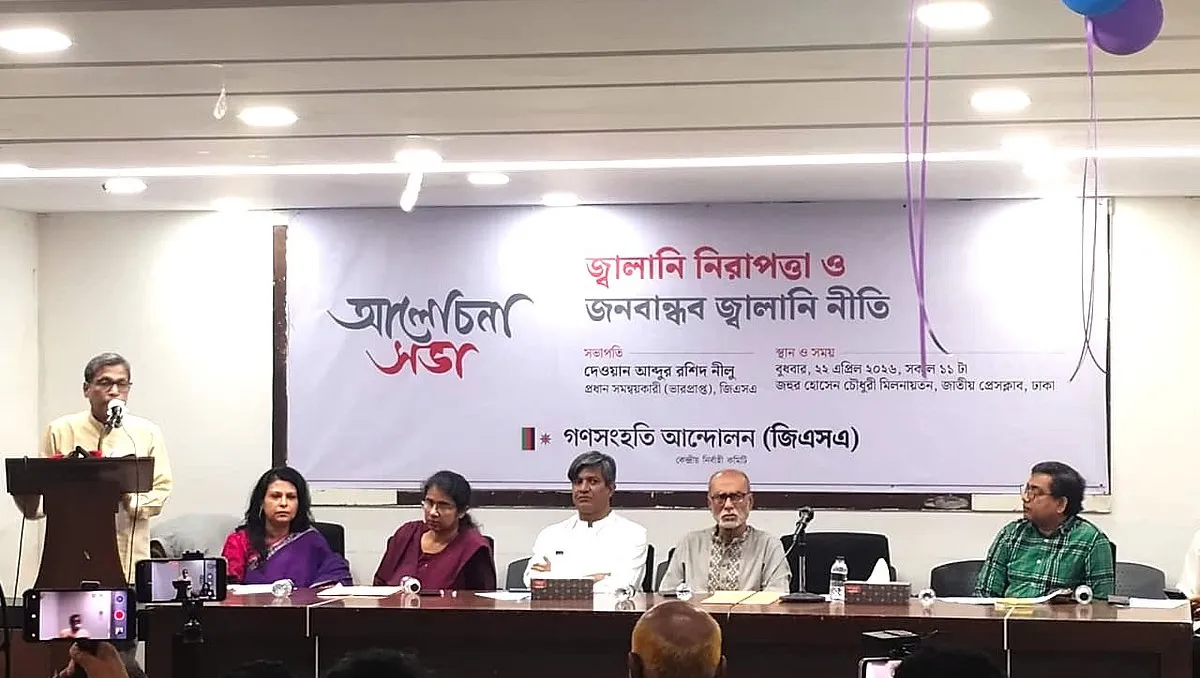
If we want a sustainable solution in the energy sector, not only policy changes, but entire structural reforms are necessary. Working within the existing framework will not yield different results.
Speakers said this in a discussion meeting titled 'Fuel Security and People-Friendly Energy Policy' at Jahur Hossain Chowdhury Auditorium of the National Press Club of the capital on Wednesday. The organizer of the discussion meeting is Ganasanhati Andolan.
In the discussion meeting, Consumers Association of Bangladesh (CAB) energy adviser M Shamsul Alam said that the current structure of the energy sector is such that the tendency to satisfy the beneficiary groups works here during the crisis. As a result, ordinary consumers suffer, but structural problems remain intact.
Highlighting the issue of 'structural corruption', Shamsul Alam said that the energy sector is not only government agencies; Rather, a large group including petrol pump owners, LPG traders are the beneficiaries of this system. This structure is embedded within the state system itself. As a result, any government that fails to break it will eventually become part of the system.
Dhaka University teacher Moshahida Sultana complained that long-term savings are not given importance in the energy sector. He said policymaking still focuses on immediate cost calculations and not on long-term savings or strategic gains. Calculating the project's 'internal rate of return' ignores environmental and social impacts.

Hasan Ashraf, a teacher of Jahangirnagar University, highlighted the three-term plan to solve the energy crisis. He said, in the short term, it is necessary to ensure fair distribution of fuel, reduce wastage. In the medium term, investment in renewable energy, especially solar energy, should increase. Decentralized energy system should be developed at the local level. And the most important thing in the long term is to rethink the development model.
Hasan Ashraf said, 'We should aim for an energy system which is environmentally friendly and which reduces inequality among people. We must not only look to technology to solve the crisis, but to human resilience and inclusive policies. There is no alternative to establishing energy justice.
Dewan Abdur Rashid Nilu, Acting Chief Coordinator of Mass Solidarity Movement presided over the discussion meeting. Gholam Mustafa, member of the central executive committee of the mass solidarity movement, moderated. Abul Hasan Rubel, executive coordinator of Mass Solidarity Movement, Taslima Akhtar, member of political council, Feroz Ahmed and others spoke at the discussion meeting.




