
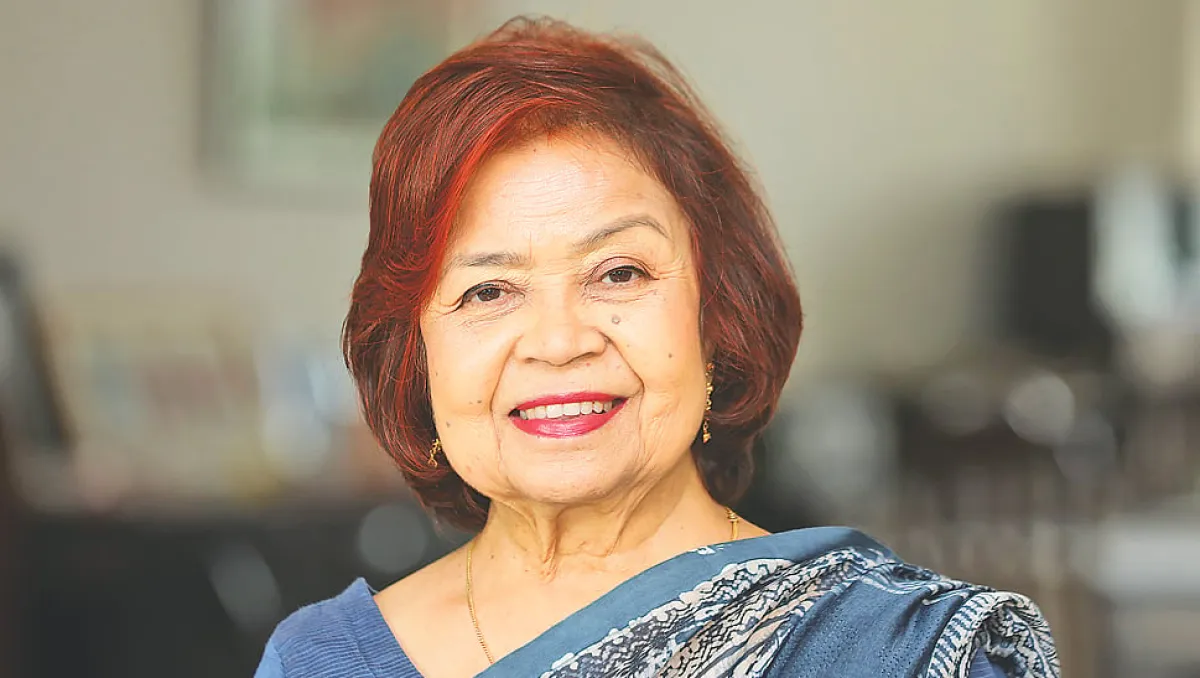
I met political scientist Rawnak Jahan on April 8, 2026, at his home in Gulshan. I got to know a lot about the past and present by talking to a close observer of the political policy of Bangladesh, the author of several research books on this subject, a PhD from Harvard, a teacher from Columbia University. We caught up with him as part of an event titled 'Crown Cement Experience Light'.
He was born on March 2, 1944, in Khatra, Bankura, West Bengal. But the roots of his identity were formed in various towns of East Bengal - Comilla, Bagerhat, Bhola, Munshiganj, Narayanganj. Traveling from one district to another due to his father's job, this childhood gave him a multidimensional experience. His father Ahmadullah was an honest government official; Uncompromising on questions of law and justice. It was in that environment that Ronak Jahan developed a sense of justice, logic and a deep commitment to education.
One childhood memory is particularly significant—his admission to a boys' school in Bhola. He was not allowed to sit in the class even though his father admitted him by circumventing the rules; They had to sit in a separate room during the exam only. This experience raises the question in her mind—can education be gender based? Later, her connection with feminist thought was born from the seed of this real experience.
Chintaharan Dey, a teacher at AVJM Girls School in Munshiganj, had a major influence on her life. She has experienced in her own life how a teacher's encouragement can build a student's confidence. That motivation earned her a place on the merit list, which is not just a personal achievement—a symbol of women's progress in the context of the times.
His educational career in Dhaka University through Eden College was to face another reality. Even in coeducational environments, there were invisible walls for girls—confinements to common rooms, shyness from speaking up in class, social surveillance. Yet he moves on, making his own place.
Transfer to Harvard University in 1965 changed his life. Linguistic discomfort, cultural differences, dietary problems—everything was a difficult start. But his conviction—'don't sink, swim'—keeps him going. He himself called the four years at Harvard a 'transformational time'. This is where he finds his voice, gains confidence.

Returning to the country after independence in 1973, she founded 'Women for Women' - one of the first organizations for women's research and thought in Bangladesh. The lack of data-based research on the reality of oppressed women, women's economic contribution, legal and social status in the post-liberation war motivated her in this initiative. According to him, any social change requires information first, then logic.
His analysis of Bangladesh's democracy is deep and realistic. He feels that the desire for democracy in the country has always been and is there. But the problem is institutionalization—a lack of rules, processes, and continuity of leadership. According to him, democracy is not something achieved overnight; It has to be practiced daily.
His views on women's movement are also clear. Not just protest, he thinks—what is needed is organized power, a broad social base. The movement is not sustainable unless it transcends the limitations of middle-class women and includes rural and working-class women. At the same time, men also have to participate in this fight.
His decision to remain single for a long time in his personal life was a conscious choice, due to his own independence and dedication to work. Later she got married to economist Rehman Sobhan. Their closeness is formed through long intellectual companionship, research and exchange of views. The core strength of this relationship remains mutual respect and exchange of ideas; Where intellectual friendship prevails.
His outlook on Bangladesh is optimistic. He believes that despite the various limitations, the creativity, solidarity and protest power of the people of the country will show the way for the future. According to him, our greatest asset is people. That man has proven time and again that change is possible.




