
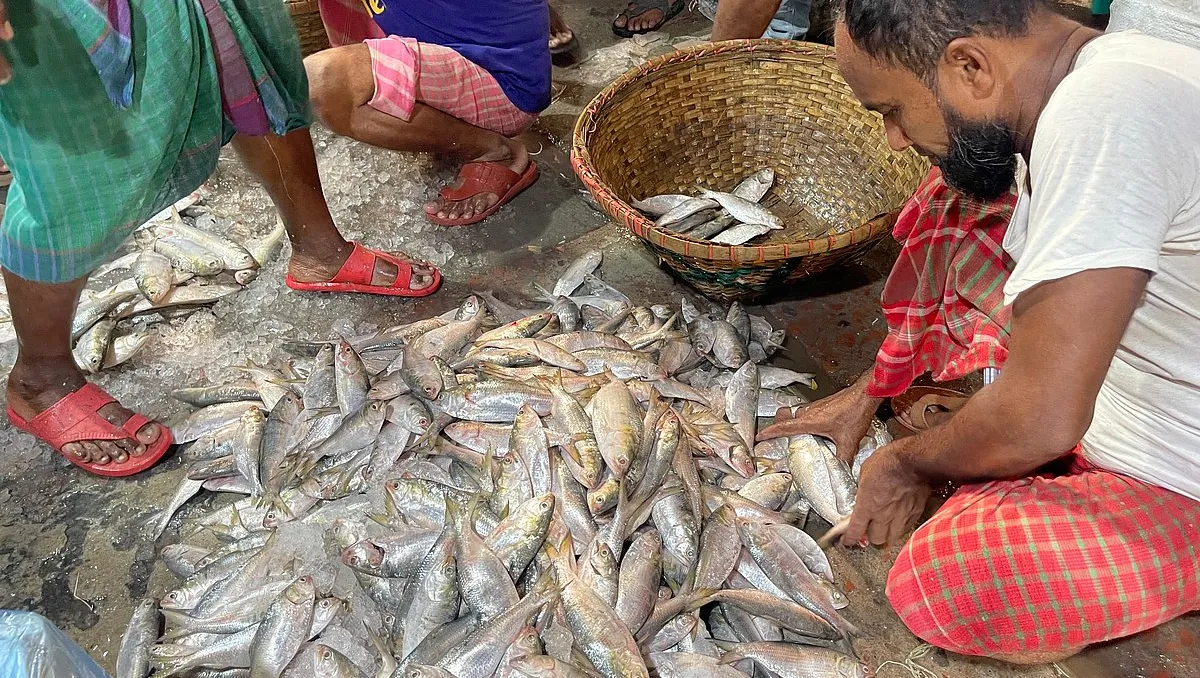
Hilsa production in the country has been decreasing for two years. Small size hilsa is mostly caught. The average size of hilsa caught from July to March is around 34 centimeters or 13 and a half inches. This average size of hilsa is less than an inch compared to last year.
The price of hilsa is also increasing year by year. According to the Directorate of Agricultural Marketing, the price of 400 to 900 grams of hilsa is now between Tk 1,500 and Tk 3,000 per kg in the Dhaka market, which is 50 percent higher than last year. In 2020, the average price of hilsa throughout the year was Tk 701 per kg.
Dhaka's caravan market fish seller. Suman told Prothom Alo on Sunday that a kilogram of hilsa around 900 villages is worth two and a half thousand taka. And small hilsa (400 grams) is being sold for 1.5 thousand taka per kg.
Hilsa is the national fish of the country. Mohammad Farasuddin, who served as Bangabandhu Sheikh Mujibur Rahman's personal assistant, told Prothom Alo in 2022 that in 1972, large hilsa was found in rivers in the war-torn country. Hilsa played a major role in meeting the animal meat needs of the poor people in the village. This is why hilsa is selected as the national fish.
That hilsa has gone beyond the reach of common people. Now the price of one kilogram of hilsa is equal to six days minimum wage of garment workers. 50 fish sold in the market (250 taka per kg) is 12 times the price of hilsa.
The government is spending a large amount of money to increase the production of hilsa. A five-year project is being implemented by the Department of Fisheries. This project of Tk 229 crore which started in July 2021 will end after two months; But production appears to be declining.
The purpose of this project named 'Hilsha Resource Development and Management Project' was to implement the Fisheries Conservation Act in the conservation of mother hilsa and jatka; Increasing hilsa production through shelter management; Creating alternative employment opportunities for the 30,000 fishermen families who collect jatka and mother hilsa; Distribution of 10 nets among the fishermen and creation of public awareness on the conservation of mother hilsa and jatka through publicity. There are allegations of irregularities in providing support to the jailer's family.
Hilsa production is decreasing during the implementation of the project. When the project was taken up in July 2021, the annual production of hilsa was 5 lakh 50 thousand tons. In the next two financial years, production increased slightly. In the last two fiscal years, production has declined. 5 lakh tonnes in FY 2024-25 (71 thousand tonnes less than FY 2022-23).
Molla Emdaduliah, Director of Hilsa Resource Development and Management Project of Fisheries Department, told Prothom Alo that the production of Hilsa increased after Jatka conservation, fishermen's alternative work organization and food aid started. The problem is that hilsa conservation activities were river-centric. There are no activities at sea. He claims that there is overfishing of Hilsa in the sea. On the other hand, the navigability crisis in the river has increased. There is no water in the river as before. As a result, the journey of hilsa has been damaged.
According to the Department of Fisheries, 28,000 artisanal trawlers (those that catch fish at a depth of less than 40 meters) and 268 industrial trawlers (trawlers that catch fish at a depth of more than 40 meters) fish in the sea. When industrial trawlers are not fishing in the deep sea, they catch jatka hilsa at a depth of 40 meters. Illegal fishing could not be stopped.

Six areas including Nijhum Island and Naf River have been declared sanctuaries to protect Hilsa in the sea. The project director also mentioned that those shelters could not be effectively protected.
A recent study by the Bangladesh Fisheries Research Institute shows that the average size of hilsa fish caught in three fiscal years is getting smaller. The average size of hilsa caught in the 2022-23 fiscal year was 14.65 inches. In the last financial year 2025-26, it has come down to 13.39 inches.
The smallest hilsa in average size was caught in Rajshahi district (11.42 inches). And the average size of Hilsa is available in Cox's Bazar (15.16 inches).
The research was conducted by Mohammad Ashraful Alam, Chief Scientific Officer, Fisheries Research Institute. He told Prothom Alo that the food plankton required for hilsa in the Padma and Meghna estuaries is decreasing dangerously, which is also affecting the shape of hilsa. Hilsa is not fast growing. On the other hand, they are caught in the fishermen's nets before they grow up.
According to the study, there are 27 species of plant particles (zooplankton) and 12 species of animal particles (phytoplankton) in the hilsa diet. The amount of these planktons has decreased by 68 percent in the Meghna River. The main reason is river pollution.
"Everybody catches jatka as they wish"
Hilsa matures in one to two years. A Jatka grows up to 11.81 inches in size when it lives for one year. A hilsa can grow up to 22.68 inches if it lives for five to seven years.
Iqbal Hossain, Secretary General of the National Fishermen's Association, believes that indiscriminate catching of jatka, i.e. small hilsa, is the reason for the decrease in production. He said to Prothom Alo, everyone takes jatka as they wish. There is not much hilsa to grow in the sea. He said that these jatkas were caught during the anti-jatka campaign of the government. No one seems to have any sympathy for Hilsa.




