
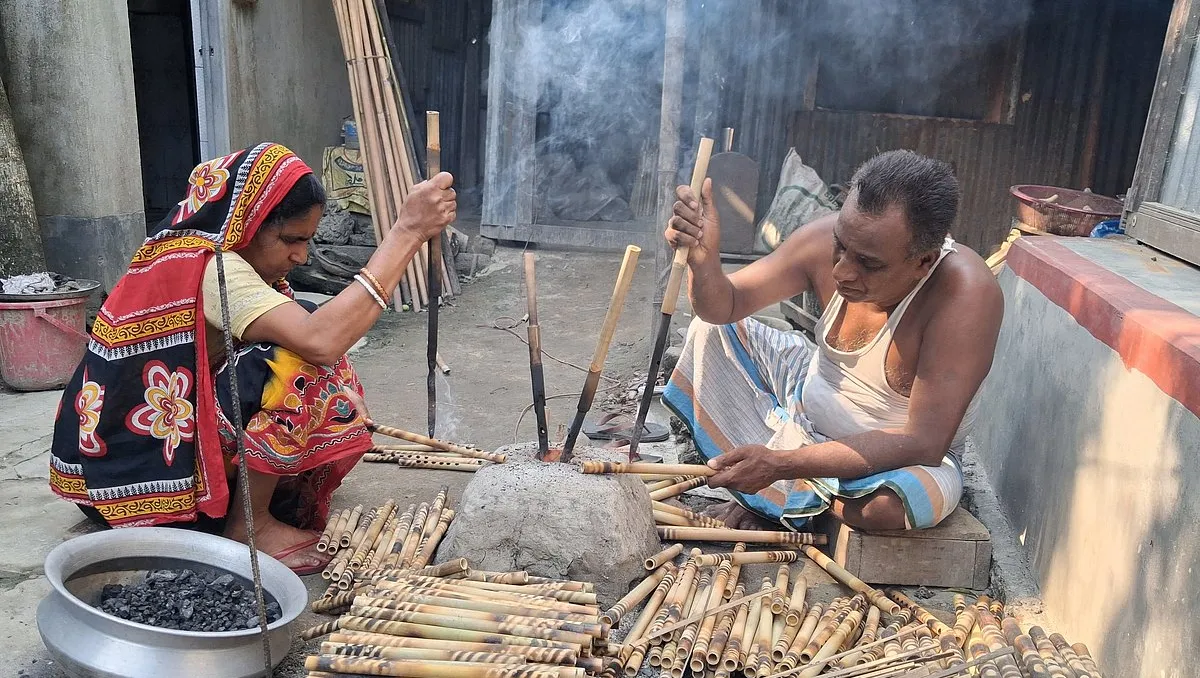
As you enter the village, the sound of the flute floats in—as if the story of an ancient craft is mixed in the air. The village residents have been making flutes for generations with a tradition of two centuries. Small muli bamboos, fire filters and flutes made by skillful hands are not only confined to the borders of the country, but are spreading to different parts of the world. Livelihood, art and passion – the village has come to be known as the 'Flute Village'.
Residents of Srimaddi village in Homna Upazila of Comilla have been doing this creative work of their ancestors for generations. At least 40 families of Srimaddi village are involved in making 14 types of flutes. Village men and women and even children do this work. The artisans of flute making are having a busy time ahead of Paola Baisakh. Traders from different parts of the country are flocking to the village to buy flutes.
According to senior residents, the tradition of making flutes started in Srimaddi village about 200 years ago. Kokil Das Bairagi and Dinbandhu Das of the village started the first flute making. They traveled to different states of India. From there they learned the process of making flutes and started this work. In the beginning, they made a small number of flutes and sold them by themselves. He himself could play the flute in a beautiful tone. Seeing them, others in the village learn this work. Later, the villagers have been making flutes for generations.
Jatindra Chandra Biswas (70) and his wife Reena Rani Biswas of Srimaddi village have been making flutes for a long time. He learned this work from his father Bhagwan Biswas in his childhood. Jatindra Biswas told Prothom Alo that his father learned flute-making from his grandfather Haricharan Biswas. His three daughters learned from him (Yatindra). They are now studying for graduation. After completing education, they will do this if necessary. Currently, his family is running on the income of making flutes. He said, earlier the flute market was very good. When the month of Chaitra came, the traders of Dhaka's Chawkbazar used to come and buy flutes. Now the demand has not increased but the price has not decreased.
Flute maker Abul Kashem (60) said he has been making flutes for 50 years. He learned this work from the work of his father and elder brother. His four children also learned this work along with education. Do this if you don't get a good job after your studies. Besides making flutes, he also sells flutes online at home and abroad. He can also play the flute well.
There are 13 to 14 steps to make a flute. It is mainly made of bamboo. The flutes are 13 to 20 inches long. First cut the radish and dry it. Later the bamboo mold (top cover) is removed. However, it is not done in case of arbansi. Scars are cut to pierce.
In case of abashi, different designs are made out of clay and filtered with fire. This causes the soil to dry out from the stem of the flute and the design emerges. A special type of chokha shik is used to pierce the flute. Later it is smoothed by rubbing with sirish and painted with paint. This is how the flute is made. It is then packaged and marketed.
Residents of Srimaddi village make different types of flutes. Flute makers said that here are made Abarbashi, Balloon Bashi, Mukha Bashi, Sanai Bashi, Kelenet Bashi, Pata Murali Bashi, Chota Nag Bashi, Big Nag Bashi, Pakki Bashi, Mohan Bashi, Tota Bashi, Tippera Fullt Bashi, Thrips Bashi, Telly Bashi. The flutes made by them go to several countries including France, Germany, Canada, Spain, Italy besides the domestic market.

Flute craftsman Abul Kashem told Prothom Alo that mouth flutes and flutes are highly valued abroad. These flutes are completely natural. Mohan banshi is in high demand in the country. He said that some traders in Dhaka take orders for flutes from abroad and provide samples to them for making them. They make accordingly. He thinks it is possible to send flutes widely abroad if government support is obtained.
Last Saturday morning, going to Srimaddi village, it was seen that flute making is going on from house to house. Someone is cutting muli (bamboo) into small pieces. Some are making holes in the flute with a hook, some are making designs on the flute with fire sprinklers. Someone is making designs in colors. He said that they do this work not only for livelihood, but also from the tension of the mind.
Senior flute maker Anil Biswas told Prothom Alo that at least 40 families of Srimaddi village are involved in making flutes. Women, men, children of all ages in the family—everyone at some stage or the other involved in flute making.
The flutes made in Srimaddi village go to different parts of the country. Apart from Dhaka's Chawkbazar, traders from different areas including Chittagong, Khulna, Rajshahi, Rangpur, Sylhet buy flutes from here. Besides, it also goes to different European countries outside the country. The price also varies depending on the type of flute. At the retail level, each flute is sold from Tk 10 to Tk 10,000. Generally, the crowd of traders is highest in the month of Chaitra ahead of the Boishakhi fair.
Raju Mia, a businessman of Triyashri village of Madan upazila of Netrakona, has come to Srimaddi village to buy flute. He said that he has been buying and selling flutes from Srimaddi village for 43 years. Youth are the real customers. Kids buy too. He has a shop in Dhaka. He buys and sells in shops throughout the year. He stays in Srimaddi village for six consecutive days and buys flutes for the Baisakhi fair.
Ratan Chandra Biswas, a flute maker, said that the price of flutes has decreased a little bit because of domestic and foreign plastic toys in the market. Still, traders from all over the country including Chittagong, Khulna, Rajshahi, Rangpur, Sylhet bought flutes. Flutes made by them are sold more in various fairs and events. Going abroad too. To increase the quality of flutes and send them abroad, government cooperation with bank loans is needed.
Homna Upazila Executive Officer (UNO) Md. Shahidul Islam told Prothom Alo that the residents of Srimaddi village should be encouraged to make flutes to maintain the local tradition. When they come, it will be discussed about how to cooperate in the matter of loans.




