Experts advocate for renewed focus on Euclid to strengthen foundations of modern scientific research
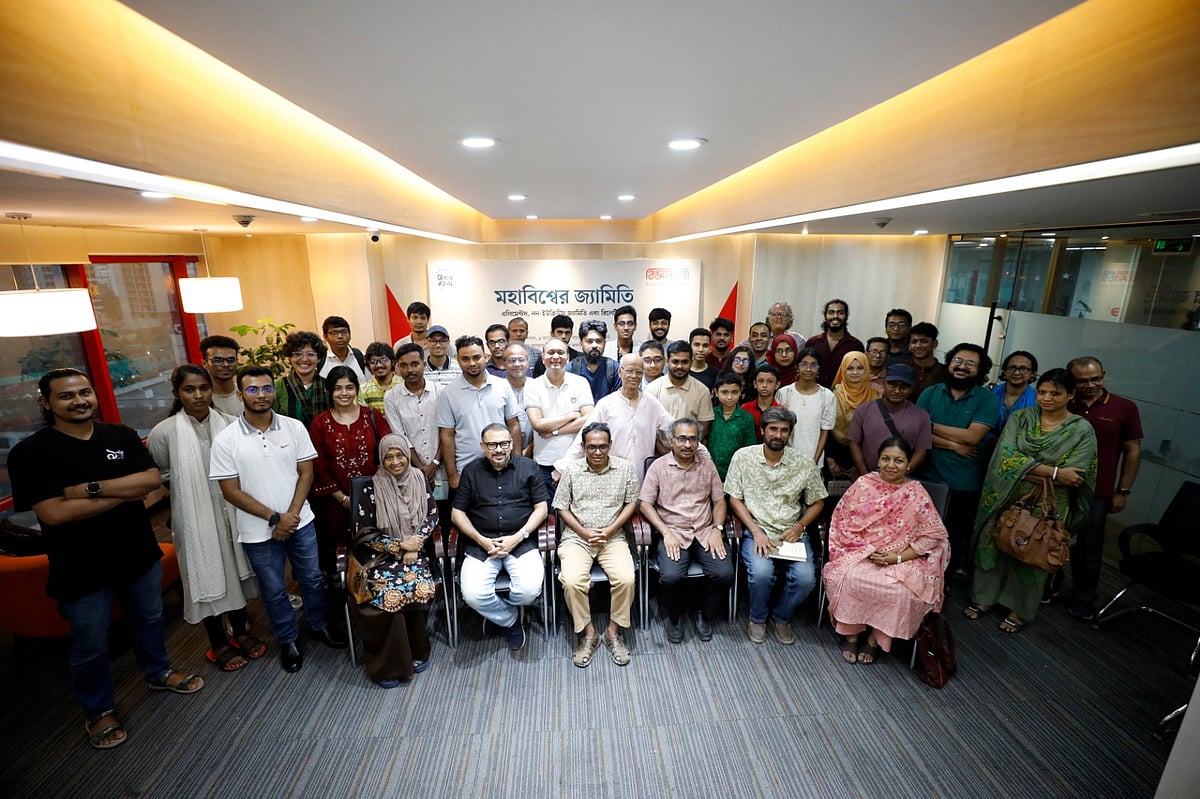
Photo Collected
Ancient Greek mathematician Euclid’s *Elements* remains a cornerstone of modern science and mathematics, providing the essential logical framework required for advanced research and discovery. This perspective was shared by science communicator and *Mahabritto* editor Asif during a lecture titled “The Geometry of the Universe: Elements, Non-Euclidean Geometry, and Relativity,” held recently at the First Light conference room in Dhaka. Organized by the popular science magazine *Bigganchinta*, the event brought together educators, students, and academics to explore the enduring impact of classical geometric thought.
Asif, who has spent decades analyzing the *Elements*, emphasized that the work’s true power lies not merely in its geometric results, but in its rigorous logical methodology. Building a system of 48 theorems upon just five postulates and five common notions, Euclid demonstrated how a vast body of knowledge can emerge from a few foundational principles. He argued that this structure is vital for scientific development, noting that luminaries such as Isaac Newton, Albert Einstein, Nicolaus Copernicus, Johannes Kepler, and Galileo Galilei all relied on the logical discipline established by Euclid to advance their own revolutionary findings.
The discussion also delved into the evolution of geometry through the 19th-century work of János Bolyai, Nikolai Lobachevsky, and Bernhard Riemann. By challenging Euclid’s “parallel postulate,” these mathematicians pioneered non-Euclidean geometry, which allowed for the exploration of curved spaces. This transition proved essential for the development of modern physics, most notably providing the mathematical language necessary for Einstein’s theory of general relativity. Asif expressed concern that current mathematics education in Bangladesh often overlooks these foundational proofs and logical structures, leaving students ill-equipped to engage with high-level theoretical research.
Adding to the discourse, Farshim Mannan Mohammadi, a professor of electrical engineering at the Bangladesh University of Engineering and Technology (BUET), highlighted the 2,300-year history of debate surrounding Euclid’s fifth postulate. He noted that the inquiry into whether this postulate could be proven from others—or if discarded entirely—led directly to the birth of modern abstract geometry. Professor Mohammadi observed that while such abstract mathematics may initially appear divorced from practical application, it serves as the backbone of contemporary explanations of space-time curvature and gravity.
Despite these advancements, Professor Mohammadi echoed concerns regarding the state of mathematics education in the country. He pointed to a declining interest in fundamental research in geometry and algebra, stressing that a robust environment for inquiry must be fostered if the next generation is to produce significant contributions to global science.
The lecture, moderated by *Bigganchinta* editorial team member Uchchash Tawsif, served as part of the magazine’s broader mission to cultivate a science-minded generation. According to *Bigganchinta* executive editor Abul Bashar, the magazine regularly hosts such events to promote logical reasoning and disseminate scientific knowledge in an accessible format. The program concluded with a science-themed quiz competition and a call for renewed commitment to foundational mathematical studies in academic institutions across the country.
0%
0%
0%
0%