Students across Bangladesh showcase innovative solutions in national science and startup exhibition
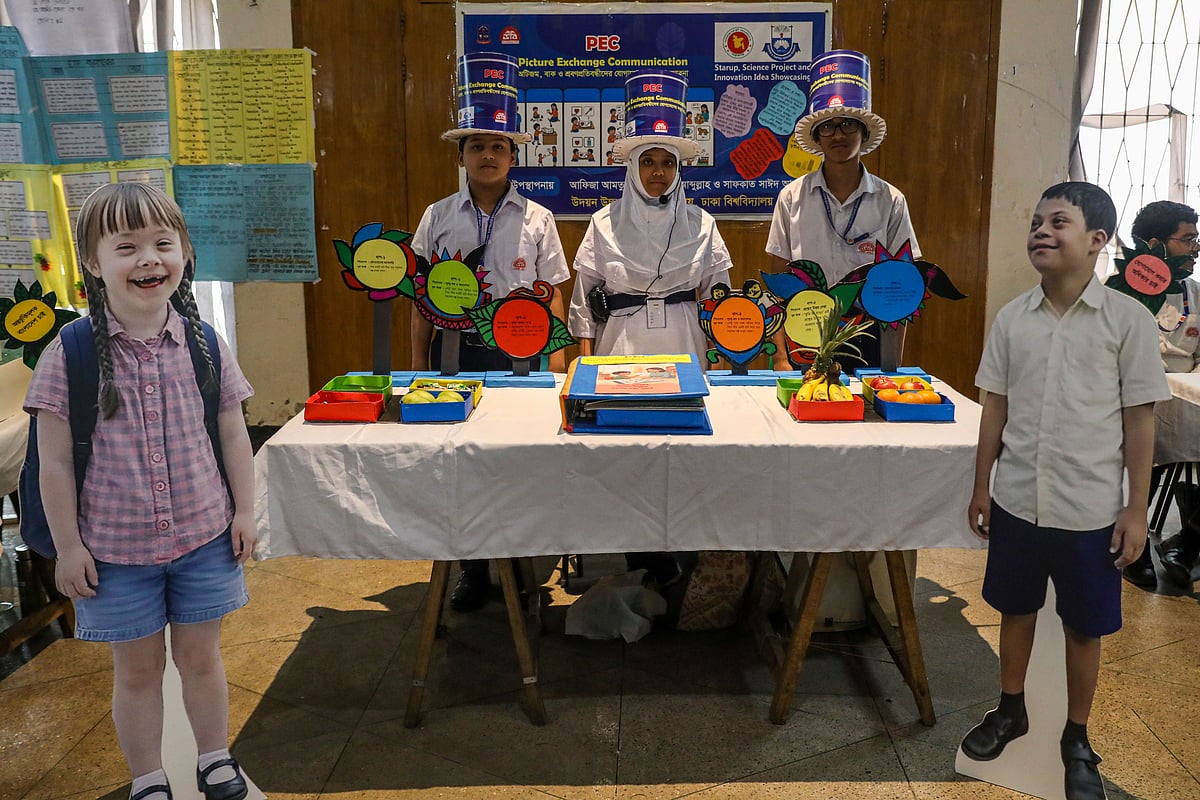
Photo Collected
Across Bangladesh, classrooms and auditoriums transformed into hubs of ingenuity on Friday as thousands of students from grades six through twelve showcased scientific projects and entrepreneurial concepts. The nationwide event, titled “Startup, Science Project and Innovation Idea Showcasing Program,” marked the inaugural phase of a massive initiative launched by the Ministry of Education’s Educational Excellence Support Scheme. Designed to move students beyond rote memorization, the program encourages creative problem-solving and technical proficiency across 520 sub-districts and metropolitan police stations.
Among the notable innovations was a communication system for children with autism and speech or hearing impairments, presented by students at Udayan Higher Secondary School in Dhaka. Their project, titled “Picture Exchange Communication,” utilizes a visual-based card system to help children express needs without expensive speech therapy. The initiative aims to provide an affordable, accessible solution for families, illustrating how grassroots creativity can address specific social challenges.
The scale of the participation highlights the program’s reach, involving students and teachers from approximately 30,000 educational institutions. Projects spanned a diverse range of fields, including agricultural technology, environmental conservation, and public safety. In Sylhet, for example, students from the Government Pilot High School engineered a specialized drone capable of capturing aerial data to assist in urban planning. In Rajshahi, another team developed a “save driving system” designed to mitigate traffic accidents, demonstrating a focus on practical, real-world utility.
The program is structured in three progressive tiers: local sub-district and station rounds, district-level competitions, and a final national exhibition. According to local education officials, the current phase serves as a rigorous selection process, with top-performing teams advancing to the district level. This sequence will culminate on June 28 at the China-Bangladesh Friendship Conference Center in Dhaka, where the top ten teams will be selected for national honors.
Beyond the competition, the initiative seeks to redefine the role of the modern school. As emphasized by local government officials during various regional inaugurations, the goal is to transform educational institutions into centers for developing skilled human resources capable of navigating a globalized economy. By moving from theoretical studies to the development of prototypes—ranging from rainwater harvesting systems to waste-to-energy concepts—the youth are positioning themselves as the architects of Bangladesh’s future technological and economic landscape.
0%
0%
0%
0%