US President Breaks Protocol to Welcome Chinese President Xi Jinping in Washington
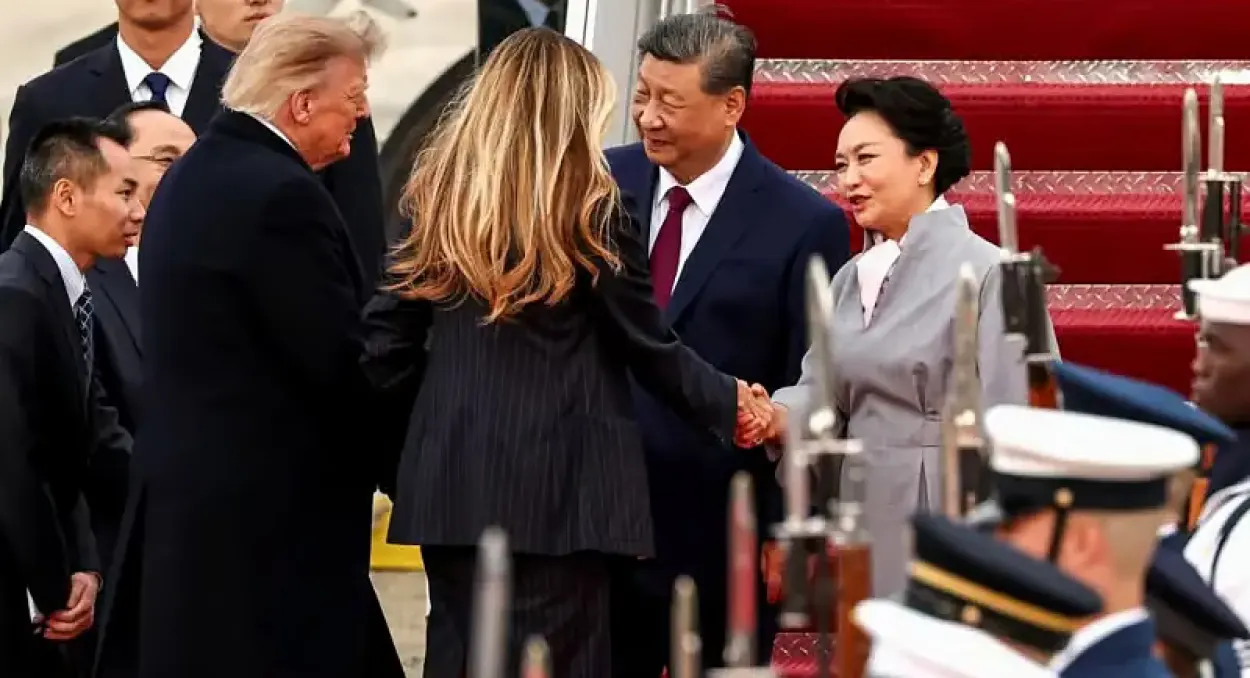
Photo: Collected
Chinese President Xi Jinping arrived in Washington on a three-day state visit, marking a critical test for relations between the world's two superpowers amid ongoing tensions over trade, technology, Taiwan, and Iran.
Upon his arrival at Joint Base Andrews in Maryland on Wednesday, President Xi and his wife, Peng Liyuan, were welcomed by United States President Donald Trump and First Lady Melania Trump. According to United States broadcaster C-SPAN, it marks the first time in approximately 11 years that a United States president has personally welcomed a foreign head of state at Joint Base Andrews, a protocol last observed in 2015 when then-President Barack Obama welcomed Pope Francis. The arrival ceremony featured a military band, a 21-gun salute, and a flyover by B-1 bombers, followed by formal handshakes and brief remarks between the leaders and their spouses.
This visit, Xi's first to Washington in nearly three years, comes as the two nations navigate persistent geopolitical friction. Analysts do not anticipate major breakthroughs from the summit, but expectations are high for an extension of the 11-month-old bilateral trade agreement. United States Treasury Secretary Scott Bessent stated on Fox News' "Special Report" that both countries have reached an agreement to extend the trade pact through January 10, avoiding an expiration date that was previously set for November 10.
A limited trade truce between Beijing and Washington could provide much-needed relief to global markets, which experienced severe volatility following the 2015 tariff disputes that saw retaliatory levies reach triple digits between the two economies.
Despite the trade extension, deep-seated disagreements remain. Key friction points include export controls on rare earth minerals and computer chips, Beijing-Tehran relations, and United States support for Taiwan. Officials familiar with the preparations indicate that President Xi is expected to reiterate Beijing's territorial claims over Taiwan during talks with President Trump, though Washington is widely expected to sidestep the issue. Concurrently, President Trump is likely to maintain stringent export controls on Chinese goods, despite objections from Beijing.
The summit takes place as President Trump faces widespread dissatisfaction over the ongoing conflict involving Iran, while President China navigates various domestic economic challenges alongside a resilient trade sector, allowing President Xi to approach the visit from a position of relative strength. Furthermore, it remains unclear whether Beijing will assist Washington in resolving the Middle East stalemate stemming from the Iran conflict. The two leaders are also expected to discuss artificial intelligence amid intense technological competition between the two nations.
While the Chinese embassy in Washington did not immediately comment on the developments, a statement released by the mission quoting President Xi emphasized that China and the United States should be partners rather than rivals, though the release did not explicitly address the trade agreement. Meanwhile, within the United States, several figures from the ruling Republican Party view China as a fundamental national security threat, fueling domestic anxiety regarding President Trump's engagement with the Chinese Communist Party.