
Rising Crime Wave Grips Dhaka as Professional Syndicates Evade Justice
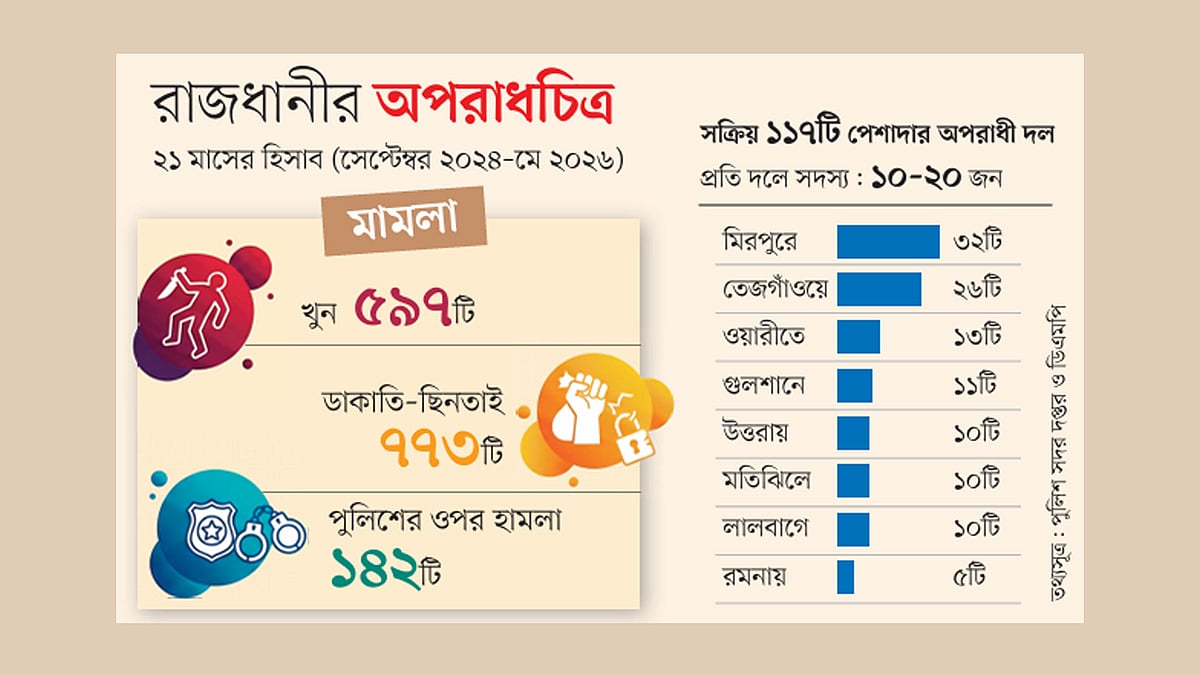
Photo Collected
A persistent wave of violent crime, including public shootings and armed robberies, is sweeping through Dhaka, raising urgent questions regarding the efficacy of law enforcement. Despite a steady stream of arrests, police struggle to dismantle organized criminal syndicates, often failing to reach the masterminds behind these operations. As a result, the cycle of violence remains unbroken, with new incidents frequently surfacing across the capital.
Data from Police Headquarters indicates that between September 2024 and May 2025—a 21-month span—597 murder cases were filed in Dhaka. Among these, at least 11 killings were directly linked to territorial control within the criminal underworld, claiming the lives of four “top-tier” terrorists. Over the same period, 773 cases of robbery and mugging were recorded, though police officials acknowledge that the actual number is likely far higher, as many victims opt against filing formal complaints due to bureaucratic hurdles or fear of retaliation.
The Dhaka Metropolitan Police (DMP) maintains a database identifying 117 professional criminal gangs operating within the city. Each group consists of 10 to 20 members specialized in contract killing, robbery, and extortion. While these lists include the identities of both the foot soldiers and their influential patrons, critics argue that authorities only take decisive action when a crime gains significant traction on social media or in news outlets.
A recurring pattern in these investigations is the lack of finality. In several high-profile mugging cases, suspects were identified but investigations stalled, allowing those released on bail to return to criminal activity. Furthermore, law enforcement personnel themselves have become targets, with 142 attacks on police reported in Dhaka during the same 21-month window. In one instance this past June, the officer-in-charge of Adabar Police Station was slashed by members of a notorious local gang while attempting an arrest.
The struggle to contain crime is compounded by the aftermath of the July 2024 mass protests and the subsequent political transition in August, which significantly disrupted police operations. While DMP officials maintain that the situation is improving through increased patrols and “block raids,” they acknowledge that the force is overstretched by managing political and social programs.
“We are under immense pressure,” said DMP Additional Commissioner S.N. Nazrul Islam. “Oftentimes, a new incident occurs before we have finished investigating the last one, making it difficult to maintain focus and follow-through.”
Expert observers and former high-ranking police officials suggest that the crisis stems from a lack of accountability and a failure to pursue the “godfathers” who orchestrate these crimes. While technical surveillance and CCTV footage often lead to the apprehension of low-level perpetrators, the masterminds—many of whom are reportedly based abroad—remain beyond the reach of the law.
Former Inspector General of Police Abdul Qayyum emphasized that the current situation requires a complete overhaul of police leadership’s approach. He noted that without stringent supervision and a culture of accountability for officers tasked with investigations, the capital’s volatile criminal landscape will remain difficult to stabilize. As families of victims continue to express frustration over the slow pace of justice, the recurring trend of suspects securing bail and returning to the streets underscores the systemic fragility in Dhaka’s criminal justice response.
0%
0%
0%
0%