
Proposed Laws on Human Rights and Disappearances Criticized for Shielding Security Forces from Independent Investigation
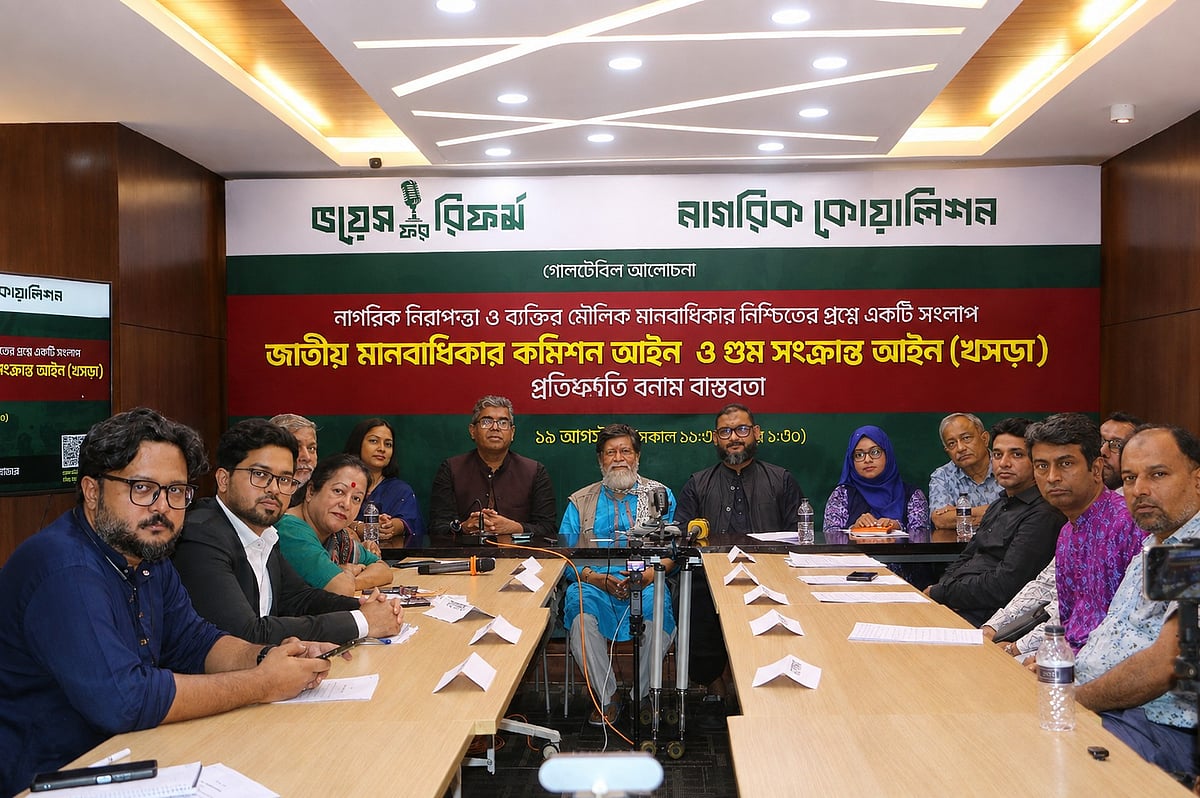
Photo Collected
Human rights activists and legal experts have expressed grave concerns that three proposed pieces of legislation—governing the National Human Rights Commission, anti-enforced disappearance measures, and the Rapid Action Battalion—effectively undermine independent investigations into security forces. During a dialogue titled “National Human Rights Commission Act and Anti-Enforced Disappearance Act 2026: Promises vs. Reality,” speakers argued that the draft laws suggest a systemic effort to shield security personnel from accountability, thereby obstructing the path to justice.
The event, held on Wednesday at the BDBL Bhaban in Karwan Bazar, Dhaka, was jointly organized by the Citizens’ Coalition and Voice for Reform. Human rights defender and former member of the Commission of Inquiry on Enforced Disappearances, Nur Khan Liton, warned that authorizing law enforcement agencies to investigate allegations against their own ranks is inherently flawed. He specifically criticized the proposed oversight mechanisms for the Special Response Battalion, noting that they fail to create a framework for credible, independent inquiry.
Liton further cautioned that reforming the law alone is insufficient to guarantee the independence of the National Human Rights Commission. He emphasized that the government’s influence over the appointment process poses a significant threat to the commission’s autonomy, urging the state to appoint individuals of integrity and courage rather than those susceptible to political pressure. He noted that national security and sovereignty have long been used as pretexts to conceal enforced disappearances.
Former commission member Nabila Idris, who presented the keynote paper, highlighted that of the more than 1,500 complaints received regarding disappearances, approximately 250 had been substantiated. She pointed out that progress had historically been stalled by the police’s refusal to file reports or register formal complaints.
Prominent activist and photographer Shahidul Alam argued that security forces have been exploited for political agendas rather than serving their intended purpose of public protection. He urged the current government to resist following the patterns of its predecessors, warning that failing to ensure professional accountability would betray the sacrifices made during the July uprising.
Member of Parliament Mir Ahmad Bin Quasem Arman criticized the government for ignoring prior promises to hold parliamentary discussions on the draft legislation. He stated that the current drafts indicate that the “deep state” remains a significant barrier to reform. Quasem asserted that enforced disappearance is a non-partisan issue and vowed to mobilize opposition efforts to block the passage of laws that lack meaningful accountability, stating that victims and the public must stand united to prevent the consolidation of power through these statutes.
Former Chief Prosecutor of the International Crimes Tribunal, Tajul Islam, questioned the feasibility of justice under the proposed framework, rhetorically asking, “If the perpetrator is the investigator, how can justice be served?” He urged the government to send the drafts back for reconsideration, as they violate fundamental principles of law by granting investigating powers to the very entities accused of wrongdoing.
Other participants, including AB Party Chairman Mujibur Rahman and youth activist Tajnuva Jabeen, echoed these concerns. Jabeen pointed out that while a 2025 ordinance had removed the defense of “following superior orders” for committing crimes, the 2026 draft appears to reintroduce such loopholes. The participants collectively called for a unified movement to prevent the passage of these laws in their current form, demanding independent, transparent, and objective investigation protocols. The event was moderated by Voice for Reform co-coordinator Fahim Mashrur.
0%
0%
0%
0%
More News from Local