



Khulna gripped by entrenched drug trade fueled by political influence and law enforcement complicity
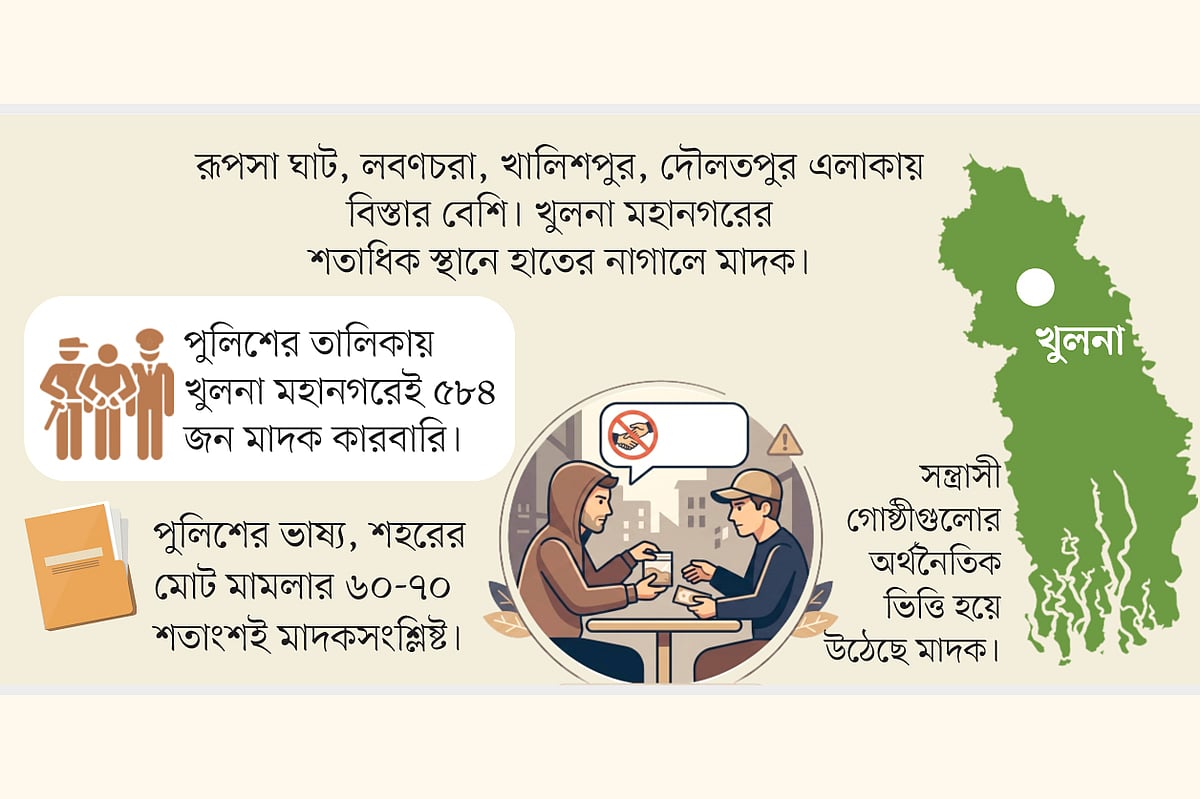
Photo Collected
Khulna has emerged as a significant hub for the narcotics trade, where the distribution of illegal substances has become deeply ingrained in the city’s social and criminal landscape. What begins as a seemingly routine gathering at locales like the Rupsha River ghat frequently shifts into an open-air marketplace for illicit drugs as night falls. Local residents and officials report that the trade, fueled by both professional criminal syndicates and the lure of quick profits, has permeated over 100 neighborhoods across the city, including Khalishpur, Harintana, Sonadanga, Labanchara, and Daulatpur.
According to the Department of Narcotics Control (DNC) and local law enforcement, the illicit trade operates through a decentralized, mobile network. Rather than relying on static dens, traffickers now utilize mobile communication, motorcycle couriers, and rickshaws to deliver narcotics directly to users. This agility makes traditional law enforcement methods increasingly ineffective. DNC data indicates that 95 percent of drug seizures in the region involve only the carriers, as major shipments are rapidly subdivided and transferred, leaving the masterminds and financiers—who often operate with significant political or social influence—largely untouched.
বিজ্ঞাপন
The integration of narcotics into the regional economy is profound. Beyond individual addiction, the proceeds from the drug trade serve as a critical financial engine for local criminal gangs. Funds generated from the sale of substances like Yaba are reportedly used to finance armed groups, cover legal fees, and secure political patronage. Investigations reveal that the trade is tightly controlled by a small cadre of influential figures who rarely face prosecution, while arrests are predominantly restricted to low-level street dealers, laborers, or addicts.
Concerns regarding the efficacy and integrity of law enforcement remain central to the crisis. While Khulna Metropolitan Police maintain a list of 584 known drug dealers, critics argue that the lack of progress in curbing the trade stems from a combination of professional apathy, political interference, and, in some instances, complicity. Internal police records have highlighted instances of officers exhibiting unprofessional conduct, such as failing to apprehend known criminals when encountered, and allegations of some personnel maintaining illicit ties with traffickers. A recent incident involving a police constable arrested in Chittagong with 50,000 Yaba pills while en route to Khulna has further strained public confidence.
বিজ্ঞাপন
The judicial process faces its own systemic hurdles, with over 8,000 drug-related cases currently pending across the Khulna division. High acquittal rates, coupled with weak investigative procedures and the tendency for defendants to return to criminal activities while out on bail, have created a cycle of impunity. Experts note that the confluence of organized crime, political protection, and police inaction has formed a dangerous “triangle” that sustains the trade.
As the narcotics network continues to evolve, adapting to avoid detection while entrenching itself in the city’s labor and transport sectors, the human cost continues to mount—manifesting in rising family violence, street crime, and social instability. For local observers, the reality is clear: until the financial and political structures supporting these syndicates are dismantled, the flow of drugs through Khulna will continue to serve as the primary fuel for the region’s growing criminal economy.
0%
0%
0%
0%


