



Farmers using boats and scythes in the submerged paddies are making a last ditch effort to at least raise food for the house
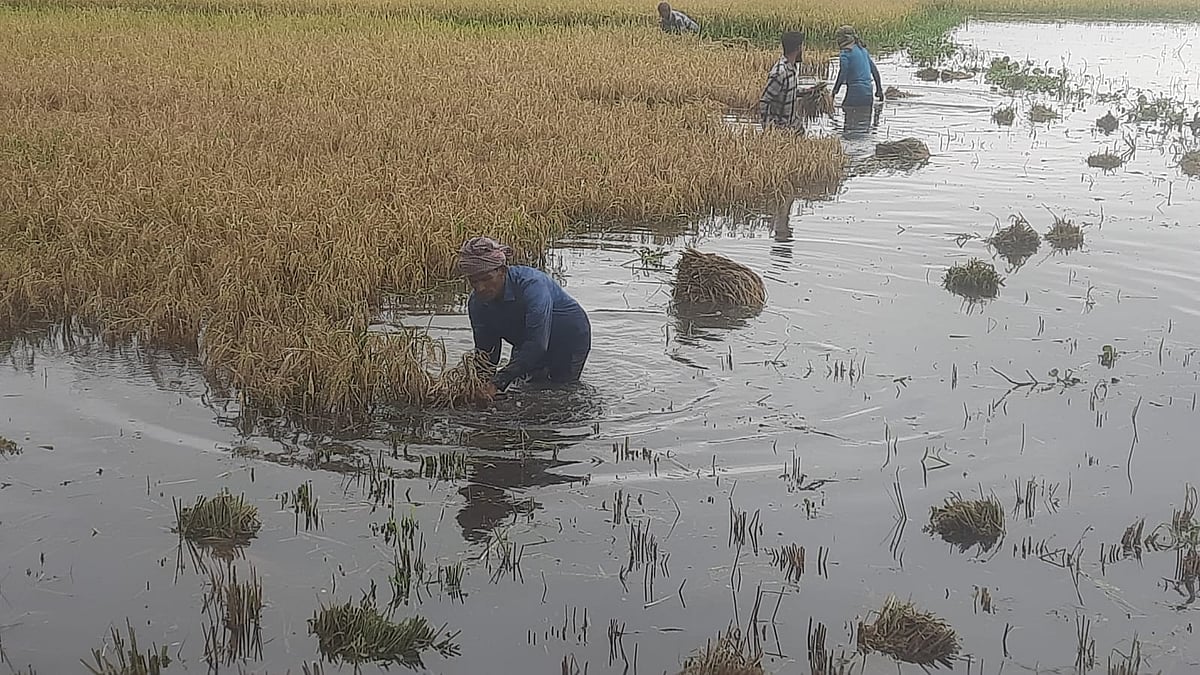
Photo Collected
“I would have been happy if I could raise some rice to feed the house because of the dry paddy. Now I am trying to at least raise food for the house.” Ramzan Ali (55), a farmer of Bill Howar, Singh, Sujatpur, Baniachong Upazila, Habiganj, spoke in his local language.
Like Ramzan Ali, thousands of farmers in Habiganj’s Haor area now have only one effort – to bring home at least the rice for the family’s food from the submerged land.
বিজ্ঞাপন
Incessant rains, floods coming down from upstream and rising water of Surma-Kushiara river have submerged the vast Haor area of Habiganj. According to the district agriculture department, about 45 percent of the boro land in the six upazilas is under water. 10 to 12 thousand hectares of rice has been damaged. The affected farmers are about 20 thousand.
More than 200 mm of rain has fallen in the district in the last one week. Along with this, the water from Kishoreganj and Sunamganj has flooded various haors of Baniachang, Ajmiriganj, Lakhai, Nabiganj, Bahubal and Habiganj Sadar upazilas. Gungiajuri Haor, the largest in the district, is similarly submerged.
বিজ্ঞাপন
This Sunday morning, going to Singh’s Bill Howar in Sujatpur Union of Baniachong Upazila, it was seen that there was only water and water all around. In some places the rice ears are floating, in some places the entire field is submerged and only the heads of the ears are visible. The same picture is also seen in nearby Paylarkandi, Mandari and Howar of Makrampur Union. Small canoes across Haor’s chest. Farmers are harvesting paddy standing or sitting on it. Someone wades into waist-deep water and wields a sickle. There is no way to understand the cropland below.
Shatmukha village farmer Shamchu Mia (50) was cutting paddy with a wet towel on his head. He said, “Brother, I never thought to cut rice like this. The land is not visible, I am cutting it by guess.
Saidul Haque was cutting paddy sitting on a boat in the same area. Sometimes the boat sways with the waves, but the work does not stop. He said, if the water had come after 7 to 10 days, then at least it would have been possible to harvest the rice for home consumption. Now it has become difficult to pick up the sunken paddy due to the labor crisis.
At the other end of Haor, some people were harvesting paddy in groups. One is cutting, another is lifting the boat. Competition with time in their eyes. A farmer said, ‘I have been working for this land for a year. Now if everything drowns in water, how will the family survive?’
Ayub Ali, a 60-year-old farmer, was watching the scene while sitting on a boat. He said, ‘Haor people know how to fight with water; But this time the water came very quickly. It is difficult to recover this loss.
Nirmal Kumar Biswas, director of the Climate Adaptation Project of the private development organization ‘ASD’, said that their survey showed that six upazilas of the district have suffered major damage due to early floods. In the beginning some farmers could harvest paddy but not more than 25 percent. According to him, short-duration rice varieties and cultivation following the advice of the Agriculture Department could have reduced the damage to some extent.
Dipul Kumar Pal, additional deputy director of the district agriculture extension department, said that 1 lakh 23 thousand 644 hectares of land has been cultivated in Habiganj this season. A significant part of this is in Haor area. However, 10 to 12 thousand hectares of paddy has been damaged due to the sudden increase in water. He said that the full calculation of the damage is still going on.
0%
0%
0%
0%