


Beyond the Uprising: The Urgent Need for Structural Reform and Social Democracy in Post-Revolution Bangladesh
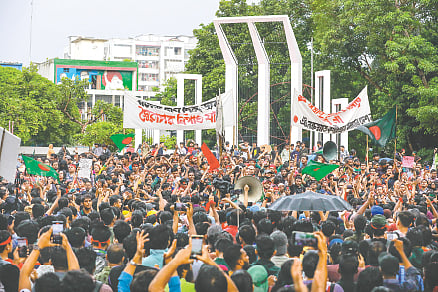
Photo Collected
The July 2024 mass uprising in Bangladesh was forged in the crucible of profound sacrifice, characterized by moments that laid bare the desperation and resolve of a population pushed to the brink. Among the enduring memories of that month is the image of an elderly rickshaw puller in Malibagh, who, on the morning of July 19, confronted police gunfire with a chilling equanimity. When urged to seek safety, he famously remarked that dying might be less painful than the life he was currently forced to lead. This sentiment captured the visceral turning point of a movement that quickly transcended student protests to become a national mandate against the entrenched authoritarianism of the Sheikh Hasina administration.
The trauma of those days was perhaps most visible at the Dhaka Medical College Hospital, where the sheer volume of casualties overwhelmed the facility’s capacity. Morgues overflowed, and medical staff worked to the point of physical collapse, surrounded by an endless stream of the injured. For those witnessing the carnage, the experience became a catalyst for absolute defiance, marking the transition from a protest movement to an irreversible crusade for the regime’s collapse. By the time the “Drodhojatra” (March of Defiance) took place on August 2, the momentum had become unstoppable, as thousands of citizens reclaimed the streets and rendered the security apparatus ineffective.
বিজ্ঞাপন
However, the aftermath of the uprising has revealed a complex and sobering reality. While the movement successfully dismantled a long-standing autocratic regime, the anticipated transformation of the state into a transparent, accountable, and humanitarian entity remains incomplete. In the vacuum created by the sudden power shift, the nation has grappled with the resurgence of revenge politics and extremist ideologies. Political institutions, weakened by years of systemic erosion, were ill-equipped to facilitate a smooth transition, leading many factions to prioritize immediate political expediency over the foundational task of structural reform.
The persistence of a “culture of retribution” has further complicated the recovery. Driven by years of suppression, this impulse for vengeance acts as a poor substitute for the rule of law, often fueling cycles of conflict rather than justice. In this fragile landscape, extremism—whether religious, political, or ideological—has found fertile ground by exploiting deep-seated social divisions and framing the political climate in binary, antagonistic terms. Such polarization threatens to stifle the democratic discourse essential for a pluralistic society like Bangladesh, which derives its strength from a diverse tapestry of religious, ethnic, and professional identities.
বিজ্ঞাপন
As the nation charts its future, the necessity for a robust social democracy has become paramount. This approach seeks to harmonize individual liberty, free elections, and a fair judiciary with economic inclusion and social justice. Addressing the country’s core crises—rising inequality, youth unemployment, and the stark disparity between rural and urban development—requires moving beyond simple GDP growth toward a state that views citizens as rights-holders rather than mere voters.
The legacy of the July uprising serves as a stark reminder that the state is not the property of any single individual or party, but a collective institution governed by law. The path forward demands an abandonment of personality-driven politics in favor of institutional integrity, where dissent is protected and democratic competition is the sole arbiter of power. While the rise of extremism has triggered widespread concern, the resilience shown during the uprising suggests a latent, potent energy within the populace. Transforming that energy into a stable, equitable, and democratic state remains the unfinished work of the revolution, a struggle that continues as the country decides between the politics of vengeance and the promise of a truly inclusive nation.
0%
0%
0%
0%