
Legendary Singer Ferdousi Rahman Launches Memoir in Dhaka
Legendary Singer Ferdousi Rahman Launches Memoir in Dhaka
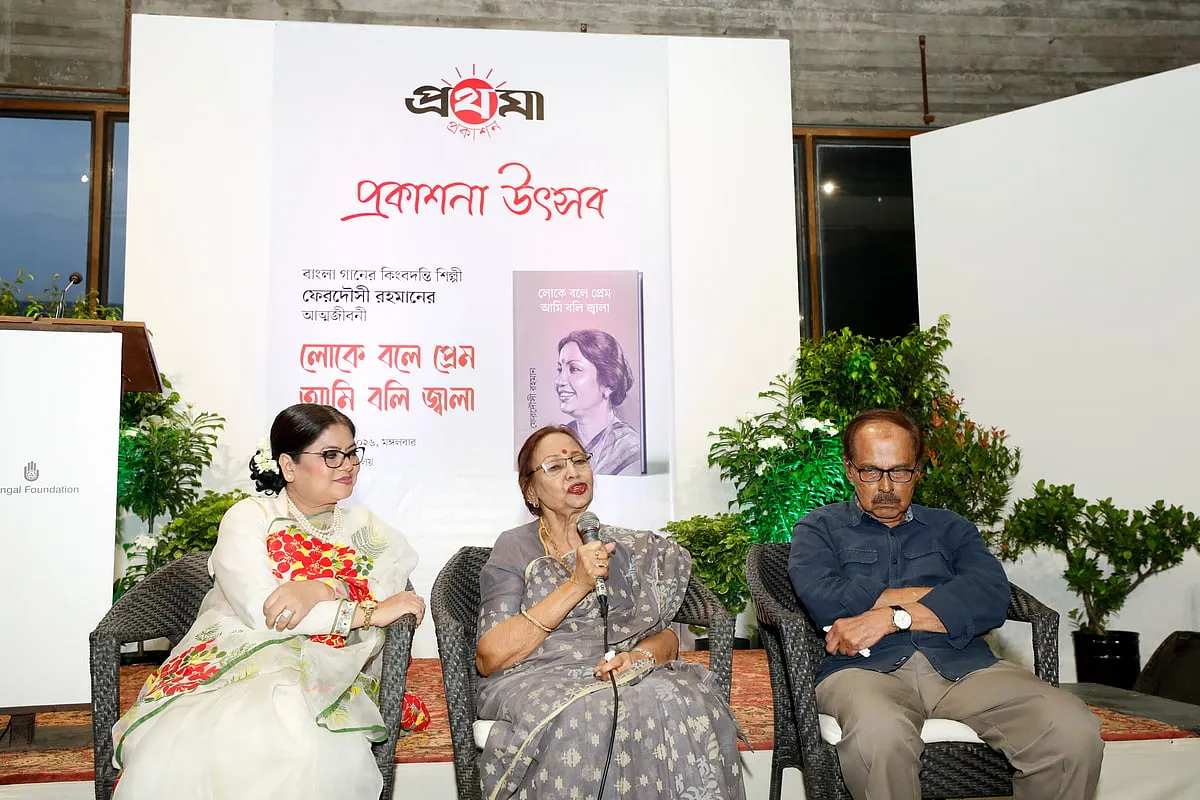
Legendary Bengali vocalist Ferdousi Rahman unveiled her autobiography, "Loke Bole Prem, Ami Boli Jwala," during a rain-swept afternoon gathering at Bengal Shilpalaya in Dhaka on Tuesday. The event brought together luminaries from the realms of music, literature, and culture to honor a career that has defined a generation of Bengali music.
Published by Prothoma Prokashan, the book’s title—derived from the lyrics of one of her most iconic songs—serves as a metaphor for her journey. During the launch, Rahman explained that for her, music is life itself, representing both the "love" (prem) she holds for the craft and the arduous "torment" (jwala) required to master it.
Fellow music legend Syed Abdul Hadi, a longtime contemporary who shared his debut duet with Rahman in the 1965 film "Dakbabu," reflected on their enduring bond. Recalling their shared experiences as students at the University of Dhaka in the late 1950s, Hadi noted that Rahman’s poise and disciplined persona remained constant throughout her rise to fame. He lauded her artistic versatility, attributing her success to both her innate talent and the early tutelage she received through her father, the illustrious folk icon Abbasuddin Ahmed.
The atmosphere was marked by deep appreciation for Rahman’s multifaceted contributions to the arts. Renowned singer Kanak Chapa described Rahman as an "incomparable" figure in the subcontinent, calling her the "Himalayas" and the "Jamuna River" of the Bengali music tradition for her mastery across modern, Nazrul Sangeet, classical, and folk genres.
In her remarks, Rahman expressed profound humility, voicing her surprise and gratitude at the large turnout for a book launch rather than a musical performance. She noted that her autobiography serves as more than a personal memoir; it acts as a cultural repository, preserving memories of a bygone era in Dhaka, including vanished traditions, culinary histories, and the social fabric of the city.
Matiur Rahman, editor of Prothom Alo and publisher of the work, highlighted the depth of the narrative, noting that the book chronicles the history of the region alongside the artist’s own story. He lauded her not only as a preeminent musician but as a trailblazing student who achieved academic excellence in the mid-20th century. He concluded that the book itself has become an essential artifact of the nation's heritage, cementing Ferdousi Rahman's legacy as both a cultural icon and a chronicler of her time.