

Maya Angelou, Rabindranath Tagore: From Caged Bird to Free Flight
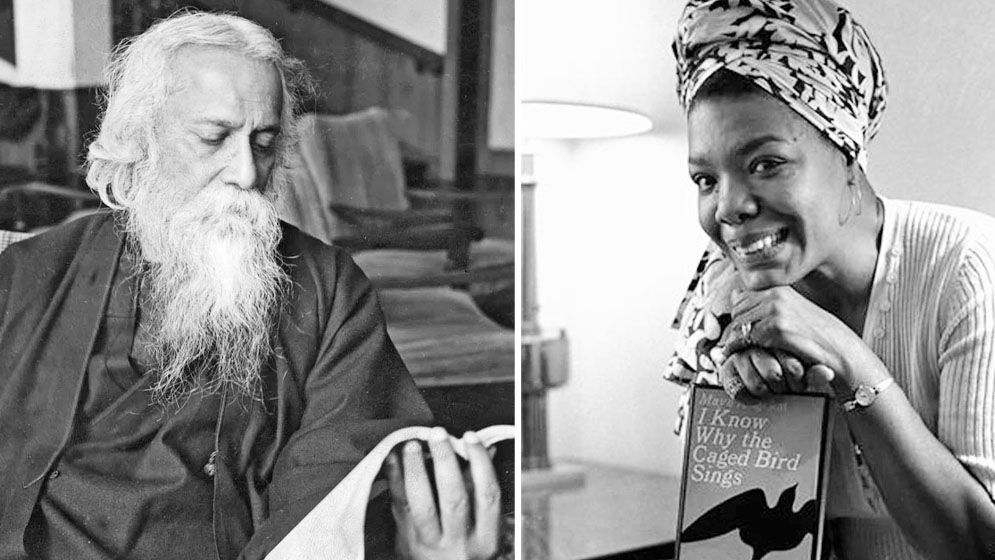
Photo Collected
Award-winning American poet, memoirist, and civil rights activist Maya Angelou, whose defining autobiography “I Know Why the Caged Bird Sings” chronicled her early experiences with racism and oppression, remarkably echoed themes found in Rabindranath Tagore’s 1892 poem “Two Birds,” despite being separated by continents, eras, and vastly different backgrounds. Their shared narratives of childhood confinement and a yearning for freedom highlight a profound, universal struggle against societal and personal cages, inspiring a collective call to rise above adversity.
Angelou (1928–2014) and Tagore (1861–1941), creators from different corners of the Earth, were distinct in class, race, gender, and language. Yet, the formative experiences of their early lives, marked by a sense of being caged, resonated deeply with both, leaving a legacy that urges individuals to embrace the spirit of “And still I rise” and dedicate their lives to the pursuit of liberation.
বিজ্ঞাপন
At the tender age of three, Maya and her elder brother, Bailey, were sent by their divorced parents to live with their grandmother, who ran a store with her disabled son. Young Maya grew up contending with parental neglect, struggling with self-doubt, and simmering with anger at the overt racism of white society and her grandmother’s resigned acceptance of it.
When Maya was seven, her mother brought the siblings to live with her. At eight, Maya endured sexual assault by her mother’s boyfriend, who was later murdered. This traumatic event silenced Maya, trapping her in a cage of doubt and guilt.
বিজ্ঞাপন
Amidst this turmoil, Maya found solace and mentorship in Mrs. Flowers, who opened up the world of literature to her, introducing books as lifelong friends. However, the sting of prejudice remained; a local dentist refused to treat her solely because of her skin color.
Years before writing her seminal work, Maya spent time with her father, only to experience physical abuse from his girlfriend. This prompted her to leave home, living among homeless youth. Before high school entrance exams, she secured a job as a streetcar conductor, becoming San Francisco’s first Black female conductor. Subsequently, she became pregnant, and her boyfriend abandoned her. Following Bailey’s advice, she concealed her pregnancy, took her exams, and passed.
The turbulent teenager transformed into a nurturing mother, giving birth to a son. The “caged bird” Maya began to sing, her voice echoing through her work as a dancer, author, university professor, administrator, and successful film director.
Inspired by Martin Luther King Jr., Angelou became a leading voice in America’s civil rights movement for Black women. Yet, even her dazzling achievements could not erase the memories of her caged childhood.
Remarkably, 91 years before Angelou’s autobiography, Rabindranath Tagore, at 31, penned “Two Birds” in 1892, exploring the dichotomy of the “caged bird” and the “forest bird.” While Tagore’s childhood was vastly different from Angelou’s, marked by privilege and education, he too felt a profound sense of confinement.
In his memoir “Jibonsmriti” (My Reminiscences), Tagore recounted a childhood spent under the care of household servants rather than his parents, gazing at the sky and nature through windows, longing for freedom. Like Angelou, he never forgot the narrative of his early confinement. However, in “Two Birds,” Tagore expresses a more pessimistic view than Angelou, concluding with the caged bird’s despair: “Alas! I have no power to fly.” He sought to shed the title of ‘Gurudev’ to be known simply as a poet and musician, wrestling with the limitations of nation, religion, and caste throughout his life.
0%
0%
0%
0%