

A victim of misconceptions, the fish is threatened with existence
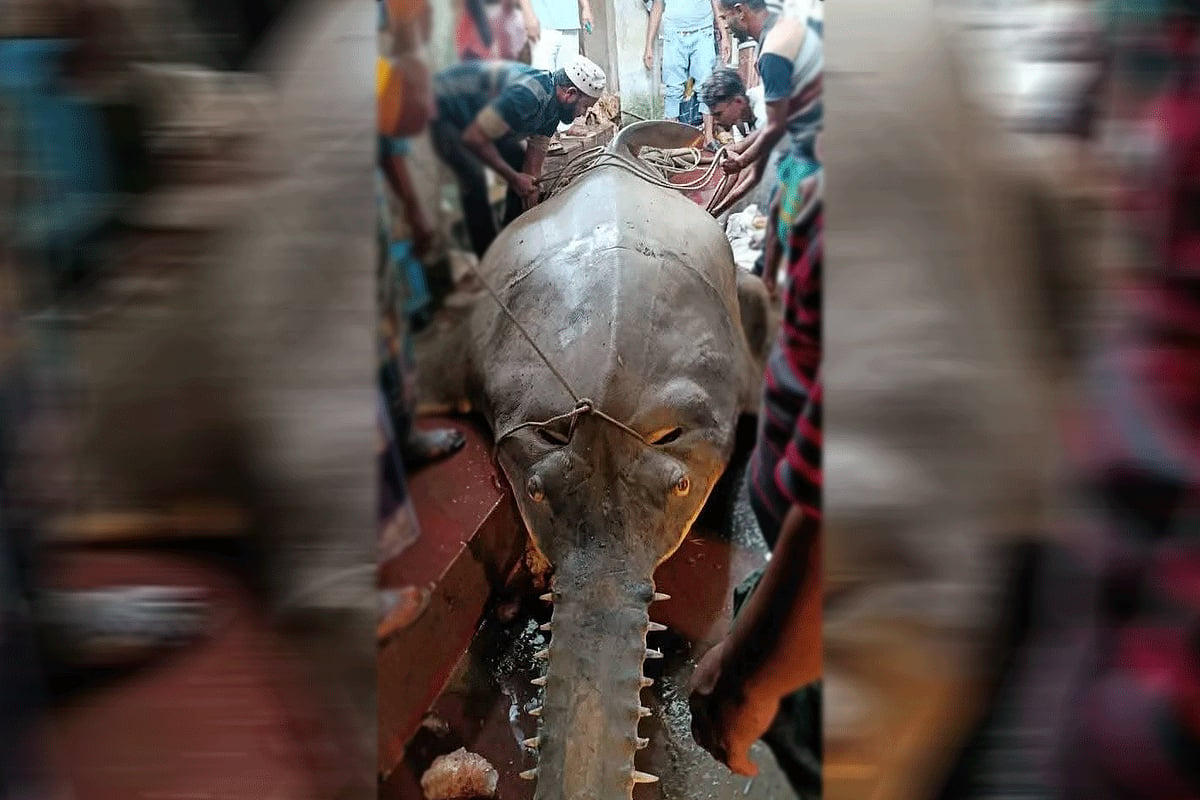
Photo Collected
Amuaghat of Kathalia upazila of Jhalkathi. On the morning of March 31, fishermen appeared at this ghat with a fish weighing about 25 maunds. The fish is caught from the Bay of Bengal.
The fish was taken to Mathbaria upazila of Pirojpur in the hope of selling it at a higher price. The fish started selling at 3000 taka per kg by miking in the market there.
The fish is called Karat. Also called Khatak fish locally. This ‘endangered’ fishing is prohibited by law. Yet it is being caught, sold and eaten.
Robiul Kausar, senior official of the WorldLife Conservation Society (WCS) Bangladesh, which works on animal conservation, has been working with sawfish for a long time. He said, there is a kind of myth, misconception among some people of the country about this fish. And that is, eating this fish cures cancer. This fish is in demand for other reasons. As a result, this fish is dying. This has created a risk of complete disappearance of this fish from the Sundarbans estuary including the Bay of Bengal.
According to WCS data, sawfish are a type of fish. It has fins spread on both sides of its body. There is a long lip in front. Saw-sharp teeth on either side of the lips. With these teeth they hunt food. Also used in self defense.
According to the WCS, five species of this fish survive in the world. Among them, three species are found in Bangladesh. All three species are threatened.
Researchers say, this fish survives in Florida, Australia coast and Bangladesh now.
The International Union for Conservation of Nature (IUCN) listed the sawfish (Pristis pristis) as critically endangered globally in 2013.
On the other hand, according to Bangladesh Wildlife Conservation and Safety Act 2026, this fish is included in Schedule-I (b). Catching, selling, consuming this fish is a cognizable and non-bailable offence. This offense is punishable by three years imprisonment.
In Mathbaria, on March 31, the law and order enforcement forces seized some parts of this fish. Shaheen Kabir, Divisional Forest Officer (Social Forest) of Bagerhat District of Forest Department accompanied the law enforcement forces in this operation. He told Prothom Alo, “We went and recovered about 150 kg of fish. I learned from people that the fish was being sold at 3 thousand taka per kg. People buy this fish from the idea that it cures cancer.
Shaheen Kabir also said that this dangerous fishing is prohibited according to the law. Legal action is being taken after identifying those who caught the fish.
“Caught giving birth”
Rabiul Kausar, senior official of WorldLife Conservation Society Bangladesh, told Prothom Alo that during this time sawfish come from the sea to the Sundarbans estuary and the surrounding rivers to give birth. In these areas they are comfortable to give birth under 5 to 6 meters of water. Unfortunately, the Sundarbans area has the most floating net leaves. They go down to the bottom of the river. The sawfish prefers to feed on the bottom of the river with its long beak. This is exactly why they get caught in floating nets.
Rabiul Kausar gives some explanation as to why fishermen catch and sell this fish despite the ban. He said that there is a local misconception that this fish cures cancer. As a result, there is a demand for this fish in the local market. Due to this demand, fishermen can sell this fish at a higher price. On the other hand, there is a demand for long beaks of this fish outside the country. Many people hang these lips on the wall of the house as a sign of nobility.
An official of Cox’s Bazar District Fish Landing Center told Prothom Alo on condition of anonymity that the beaks of this fish are sold illegally in the country for Tk 20,000 to Tk 30,000. Later it was smuggled to foreign countries.
The CITES Convention came into force in 1975 to regulate international trade in globally endangered wild animals and plants. Bangladesh joined the treaty in 1981, and it entered into force in 1982. Sawfish is listed in Sites-I. This means, the trade of this fish from Bangladesh is prohibited.
A study done jointly by Dhaka University, Shahjalal University of Science and Technology and Cosmos Foundation Bangladesh shows that this fish is caught in the nets of fishermen in the south-western part of the country, especially in Barisal, Jhalkathi, Patuakhali, Pirojpur, Khulna, Satkhira districts.
The study was published in the Journal for Nature Conservation in January 2026. Of the 318 fishermen interviewed in the study, 285 admitted to catching sawfish. They were asked to know, how much saw fish is caught? In reply, the fishermen said that from 2016 to 2020, they have caught 85 saw fish. In 2021, this number is 20.
Research has revealed that this fish is caught in shallow waters along the coast besides Baleshwar, Pasur and Shivsa rivers. Apart from this, a few sawfish have been caught in the deep sea as well.
Alifa Binte Haque, Associate Professor of Zoology Department of Dhaka University, was in the research team. He told Prothom Alo that fishermen do not have a specific target for sawfishing. It gets caught in fishermen’s nets while fishing.
Alifa bint Haque said, the physical structure of this fish is such that it gets stuck in any net. It is difficult to save if it is stuck in the net for a long time. Again, since the fish is strong, even if you want to release it, there is a risk. If it has to leave, there is the matter of training.
Researcher Alifa Binte Haque said, sawfish has a market value. Once it is caught, it becomes difficult for fishermen to make the decision to release. Because fishermen are marginalized. They don’t have much money. On the other hand, they are not given any training on how to release such a large fish. As a result, the mentality and practice of releasing these fish has not yet been developed.
Researcher Alifa Binte Haque suggested that areas where sawfish come to spawn should be brought under conservation. Besides, he stressed on training and making fishermen aware.
“This fish does not cure cancer”
Syed Akram Hossain, chairman of clinical oncology department of Bangladesh Medical University, asked whether eating sawfish cures cancer or not. He told Prothom Alo that there is a specific protocol in the treatment of all types of cancer. There is no mention of sawfish in this protocol. This fish cures cancer – one of the purposes of this campaign is to sell it at a higher price. This fish does not cure cancer.
Source: Prothom Alo Bangla
0%
0%
0%
0%