



Rare venomous lionfish caught by fishermen in Bay of Bengal near Kuakata
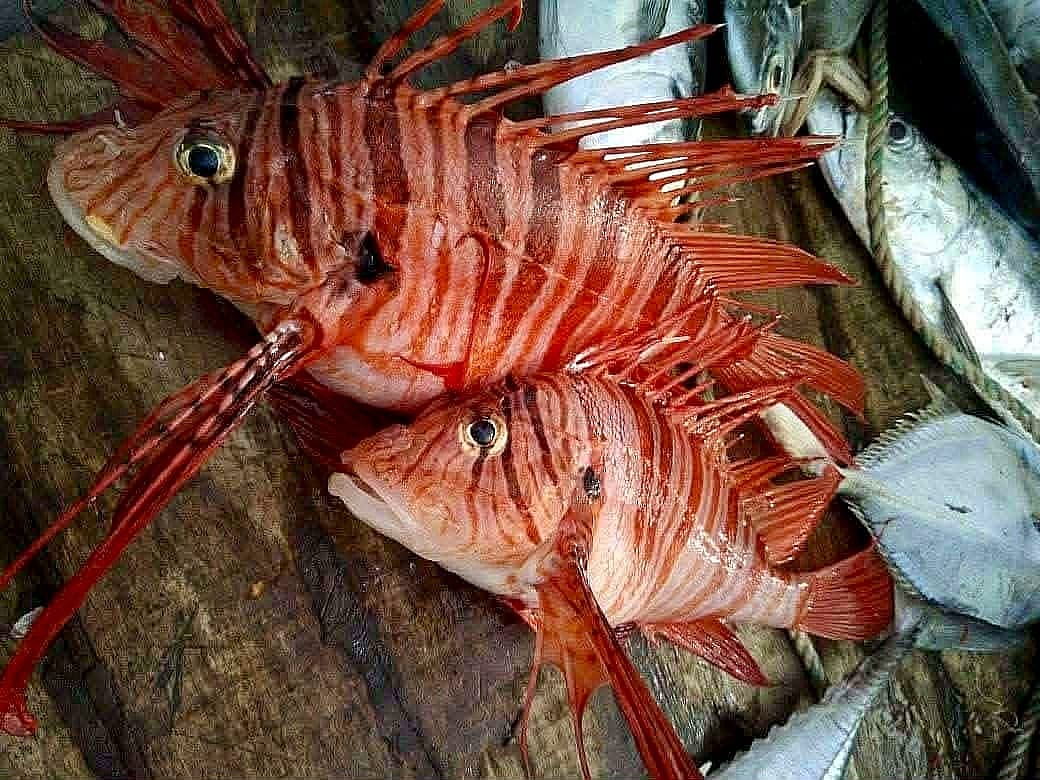
Photo Collected
Fishermen in the Bay of Bengal near Kuakata recently netted two rare lionfish, a discovery that drew significant local attention to the colorful, distinctively patterned marine species. The specimens, weighing approximately 750 grams combined, were caught late Saturday night by the crew of the fishing trawler FB Jaber.
By Sunday evening, the fish had been transported to a wholesale market at the Alipur landing center in Kalapara. The unique appearance of the lionfish—characterized by their reddish-brown and white stripes—attracted large crowds of curious onlookers. A local buyer, Sagir Akon, purchased the pair for 3,750 taka, noting that he intends to preserve them as ornamental specimens.
বিজ্ঞাপন
Experts have identified the catch as members of the *Scorpaenidae* family, known locally as “Rangila” or “Bagha” fish. Mir Mohammad Ali, a researcher and assistant professor at the Faculty of Fisheries and Marine Science at Sher-e-Bangla Agricultural University, cautioned that while the fish are visually striking, they are inherently dangerous. He noted that the lionfish possesses sharp, needle-like spines along its dorsal, anal, and pelvic fins, which are connected to venom glands. These spines can cause severe pain, swelling, and inflammation, and remain hazardous even after the fish has died.
Despite the intimidating appearance and the potential for injury, researchers clarify that the species is native to the Indo-Pacific region and is a natural inhabitant of the Bay of Bengal. While the fish are considered an invasive and aggressive species in some parts of the world, their presence in Bangladeshi waters is not an ecological anomaly, and their capture does not represent a new threat to the local marine environment.
বিজ্ঞাপন
Local fisheries officials suggest that the lionfish is not inherently inedible. According to Kalapara Senior Fisheries Officer Apu Saha, the fish is consumed in parts of the United States and the Caribbean. He explained that if the venomous spines are carefully removed, the meat is considered white, firm, and flavorful. However, officials continue to urge local fishermen and wholesalers to handle the species with extreme caution to avoid accidental envenomation.
0%
0%
0%
0%