



Resurgent Neo-JMB Militants Linked to String of Explosions Amid Declining Counter-Terrorism Oversight
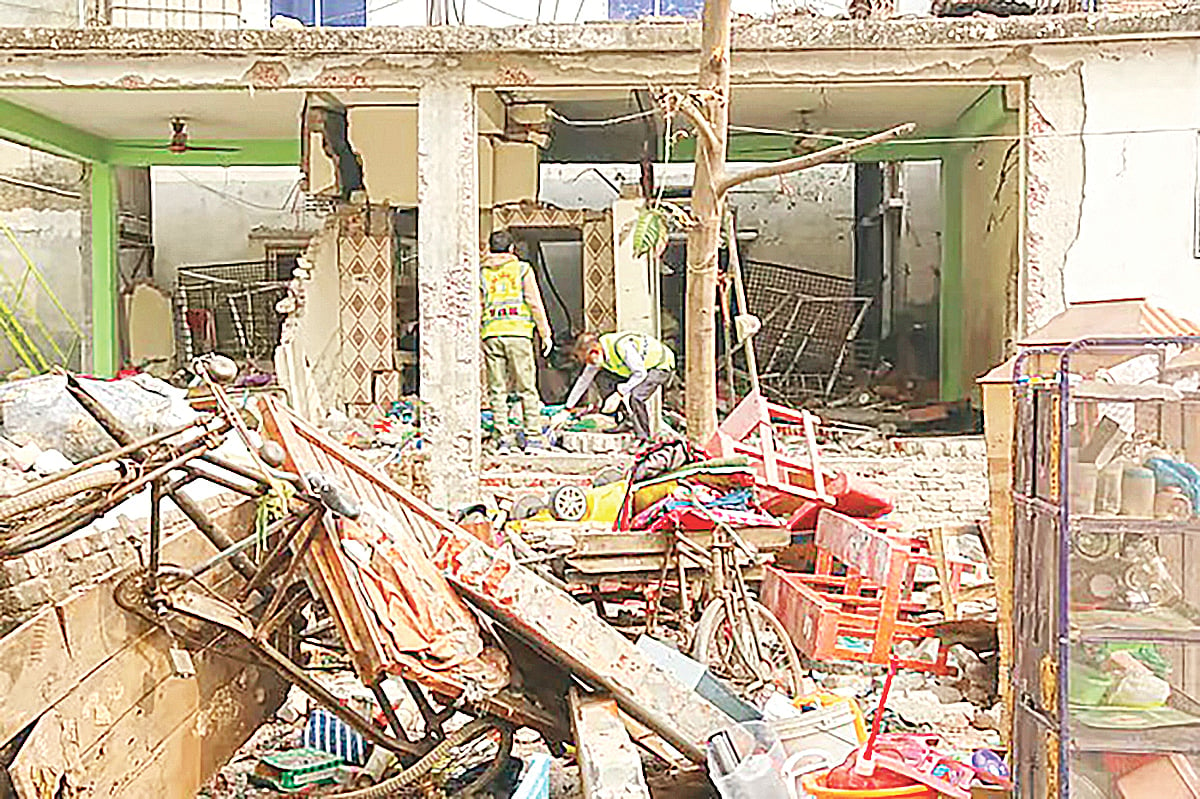
Photo Collected
A massive explosion at a residence in Keraniganj’s Hasanabad housing area on December 26 has unveiled a troubling resurgence of Islamic State-inspired extremist activities within Bangladesh. The house, which had been rented under the guise of the Ummul Qura International Madrasa, was found to be a clandestine laboratory for high-grade explosives. Upon inspection, law enforcement recovered significant quantities of hydrogen peroxide, acetone, nitric acid, and approximately 400 liters of liquid chemicals, alongside nine ready-to-use bombs wrapped in black plastic.
Seventeen individuals, including the madrasa director Sheikh Al Amin, were arrested in connection with the blast. Investigative sources identify the group as members of Neo-JMB, an extremist faction. Al Amin and two other key associates, Oli Ullah Joni and Shahin—also known as Abu Bakar—had prior records of involvement in extremist activities. Investigators believe the explosion occurred due to mishandling during the assembly of these devices, prompting Al Amin to flee to hideouts in Savar and Dolaipar before his eventual capture in February.
বিজ্ঞাপন
The Keraniganj incident serves as a nodal point connecting a series of subsequent security breaches across the country. Forensic analysis linked the bombs recovered at the madrasa to devices discarded by suspects during a February police confrontation in Dhaka’s Jatrabari area. Further investigations identified two fugitives, Nazmul Hasan Mamun and Mohammad Arif, as central figures in the Jatrabari clash, a follow-up explosion at a Sayedabad police checkpoint, and a bombing at a Hindu temple in Comilla, all occurring in March.
Security officials suggest that the reorganization of these militant factions gained momentum following the political transition on August 5, when many incarcerated extremists were either released on bail or escaped. Despite the clear pattern of violence, current counter-terrorism operations face significant stagnation. Officers from the Anti-Terrorism Unit (ATU) and the Counter Terrorism and Transnational Crime (CTTC) unit report a lack of clear strategic direction from the government regarding the prioritization of anti-extremism efforts.
বিজ্ঞাপন
Internal morale within these units has been dampened by fears of administrative repercussions. Officials disclosed that previous operations against entities linked to international groups, such as Tehreek-e-Taliban Pakistan (TTP), resulted in professional embarrassment and investigations against the acting officers. Consequently, many personnel are now adopting a cautious stance, avoiding proactive measures to prevent potential political or institutional fallout.
Although the ATU maintains that investigations into the string of bombings are ongoing, critics warn that the current lack of monitoring is dangerous. Shafqat Munir, a senior fellow at the Bangladesh Institute of Peace and Security Studies, cautioned that violent extremism remains a severe global security threat. While the domestic situation may appear manageable, he emphasized that authorities must urgently bolster the capacity of specialized agencies and institutionalize a robust, non-partisan approach to dismantling extremist networks before they can further consolidate.
0%
0%
0%
0%


