Unchecked hill-cutting and the relentless encroachment upon natural water bodies over the past four decades have dramatically transformed the ecological landscape of Chattogram, resulting in the disappearance of some 3,000 reservoirs from the port city. This rampant environmental degradation, compounded by the filling of low-lying areas and wetlands for urban development, has triggered a severe climatic shift in the region. Recent findings reveal that the average land surface temperature in Chattogram district surged by approximately 1.8 degrees Celsius over a 13-year span, rising from 32.48 degrees Celsius in 2011 to 34.27 degrees Celsius in 2024.
The steady escalation of surface temperatures—distinct from the ambient air temperatures recorded by the Department of Meteorology—is intrinsically linked to radical alterations in land use. Researchers underscore that while natural surfaces such as hills, vegetation, and water bodies possess a cooling effect, the exponential expansion of heat-absorbing concrete structures, asphalt roads, and paved infrastructure has dramatically amplified surface warmth. Over the last 23 years, the unabated destruction of hill topography has prompted authorities to file 130 legal cases, yet illicit cutting continues unabated across multiple urban and suburban zones.
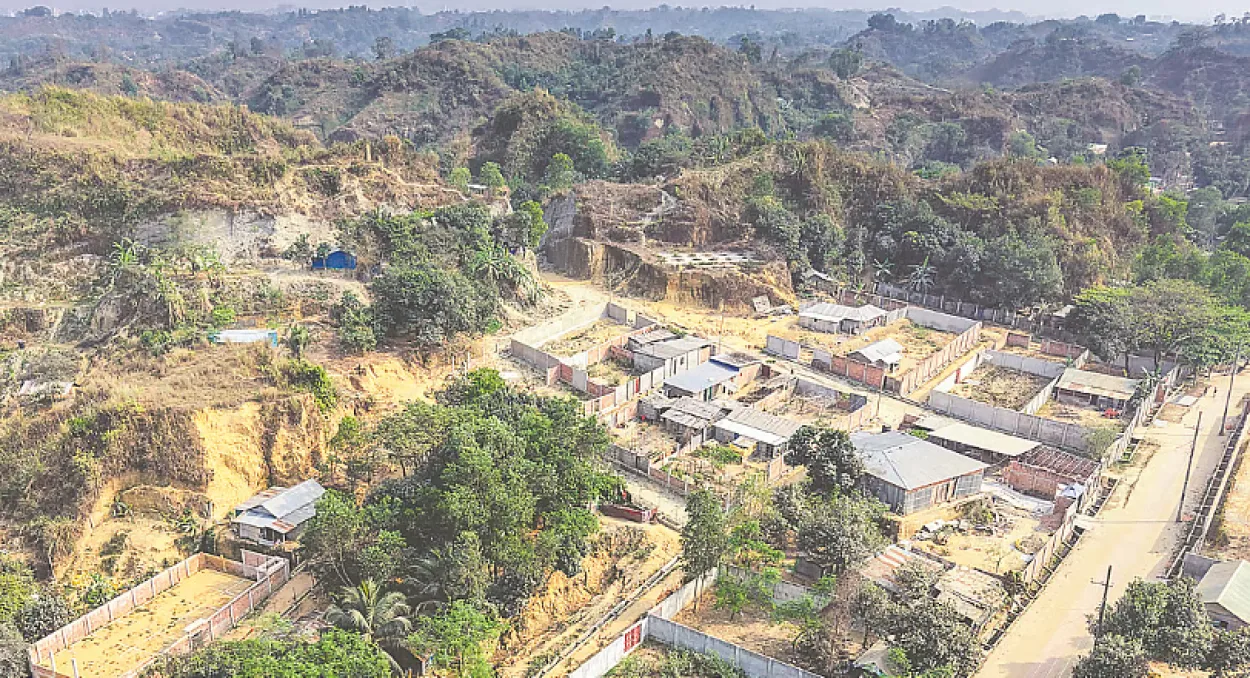
A recent field inspection of the Arefin Nagar area revealed extensive human settlement carved directly into the hillsides, where steep slopes have been terraced to erect tin-shed houses and makeshift access roads. Satellite imagery corroborates this creeping urbanization, capturing how natural vegetation, shrubbery, and protective soil covers are systematically stripped away to establish residential plots. Local residents report that hill excavation persists unabated day and night, shifting locations whenever scrutiny intensifies. However, inhabitants frequently express reluctance to publicly identify the perpetrators or pinpoint who authorizes these covert operations due to fear of reprisal.

This destructive trend extends well beyond Arefin Nagar into upscale and peripheral neighborhoods alike. In West Khulshi's Ruposhi Hill, an approximately 40-foot-high incline was mutilated following August 5, 2024, to carve out at least eight distinct residential plots demarcated by reinforced concrete pillars and perimeter walls. Plots in this vicinity reportedly command market prices ranging between Tk 2 million and Tk 3 million per katha. Similar land-grabbing and hill-levelling operations were documented in West Khulshi's Kathalbagan, Boraibagan, and Mazar Road areas, as well as the Boraitali locality under South Pahartali Ward No. 1, where subdivided plots change hands for prices between Tk 70,000 and Tk 300,000.
The crisis is not confined to the metropolitan boundaries. On September 16, inspections in the South Nishchintapur area of Rangunia Upazila—situated roughly 35 kilometers from Chattogram city near the Rangunia Aviary and Eco-Park—unveiled hundreds of houses constructed within the folds of excavated hills. Portions of these vulnerable slopes remain concealed behind corrugated tin fences while heavy machinery levels the earth within, stripping away native flora and destroying critical wildlife habitats. While local communities frequently implicate influential local syndicates in orchestrating these illegal land conversions under political patronage, profound fear of intimidation continues to silence public disclosures.