


Academic criticizes political party manifestos as deceptive regarding state-owned industry policy

Photo Collected
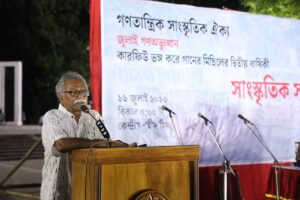
Jahangirnagar University professor emeritus Anu Muhammad has dismissed political party manifestos as a form of “political deception,” arguing that promises to revitalize state-owned industries are routinely abandoned once parties take power. Speaking at a seminar in Dhaka on Monday, titled “Specific Proposals and Actions for Reopening State-Owned Jute Mills,” the economist asserted that such pledges have become a habitual feature of the country’s political landscape.
Addressing an audience under the banner of the State-Owned Jute Mills Protection Council, Professor Muhammad noted that while political parties often appear deeply divided on ideology, they demonstrate remarkable consistency when it comes to the privatization of state enterprises. He argued that parties often include promises to reopen these mills in their manifestos despite knowing that their commitment to the existing political and economic structure makes such a goal unattainable.
বিজ্ঞাপন
The systematic transfer of state assets to private hands has persisted since the 1980s, driven by an unchanging nexus of international organizations, bureaucracy, and large corporate interests, Muhammad said. He suggested that while the figures in government change, the architects of these policies remain the same, effectively neutralizing any shift in governance. He further dismissed official justifications for privatization—such as declining demand for jute and persistent financial losses—as “fraudulent and deceptive.”
Adding to the discussion, development researcher Maha Mirza criticized the government’s approach to labor and industrial policy, asserting that successive administrations have consistently prioritized business interests over the welfare of the workforce. She argued that the government fails to view the economy through the lens of those who perform the labor, focusing instead on narrow profit metrics that ignore the reality of millions of workers.
বিজ্ঞাপন
Mirza emphasized that state policy must align with the realities of the national labor force, noting that the country cannot rely solely on high-tech sectors to absorb its vast population. She argued that the state has an obligation to build industries that provide meaningful employment for the millions of workers who form the backbone of the economy, rather than assuming that all laborers can be transitioned into technical or digital roles. The event, chaired by Bangladesh Labor and Employees Federation President Zahirul Islam, also featured contributions from Communist Party of Bangladesh General Secretary Abdullah Kafi Ratan and National Liberation Council President Faizul Hakim Lala.
0%
0%
0%
0%


