
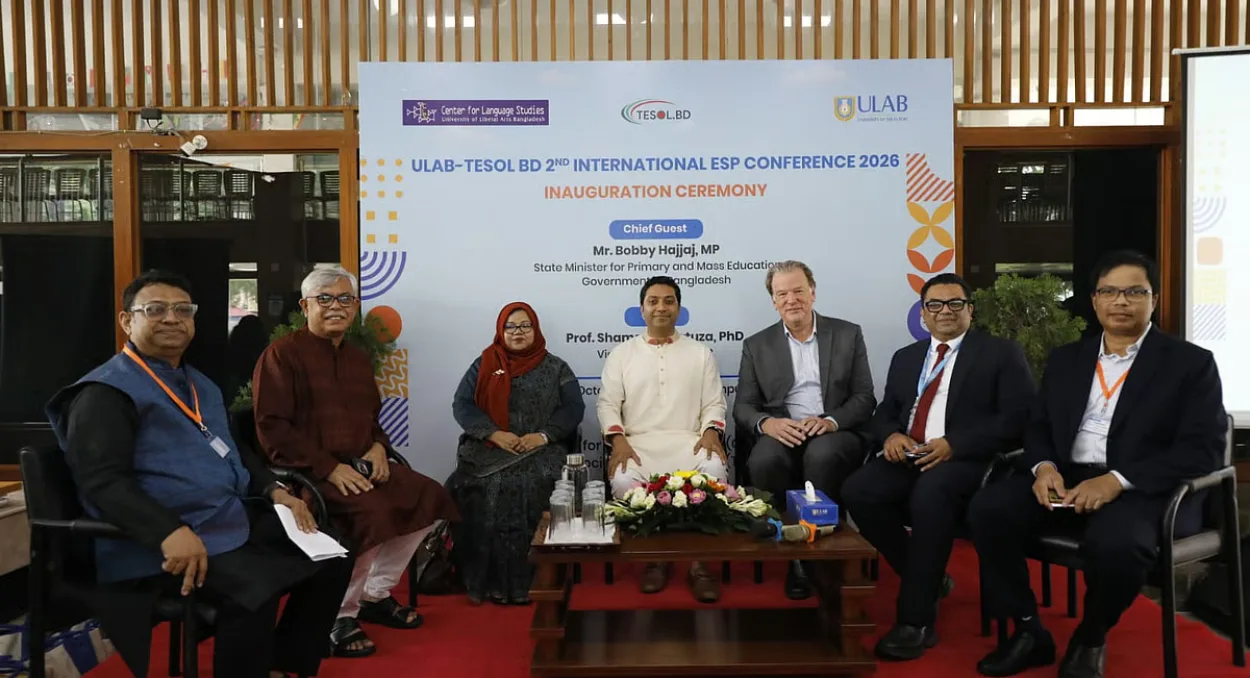
Educationists, policymakers, and academics have underscored the urgent necessity of reforming English language instruction in Bangladesh, stressing that students must be equipped with practical, occupation-specific communication skills rather than merely being taught to pass examinations. Speakers made these observations on Friday (October 17) during the day-long Second International Conference on English for Specific Purposes (ESP), which commenced at 9:00 AM at the permanent campus of the University of Liberal Arts Bangladesh (ULAB) in Mohammadpur, Dhaka. Jointly organized by ULAB and the TESOL Society of Bangladesh under the thematic banner From Margin to Mainstream: Restructuring Institutional ESP for Sustainable National Development, the academic conclave drew prominent national figures to deliberate on bridging the gap between theoretical pedagogy and the pragmatic demands of the modern workforce.
Addressing the inaugural session as the chief guest, State Minister for Primary and Mass Education Bobby Hajjaj highlighted that Bangladeshi students face significant deficits in English proficiency, which he attributed to outdated instructional methodologies rather than student shortcomings. He emphasized that mastering English is vital not only for general communication but also for acquiring technical and professional expertise across engineering, business, and management sectors. Pointing to national economic ambitions, Hajjaj noted that achieving the target of expanding Bangladesh's economy from 500 billion dollars to one trillion dollars by 2034 necessitates a highly skilled workforce, making linguistic and professional competence imperative to prevent graduates from lagging in domestic and global job markets.
Delivering the keynote address, Nigel Killick, founder and chief executive officer of digital English education enterprise ReallyEnglish, argued that traditional language education often results in wasted time and financial resources because it fails to translate into conversational capability. He advocated for integrating artificial intelligence to facilitate cost-effective speaking practice and real-time error correction, while tailoring curricula to local realities rather than relying blindly on foreign textbooks. Echoing these sentiments, University Grants Commission Member Professor Masuma Habib and Prothom Alo Managing Editor Anisul Hoque both stressed that an overemphasis on grammar and rote memorization hinders professionals, such as local engineers, from competing internationally, thereby demanding specialized, vocation-oriented language training.

ULAB Vice-Chancellor Professor Shamsad Mortuza, in her welcome address, called for the strategic incorporation of artificial intelligence and third-language acquisition alongside career-focused language training to elevate student employability. Meanwhile, Fahim Hasan Shahed, director of ULAB's Center for Language Studies, emphasized that effective language education must align directly with evolving professional demands and future career pathways. Concluding the opening segment, TESOL Society of Bangladesh Founder and Advisor Professor Sayedur Rahman highlighted that the landmark partnership between ULAB and the society will foster crucial research, professional development, and collaborative innovation to navigate the rapid shifts brought about by technology, artificial intelligence, and globalization.