
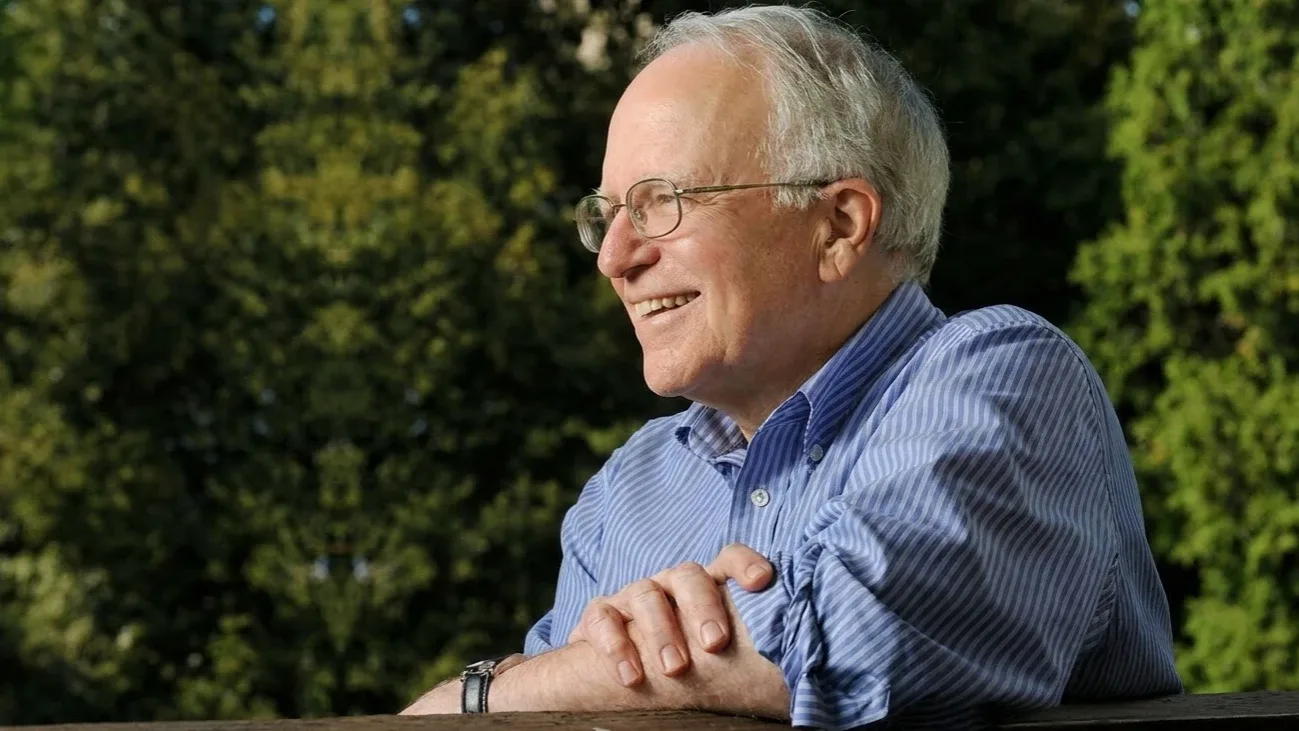
American economist Robert E. Hall has been awarded the 2026 Nobel Memorial Prize in Economic Sciences, sharing the honour with fellow economist Michael Woodford. Their research has helped reshape how governments and central banks understand economic crises, inflation, unemployment and the impact of policy decisions on everyday life.
Hall, a professor emeritus of economics at Stanford University and a senior fellow emeritus at the Hoover Institution, has spent decades studying how people, businesses and markets respond to changing economic conditions. His work has become an important part of modern economic thinking, particularly in understanding how government policies can help stabilise an economy during difficult periods.
A Career Built on Understanding the Economy
Born on August 13, 1943, in Palo Alto, California, Robert Ernest Hall developed an academic career focused on economics and public policy. He earned his bachelor's degree from the University of California, Berkeley, before completing his doctoral studies at the Massachusetts Institute of Technology.
Before joining Stanford University, Hall taught at the Massachusetts Institute of Technology and the University of California, Berkeley. Over the years, his research covered household spending, employment, economic growth, competition and the influence of technology on markets.
He also became known for examining how expectations about the future affect decisions people make today. For example, a family may reduce spending if it expects a recession, while a business may delay investment if it believes demand will fall. When millions of households and businesses make similar decisions, their combined actions can influence the entire economy.
Why Did Robert E. Hall Win the Nobel Prize?
On October 12, 2026, the Royal Swedish Academy of Sciences announced that Hall and Michael Woodford would share the Nobel Memorial Prize in Economic Sciences. They were recognised for their contributions to the microeconomic foundations of macroeconomic stabilisation.
In simple terms, their work helped economists build better models of how an entire economy behaves by examining the decisions of individual households and businesses.
Earlier economic models often relied heavily on statistical relationships between broad measures such as inflation, production and consumption. Hall and Woodford helped strengthen a different approach by showing how individual decisions, expectations and the behaviour of businesses can explain wider economic developments.
Their research has contributed to modern economic models used to assess how governments and central banks can respond to recessions, inflation and other economic shocks.
How His Research Can Affect Everyday Life
Hall's work on household consumption helped economists understand why people do not always change their spending in predictable ways when their income or economic circumstances change.
Some households can draw on savings or borrow money when their income falls. Others have limited financial resources and may need to cut spending immediately. Understanding these differences helps economists build more realistic models of consumer behaviour.

This matters during a recession. When households reduce spending, businesses may experience falling sales, cut production or reduce employment. Policymakers need to understand these connections when deciding whether measures such as interest-rate changes or government spending could help support economic activity.
Hall's research does not provide a simple solution to every economic crisis. Instead, it gives policymakers a stronger framework for understanding how people and businesses respond to economic uncertainty.
Working Alongside Michael Woodford
Hall shared the 2026 prize with Michael Woodford, a professor at Columbia University. While Hall made influential contributions to the understanding of household consumption and economic expectations, Woodford developed a broader framework explaining how monetary policy, price-setting decisions and expectations about future interest rates interact.
Their work helped lay the foundations for modern New Keynesian economic models. These models are used by economists and policymakers to study how changes in interest rates, inflation expectations and government policy affect economic activity.
The Nobel recognition highlights the importance of connecting the decisions of individuals and businesses with the wider performance of national economies.
A Lasting Contribution to Economic Research
Beyond his Nobel-winning work, Hall has contributed to debates on taxation, productivity, competition and economic policy. He has also advised government agencies and testified before congressional committees in the United States.
His career reflects a central question in economics: how can policymakers respond to economic downturns without creating new problems, such as persistent inflation or excessive financial instability?
Hall's research has helped improve the tools economists use to investigate that question. Although recessions and inflation remain difficult challenges, better models can help governments and central banks evaluate their options more carefully.
Robert E. Hall's Nobel Prize recognises decades of research into the relationship between individual decisions and the wider economy. Together with Michael Woodford, he has helped shape the modern understanding of economic stabilisation—work that continues to influence how experts study the forces affecting jobs, prices, spending and economic growth.